Hello.
I’m Kang In-jung, the chief director of The River Dermatology.
Recently, as the weather has warmed up, I’ve been receiving quite a few inquiries about peels.
If you want to try something refreshing and start looking for what kind of peel would be best, you’ll find yourself choosing among
Water-Tox Peel, Black Peel, Pumpkin Peel, Lala Peel, Aqua Peel, Oxygen Peel, Seaweed Peel... and so on.
There are really more types of peels than you might expect, so it can be hard to choose~
Today, I’d like to talk about Lala Peel, which has become one of The River Dermatology’s spring event items. Hehe.
Yeongdeungpo Dermatology: The Renewal Cycle of Our Skin
Skin has a cycle in which it periodically sheds dead cells from the surface and regenerates itself.
But when this process does not happen smoothly, old dead skin cells can build up in the pores, and dead skin that is not properly shed can make the skin texture look rough and may also lead to acne.
To remove this dead skin, many people do scrubs at home as part of their home care,
but honestly, what I always tell patients is: please do not scrub at home.
I often say that with a laughㅎㅎ
Dead skin cells are originally supposed to go through the process of production → movement → natural shedding,
but during this process, which is called the “turnover cycle,”
if you are bothered by visible dead skin and apply physical刺激 to the skin with scrub products,
it may temporarily look as if the dead skin has been removed,
but because this is not a normal shedding process and is closer to being “forced off,”
afterwards, the body quickly tries to repair the damage to the forcibly removed area and ends up overproducing dead skin in an abnormal way.
As a result,
repeated dead skin buildup
↓
weakening of the skin barrier
↓
increased skin sensitivity
can create a vicious cycle.
Of course, the most ideal thing is to wait for the natural shedding process,
but depending on the external environment or skin condition,
if dead skin is not shedding properly,
carefully removing it in an appropriate way can actually help improve the skin.
Four Types of Chemical Peels
Peeling procedures used in dermatology come under various names,
but in terms of the principle used to clear dead skin,
“chemical peels using acid ingredients” are often the basic type.
The representative ingredients used can be divided into the following four types.
AHA / BHA / PHA / LHA
These ingredients are broadly divided into water-soluble and oil-soluble types,
but to make it a little easier to understand,
it may help to think of them as differing according to the “size of the molecule” :)
When the molecule is small
→ it penetrates quickly and deeply,
so the effect is fast, but it may be irritating
When the molecule is large,
it works slowly and mainly on the surface,
so it causes less irritation and has a relatively stable effect.
So even though they are all peels,
the way they work and the skin’s response differ depending on the ingredient used.

Types and Ingredients of Chemical Peels
The most important point is one thing.
“Peel products are not the same for every skin type,
but should be selected according to the skin type!”
Yeongdeungpo Dermatology Specialist: The Effects of Lala Peel (LHA), Called a “Celebrity Peel”
Now I’ll briefly explain the four acid ingredients and then look at LHA, the key ingredient in Lala Peel. Hehe.
As mentioned earlier, absorption varies depending on the particle size of the molecule.
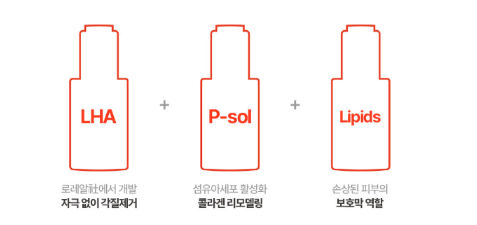
LHA is oil-soluble,
and its action speed is relatively gentle,
so it has the characteristic of evenly clearing away dead skin, mainly on the skin’s surface.
A peel based on these characteristics of LHA is exactly ‘Lala Peel.’
Lala Peel softly dissolves dead skin proteins through the penetration of LHA ingredients,
naturally clears old dead skin,
and at the same time allows active ingredients to penetrate deep into the skin,
helping improve the internal skin environment as well.
What skin types is Lala Peel good for?
Lala Peel is not a treatment that strongly removes dead skin,
but a method that helps restore the skin’s normal keratinization cycle,
so it can be applied to a relatively wide range of skin types, from sensitive skin to skin undergoing early aging, skin with fine wrinkles, and cases that need texture improvement.
Also,
for people who have experienced irritation from previous peel treatments, or
for those receiving chemical peels at a dermatology clinic for the first time,
it is a treatment that can be started relatively comfortably.
However, depending on the condition of the skin,
if inflammatory acne is severe, or
if the skin barrier has become significantly weakened,
then even a low-irritation peel may cause temporary irritation or a reaction,
so after accurately diagnosing the skin condition through consultation with a Yeongdeungpo dermatology specialist,
it is important to proceed with the treatment based on selecting the appropriate peel product for you.