Tattoo Laser Treatment
Hello, this is Jamsilon Dermatology at Jamsil Station :)
A tattoo is not simply ink on the surface of the skin; because it is made up of pigment particles deposited deep within the skin, it is difficult to remove completely with just one or two laser sessions. In particular, the response varies depending on the color, size, and location, so a steady treatment process is necessary! In the past, side effects such as scarring and blisters were common during removal, but recently, with the introduction of various techniques based on scientific principles, safety and effectiveness have improved significantly. Today, we will look at different tattoo removal methods and also explain how treatment is being carried out at Jamsilon :)

Tattoo Laser Treatment
What is TRT?
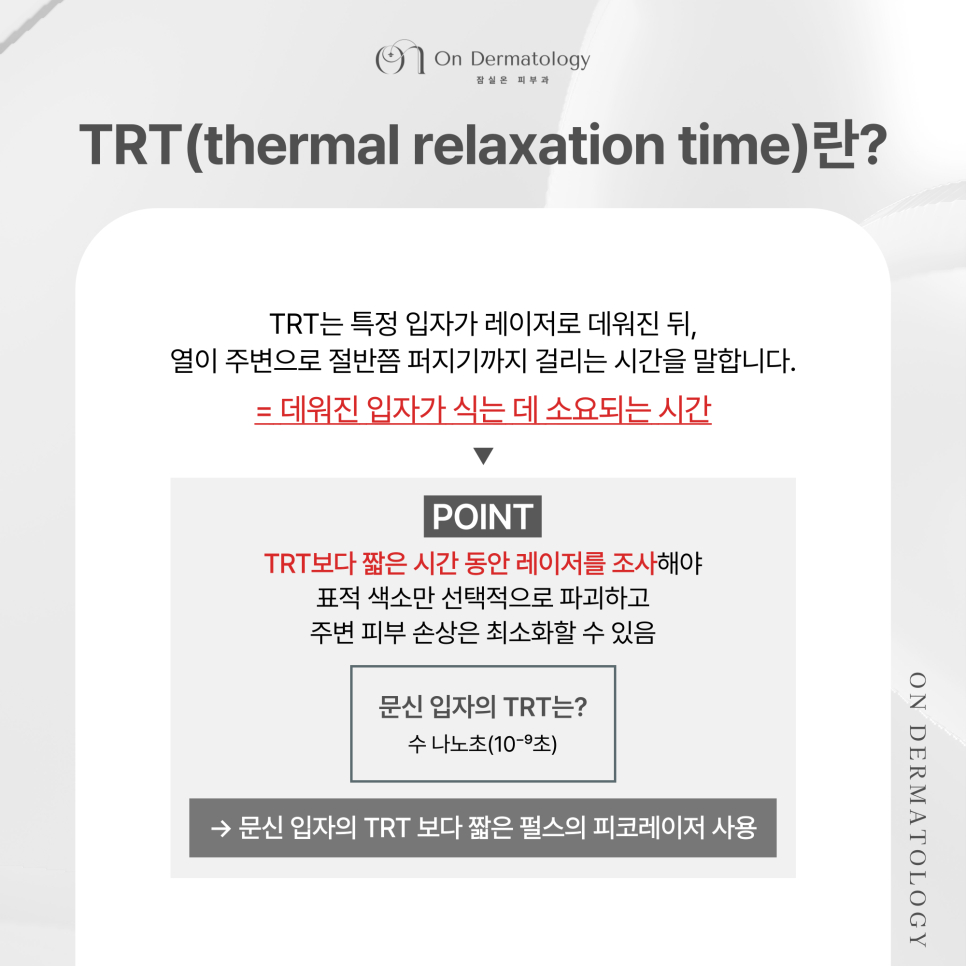
To properly understand tattoo treatment, you first need to know the concept of TRT (thermal relaxation time). It refers to the time it takes for the heat from a pigment particle heated by a laser to diffuse to the surrounding tissue by about half. Simply put, you can think of it as “the time it takes for something heated to cool down.” If the laser is delivered in a shorter time than the TRT, only the target particles can be effectively destroyed, while damage to the surrounding normal skin can be minimized!
The TRT of tattoo pigment is very short, at only a few nanoseconds. Conventional Q-switched Nd:YAG lasers emit in the nanosecond range, so they are somewhat effective, but with repeated treatments, removal became slower and the remaining pigment did not fade easily, which was a limitation. In contrast, picosecond lasers have pulse widths of only hundreds to thousands of picoseconds, which are much shorter, so they break pigment into finer particles and minimize damage to surrounding tissue, making treatment much more efficient :)
What is TRT?
Conventional Tattoo Treatment
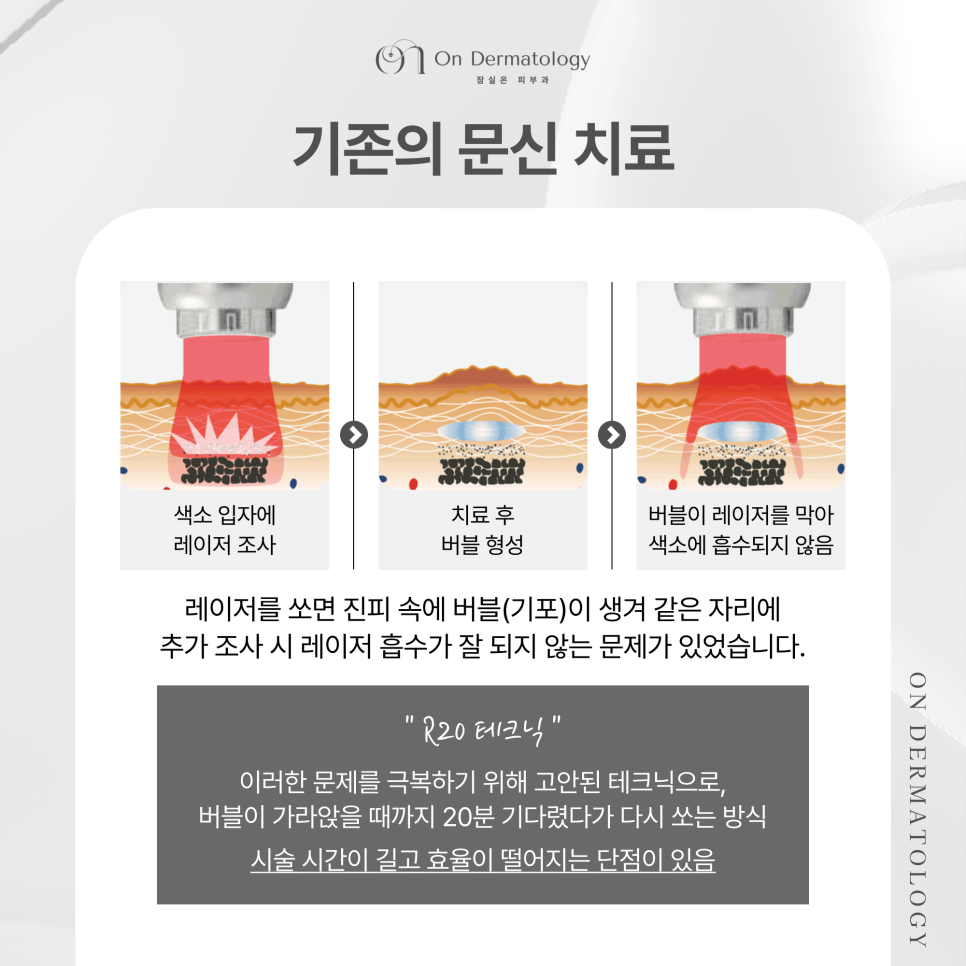
Meanwhile, during tattoo treatment, as the laser is absorbed by the pigment, the pigment expands momentarily and “bubbles” form within the dermis. The problem is that these bubbles scatter light, so even if the laser is applied to the same area afterward, the pigment cannot absorb enough energy. That is why, after one treatment, a certain amount of time had to pass before additional laser irradiation could be performed!
To address this, the R20 technique was developed. After one pass, the same area is treated again after waiting about 20 minutes for the bubbles to subside. While it has the advantage of allowing multiple laser passes, it also has clear limitations because it takes a lot of time and places a burden on the patient.
<R20 Technique>
Conventional Tattoo Treatment
R0 Technique
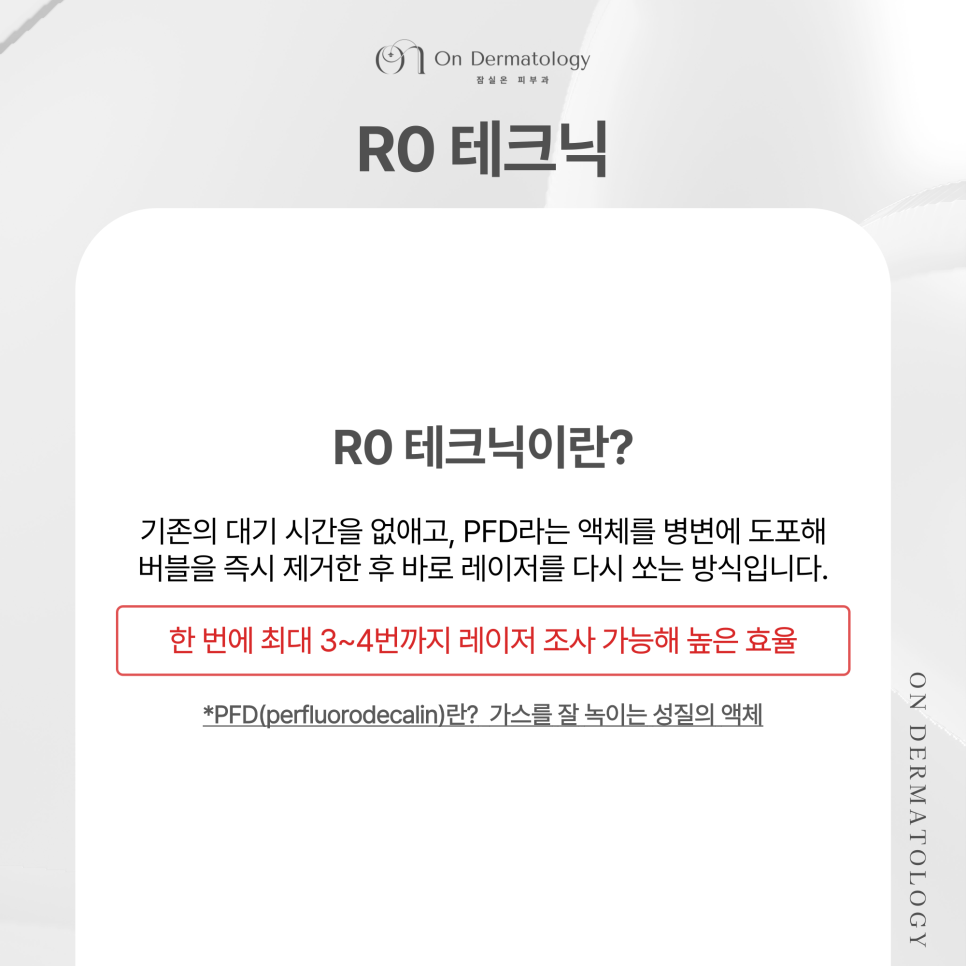
The method that improved these limitations is the R0 technique. The key is a special solution called PFD (perfluorodecalin). Because it dissolves gas well, applying it to the skin can quickly remove the bubbles created after laser irradiation.
Thanks to this, additional laser passes can be applied to the same area right away without waiting 20 minutes for the bubbles to subside, and up to 3 to 4 repetitions are possible within a single session! It has the advantage of increasing treatment efficiency and dramatically reducing the total number of treatment sessions.
<R0 Technique>
-
Bubble removal using PFD solution
-
Up to 3 to 4 laser passes in one session
-
A more efficient tattoo removal method
R0 Technique
FracTat Technique
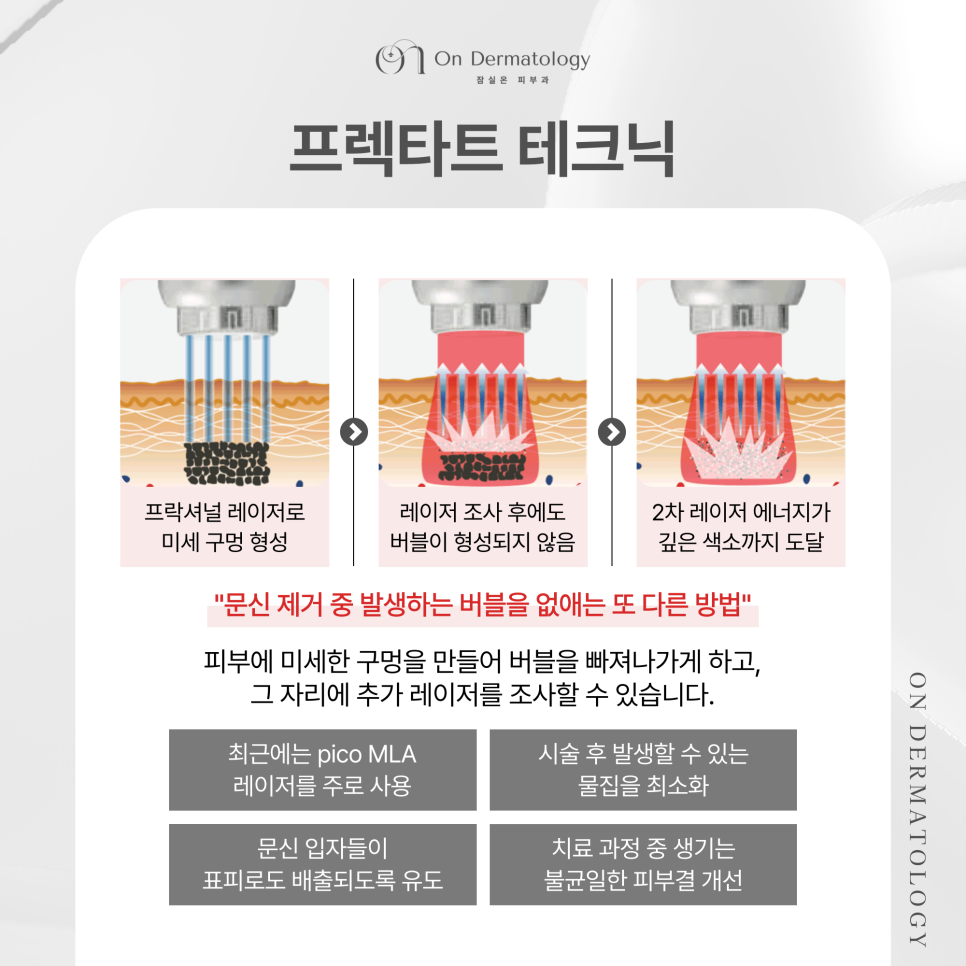
Another way to solve the bubble problem is the FracTat technique. It works by creating very tiny openings on the skin surface to let the internal bubbles escape, and then performing additional laser irradiation. Recently, pico MLA lasers have mainly been used to create these openings precisely and improve safety.
In addition to removing bubbles, the FracTat technique offers various other benefits. Through the tiny channels, tattoo pigment particles can also be expelled to the skin surface, and at the same time, it may help improve the uneven skin texture that can occur during treatment. It is also a highly stable treatment method in many ways because it can reduce blisters that may occur during treatment and ease the recovery burden!
FracTat Technique
Frac-Zero Technique
So, how does Jamsilon Dermatology treat tattoos? We perform the “Frac-Zero technique,” which combines the R0 technique and the FracTat method. It uses PFD to increase the number of laser passes in a single session while incorporating a fractional laser to reduce side effects such as blisters and scarring.
In other words, you can understand it as a treatment method that more effectively breaks down pigment while minimizing the possibility of skin damage as much as possible. In addition, from the pre-treatment consultation to the treatment plan and post-treatment care, all processes are directly managed by board-certified dermatology specialists. If you are considering tattoo removal, we hope this post helps you find the removal plan that is right for you :)
<Frac-Zero Technique>
-
R0 technique + FracTat technique
-
A treatment method that combines the two concepts
-
Effective tattoo removal while reducing side effects
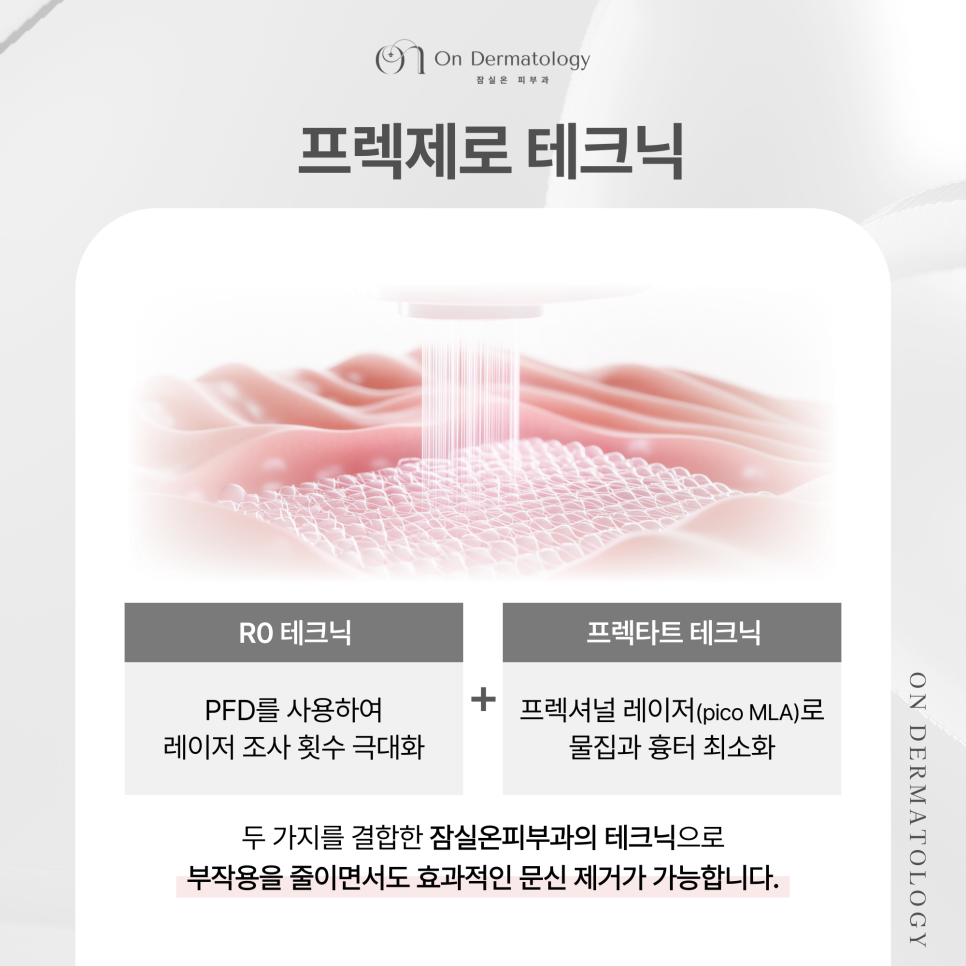
Frac-Zero Technique
Tattoo Treatment, Director Gok Won-ho
Meanwhile, tattoo treatment will mainly be handled by Director Gok Won-ho at Jamsilon. A detailed introduction to Director Gok Won-ho has been covered in a separate post, so please refer to that as well! He has extensive experience and expertise, having performed as many as 2,200 tattoo removal procedures :) Worrying only takes away your time. We hope you can share your concerns with a board-certified dermatologist!
▼Introduction to Director Gok Won-ho▼
https://blog.naver.com/gorogoro364/223963315949