Hello. This is Skin ON Air from Jamsil On Dermatology, run by a married couple of board-certified dermatologists!
Following up on our previous post, let’s talk about tattoo removal again :)
“About how many tattoo removal sessions does it take to remove a tattoo completely?”
This is one of the questions we hear most often during tattoo removal consultations at the dermatology clinic.
Unfortunately, because the number of tattoo removal sessions can vary greatly from person to person, it is difficult to give an exact answer such as, “It will be finished in exactly five sessions.”
Even tattoos of the same size can be removed at different rates depending on the amount of ink, tattoo color, treatment area, and skin tone.
For this reason, dermatology clinics may refer to an assessment system called the Kirby-Desai Scale when estimating the number of tattoo removal sessions.
In this post, we will look at the main factors used to determine the number of tattoo removal sessions, one by one!
What Is the Kirby-Desai Scale?
The Kirby-Desai Scale is an assessment method that assigns scores to tattoo characteristics to estimate the expected number of tattoo removal sessions.
The score is calculated by considering the following factors together!
-
Skin tone (Skin Type)
-
Tattoo location (Location)
-
Tattoo color (Color)
-
Amount of ink (Ink Amount)
-
Scarring or tissue changes (Scarring)
-
Tattoo layers (Layering)
Of course, it is not a formula that can accurately predict the exact number of treatments required.
However, it is widely used as an indicator that helps explain the difficulty of tattoo removal and develop a treatment plan.
1. Skin tone affects the number of tattoo removal sessions
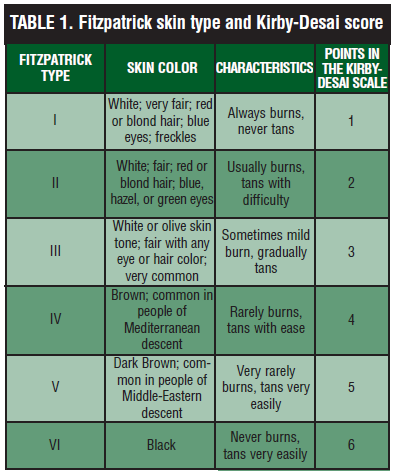
Surprisingly, skin tone is a more important factor in tattoo removal than many people realize.
The darker the skin tone, the more melanin it contains, so some of the laser energy may be absorbed not only by the tattoo but also by the melanin.
In this case, the likelihood of hypopigmentation (loss of color) may increase, so medical professionals often set the laser intensity more conservatively.
As a result, the tattoo removal process may be somewhat slower.
2. Why tattoo removal speed varies depending on location
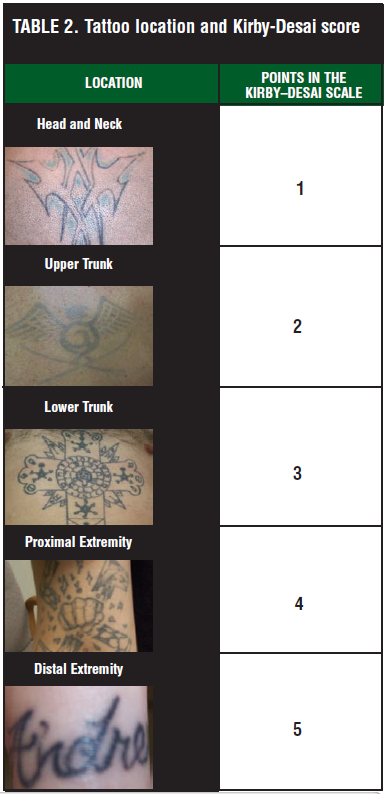
“Why do ankle tattoos take a long time to remove, while facial tattoos disappear relatively quickly?”
The reason becomes easy to understand once you understand how tattoo removal works.
The laser breaks the tattoo pigment into small particles.
Afterward, macrophages in the skin absorb the fragmented pigment and eliminate it from the body through the lymphatic vessels.
In other words, tattoo removal is not achieved through the laser alone; it is a process involving the body's immune cells and lymphatic circulation as well.
Therefore, areas with good lymphatic and blood circulation tend to show faster removal, while areas with slower circulation require more time.
In general:
-
Face and neck: Relatively fast removal
-
Torso: Moderate
-
Arms and legs: Somewhat slower
-
Wrists, tops of the feet, and ankles: The areas that take the longest
In particular, ankle tattoo removal often requires a longer treatment period than removal in other areas.
3. Colored tattoos are more difficult to remove than black tattoos
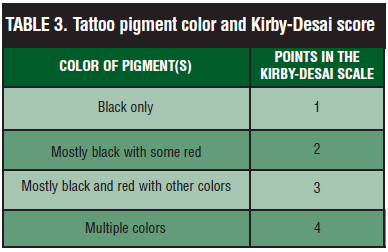
You may have often heard that colored tattoos are much more difficult to remove than black tattoos.
This is because the particles of the materials used in colored tattoos are much larger than those in black tattoos.
Therefore, more laser treatments are needed to break them into particles as small as those in black ink, right?
In addition, unlike black ink, colored tattoo pigments do not respond as well to lasers.
Their particles are already larger, and they also do not respond as well to the laser, so they are more difficult to remove, right?
Among colored pigments, red is relatively easier to remove, while white, yellow, and orange are generally more difficult to remove.
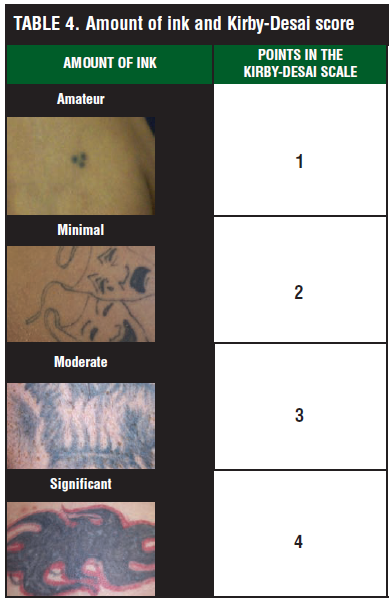
4. The greater the amount of ink, the more tattoo removal sessions are needed
One of the most important factors in tattoo removal is the amount and depth of the ink.
The more ink that has been injected into the skin, and the deeper it is, the greater the amount of pigment that must be removed. Naturally, this means that the number of tattoo removal sessions is also more likely to increase, right?
The Kirby-Desai Scale evaluates the amount of ink on a scale of 1 to 4 points.
Interestingly, amateur tattoos often contain less ink, and the depth of the ink in the skin is frequently uneven, so they may respond better to laser treatment.
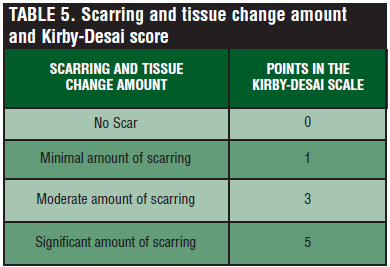
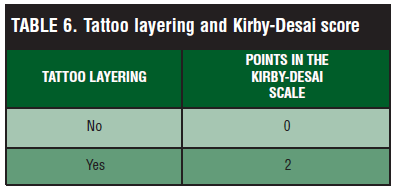
The presence or absence of scarring and the layering of the tattoo are also important.
Scar tissue is firmly fibrotic and differs from normal tissue, so the pigment can only fade more slowly, meaning that more sessions may be required.
Tattoo layering refers to covering a tattoo with multiple layers, as in a cover-up. Naturally, the tattoo ink will be darker and deeper, right?
How is the number of tattoo removal sessions determined?
Ultimately, the number of tattoo removal sessions is not determined by a single factor.
The following conditions can all have an impact:
By evaluating these factors together, it is possible to provide an estimate of the expected number of treatments to some extent.
However, the Kirby-Desai Scale is also only a reference indicator for calculating an estimate.
The actual number of tattoo removal sessions may vary depending on an individual's skin response, immune response, type of laser, interval between treatments, and other factors.
Even so, this indicator can help you estimate roughly how many sessions your tattoo may require, right?
In tattoo removal, safe treatment is more important than the number of sessions
Many people who begin tattoo removal are most curious about one thing: “How many sessions will it take to finish?”
In reality, however, it is more important to remove the tattoo safely and minimize scarring than to remove it in as few sessions as possible.
Treating with excessively high energy may increase the risk of scarring or pigment changes.
Maintaining sufficient intervals between treatments, checking the condition of the skin, and proceeding with treatment accordingly is the best way to achieve the best results.
If you are planning tattoo removal, rather than looking only at the estimated number of sessions,
we recommend having your tattoo condition accurately evaluated by a board-certified dermatologist and developing an appropriate treatment plan.