Hello! This is Skin On Air from a married couple of dermatology specialists at Jamsil On Dermatology.
Today, we’ll take a look at Thermage, one of the best-known lifting treatments alongside Ultherapy.
“I'm considering a lifting treatment. Is Ultherapy better, or is Thermage better?”
This is a question we hear very often in the consultation room.
Many people think of the two treatments as being similar, but
in fact, they work on completely different layers and have entirely different goals.
Today, we’ll explain in simple terms what Thermage is
and who is most likely to benefit from it.
⸻
How does Thermage work?
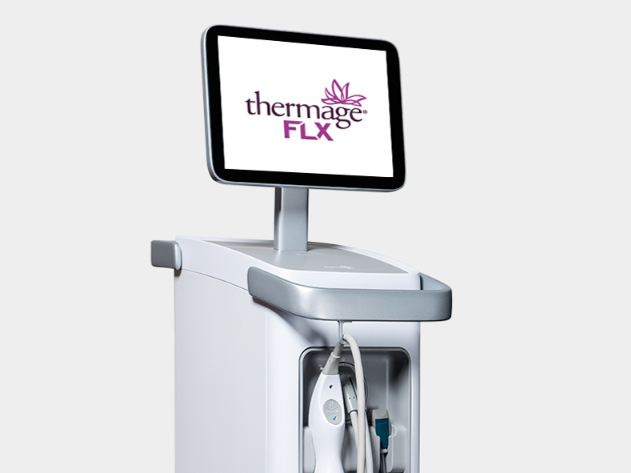
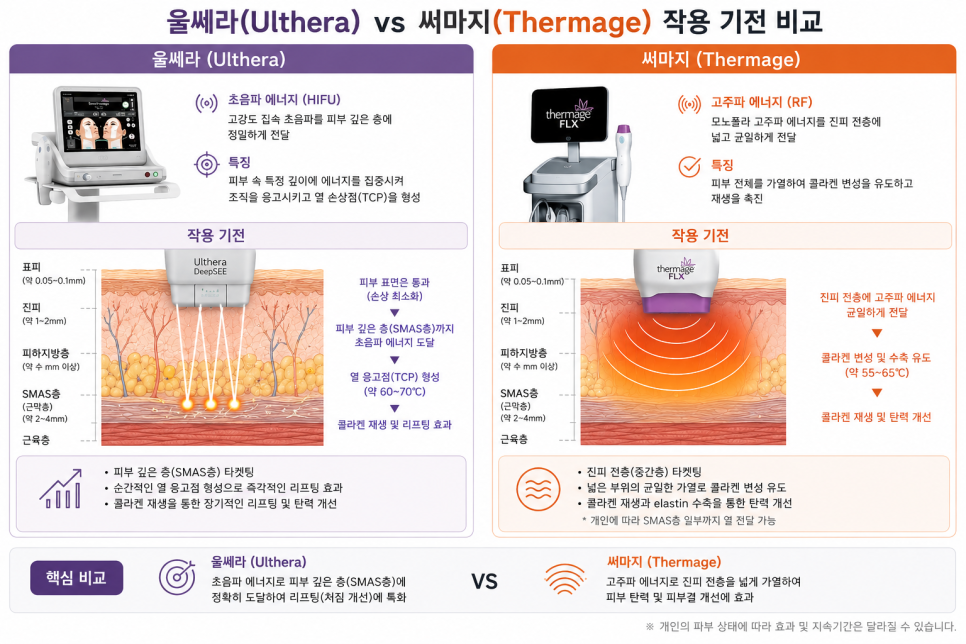
Thermage uses radiofrequency (RF) energy to deliver heat to the collagen in the dermal and subcutaneous fat layers of the skin.
When an appropriate amount of heat, approximately 55–65°C, is delivered,
-
existing collagen contracts, creating an immediate tightening effect, and
-
the production of new collagen is promoted over the following several months, gradually improving skin elasticity.
In other words,
rather than strongly pulling up sagging tissue, Thermage can be understood as a treatment that makes the skin itself firmer and more resilient.
⸻
What is the biggest difference from Ultherapy?
Many people ask, “Do I only need to choose one of the two?”
However, the two treatments are not so much competitors as complementary treatments.
| Thermage | Ultherapy |
|---|
| Radiofrequency (RF) | Ultrasound (HIFU) |
| Delivers heat mainly to the dermis | Delivers energy as deep as the SMAS layer |
| Improves skin elasticity | Lifts sagging tissue |
| Improves skin texture and fine lines | Improves the jawline, lower-cheek fullness, and sagging cheeks |
| Firms the entire face | Helps pull downward-sagging tissue upward |
Put simply,
Ultherapy is “lifting,”
while Thermage is “firmness enhancement.”
How is Titanium lifting different?
Titanium lifting, which has also become popular recently, has a somewhat different purpose from Thermage.
Titanium lifting uses lasers with multiple wavelengths to deliver heat to the deeper layers of the skin, allowing you to expect improvements in several areas at once:
In contrast, Thermage
focuses on making the collagen within the skin itself denser and more tightly organized.
In other words,
We recommend Thermage for people who
✅ Feel that their skin has become thinner and less elastic than before
✅ Feel that their pores look more enlarged when wearing makeup
✅ Have developed more fine lines
✅ Want to improve their overall skin texture
✅ Want an anti-aging treatment for preventive purposes
✅ Want to further improve skin elasticity after Ultherapy
⸻
When Ultherapy may be more suitable
On the other hand, if your main concerns are the following:
Ultherapy is often prioritized over Thermage in these cases.
In other words,
the treatment for lifting the lower cheeks is Ultherapy, not Thermage.
Many people are confused about this point.
⸻
Why receive both treatments together?
In dermatology clinics,
Ultherapy + Thermage are very often performed together.
The reason is simple.
Ultherapy lifts sagging tissue upward and refines the facial contour,
while Thermage makes the skin itself firmer, helping the lifting effect last longer.
In other words,
Because each treatment has a different role, receiving them together may provide a synergistic effect.
⸻
Conclusion
Thermage is a treatment for firming the skin rather than for creating a more defined jawline.
Therefore,
if you are saying,
“I want to lift my jawline.”
“I want to reduce my lower-cheek fullness.”
Ultherapy or Titanium is more likely to be suitable,
whereas if you are saying,
“My skin doesn’t feel the same as it used to.”
“My skin has generally lost elasticity.”
“I want to improve my pores and fine lines as well.”
Thermage may be the better choice.
The most important thing is to accurately assess your current skin condition and the cause of the sagging before choosing the treatment that is right for you.
Even though they are all called “lifting” treatments, each procedure has different goals and strengths, so we recommend making your decision after a thorough consultation.