A New Concept in Skin Boosters: Directly Replenishing the “Building Materials” of the Skin
Hello! This is Skin ON Air from a married couple of dermatologists at Jamsil On Dermatology!
Today, let’s talk about Re20, one of the hottest treatments these days.
If you have even a little interest in dermatological treatments, you may have heard of Re20.
Like existing skin boosters such as Rejuran, Juvelook, and glow injections, it aims to improve skin elasticity and texture,
but Re20 has some distinctive features in the way it approaches the skin.
While existing skin boosters focus on stimulating skin cells to produce collagen on their own,
Re20 is based on the concept of directly replenishing the extracellular matrix (ECM) that makes up the dermis.
What Is Re20 Made Of?
The key component of Re20 is human-derived acellular dermal matrix (hADM).
Simply put, it can be understood as a material in which the cellular components have been removed from skin,
leaving primarily the extracellular matrix (ECM), including collagen, elastin, and glycosaminoglycans (GAGs), which form the skin’s structure.
The dermis of our skin is not made up of cells alone.
Structures such as collagen and elastin are interconnected in a mesh-like arrangement, creating the skin’s elasticity, density, and structural support.
Therefore, Re20 can be regarded as a skin booster that injects the structural environment of the dermis in essentially the same composition as it exists naturally.
Key components of Re20 (= human-derived acellular dermal matrix, hADM)
In other words, this is a somewhat different approach from hyaluronic acid, which simply adds moisture, or PN-based products, which deliver skin-regeneration signals.
Why Re20’s Origin Is Special
This is something many people may be curious about.
Is it safe because it is derived from human tissue?
The human-derived acellular dermal matrix used in Re20 is not itself a completely new concept that has suddenly appeared recently.
In fact, acellular dermal matrix (ADM) has been used as a medical material in plastic surgery and reconstructive surgery for many years.
In particular, it has been used as a biomaterial to reinforce the skin and soft tissue and provide structural support in breast reconstruction after breast cancer surgery and in soft-tissue reconstruction.
Research on breast reconstruction using ADM began to be reported extensively in the early 2000s,
and more than 20 years of experience have since accumulated in various areas of plastic and reconstructive surgery.
Therefore, rather than viewing the material used in Re20 as a completely new biomaterial,
it is better understood as
“a human-derived dermal material that has long been used in plastic surgery and reconstructive medicine, applied in a new way as a dermatological skin booster.”
However, one distinction should be made here.
The long-term experience with ADM as a material should not be considered identical to the specific product Re20.
The clinical data and long-term safety information on Re20 itself as an injectable skin treatment must be evaluated separately from the extensive history of ADM use as a whole.
How Does Re20 Work in the Skin?
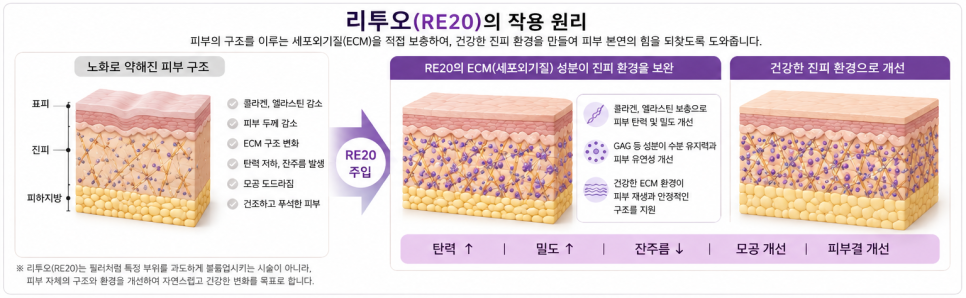
To understand Re20, it is helpful to first understand the ECM, or extracellular matrix.
The dermis contains various types of ECM, including collagen and elastin.
When this structure is maintained in a healthy condition, the skin can retain a firm and dense structure.
However, as we age,
-
Collagen decreases
-
Elastin function declines
-
Skin thickness decreases
-
The ECM structure changes
-
Moisture and moisturization capacity decline
and the skin gradually becomes thinner and less elastic.
Re20 takes the approach of directly replenishing the ECM in this skin environment.
Put simply,
if a PN-based skin booster sends a signal to skin cells to “make it again,”
Re20 can be described as an approach that replenishes the “structural materials” that make up the skin.
Expected Effects of Re20
① Improved Skin Elasticity
This is one of Re20’s most important features.
By supplementing the ECM environment, including collagen and elastin, which form the primary structure of the dermis, it may help improve skin elasticity.
Rather than simply making the skin’s surface feel moisturized, the goal is to improve the skin’s structural firmness itself.
② Improved Skin Density
As skin ages, the dermis becomes thinner, and the skin may feel generally less dense.
By supplementing the ECM of the dermis, Re20 may help improve the skin’s sense of density and firmness.
③ Improvement in Fine Lines and Skin Texture
As the dermal environment improves, improvement in fine lines and rough skin texture may also be expected.
It can be used particularly in areas such as around the eyes and mouth, where the skin is thin and fine lines develop easily.
④ Improvement in Pores
When skin elasticity and dermal density decline, pores may appear more prominent.
Therefore, as the structure and elasticity of the dermis improve, a reduction in the appearance of enlarged pores may be expected.
⑤ A Natural Sense of Volume and Improved Skin Thickness
Re20 is not a treatment intended to excessively add volume to a specific area like a filler.
Rather, because it is aimed at improving the skin’s own density and structure, it may create a change in which the skin looks somewhat firmer and healthier without significantly altering the overall impression of the face.
How Is It Different from Existing Skin Boosters?
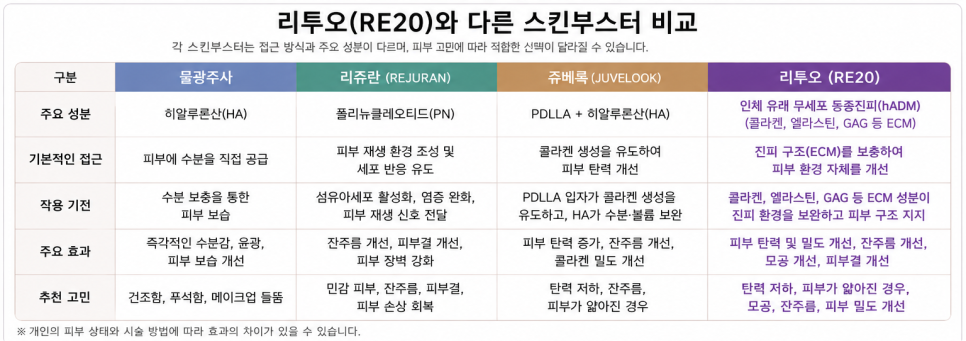
Comparing Re20 with other skin boosters makes it easier to understand.
| Category | Main Ingredient | Basic Approach |
|---|
| Glow injection | HA | Moisture supply |
| Rejuran | PN | Promoting a skin-regeneration environment and cellular responses |
| Juvelook | PDLLA + HA | Promoting collagen production |
| Re20 | Human-derived ECM | Supplementing the dermal structure and ECM environment |
Of course, the actual effects of a treatment may vary depending not only on the characteristics of the product but also on the injection depth and amount, treatment area, and skin condition.
Therefore, rather than assuming that one particular skin booster is always better, it is important to determine what your skin currently needs and choose accordingly.
“I’m concerned because it is human-derived. Is it safe?”
This is also a common question among people encountering Re20 for the first time.
The fact that it is human-derived tissue does not mean that unprocessed tissue is injected directly.
Re20 is based on acellular dermal matrix (hADM), with the cellular components removed and the ECM used as the primary material.
This hADM is a biomaterial that has been studied and used in plastic and reconstructive surgery for many years.
In fact, ADM has been used in various areas of soft-tissue reconstruction, including breast reconstruction.
Therefore, when explaining the safety of Re20,
it is more accurate to say:
“Rather than using unfamiliar human tissue that has been newly developed, it is based on a human-derived dermal material that has been used for many years in plastic surgery and reconstructive medicine.”
However, this does not mean that “there are no side effects at all because it has been used for a long time.”
As with all injectable treatments, side effects such as bruising, swelling, and temporary inflammatory reactions may occur,
and they may vary depending on the individual’s skin condition and the treatment method.
We Recommend Re20 for People Who
✔ Have skin that has generally become thinner and less elastic
✔ Are concerned about both fine lines and skin texture
✔ Have enlarged pores and decreased skin density
✔ Feel that their skin has become less firm than before
✔ Feel uncomfortable with treatments that significantly change the shape of the face, such as fillers
✔ Want to naturally improve the firmness of their own skin
In particular, it is best to approach Re20 as a “treatment for improving skin quality” rather than a “treatment that changes the face.”
If previous skin boosters have focused on supplying moisture to the skin or stimulating the regeneration of skin cells,
Re20 can be described as a treatment that takes this a step further by focusing on the structure itself known as the extracellular matrix (ECM), which makes up the skin.
Based on human-derived acellular dermis, it supplements the ECM environment, including collagen and elastin,
with the goal of improving skin elasticity, density, texture, and fine lines.
One of Re20’s features is that it is based on hADM, a biomaterial that has been used for many years in plastic surgery and reconstructive medicine.
Ultimately, the key concept of Re20 can be summarized as follows:
“Going one step beyond delivering stimulating signals to the skin, it supplements the environment that makes up the skin itself.”
For those concerned about fine lines and pores along with thinning and decreased elasticity, Re20 may be considered in comparison with existing skin boosters.