Hello.
This is Blanche Dental Clinic, where your smile becomes a work of art.
After you have a molar pulled at the dentist, you are usually advised to consult about an implant.
But if chewing is not especially inconvenient right away and the pain is gone,
it is natural to think, “Maybe I can do it later?”
Today, a Seoul National University dentist honestly explains the domino effect that happens inside the mouth when the empty space left by a molar is left untreated, as well as the treatment criteria.

Implants are a treatment that comes with both the psychological pressure of surgery and the practical burden of cost.
We often see people putting off treatment while comforting themselves by saying, “I can just chew on the other side.”
But you should remember that teeth do not simply end with one tooth being lost,
and that they can upset the balance of the entire mouth.
Some people say, “A lot of people seem to live fine even with one missing molar.”
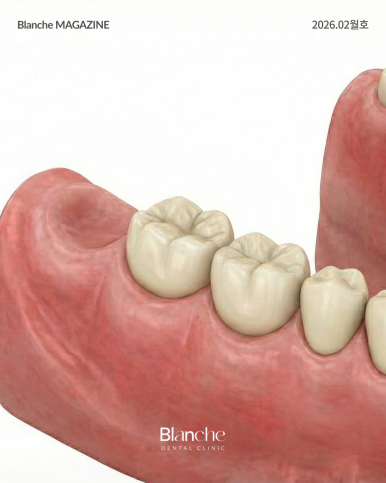
Of course, there may not seem to be a problem at first, but our teeth have an instinct to fill empty space.
The neighboring teeth tilting into the vacant space, and the upper and lower teeth over-erupting, happen slowly, but surely, without us even noticing.
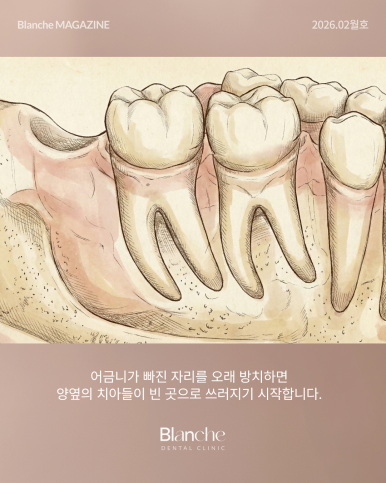
If the space left by a missing molar is left alone for a long time, the teeth on both sides begin to tilt into the empty area.
When teeth lean this way, gaps form between them,
which makes it easier for food to get trapped and creates an environment where cavities and gum disease can develop.
Even if you later try to get an implant, orthodontic treatment to upright the tilted teeth may also be needed,
which can double the cost and time.
Our teeth maintain their height by fitting together.
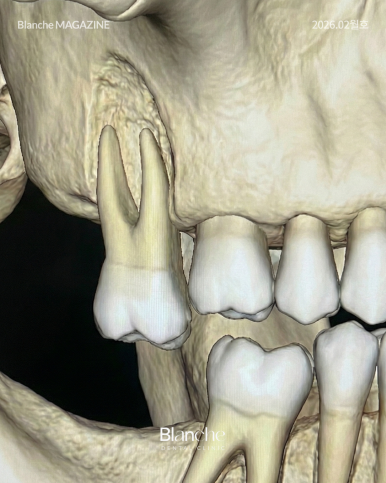
But if a lower molar is missing, the upper molar will come down, and the opposite is also true.
This is called “over-eruption,”
and a tooth that has come down too far can block the space needed for an implant later.
In the end, an unfortunate situation can arise where even the healthy opposing tooth must be shaved down or removed.
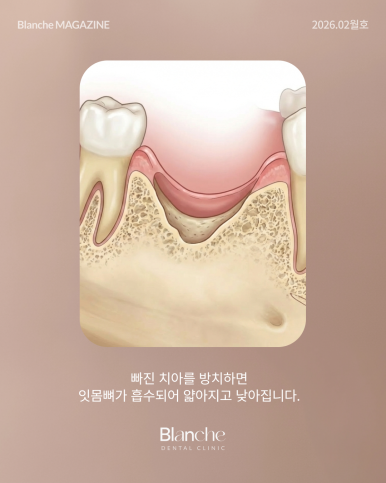
The jawbone maintains its volume when it is supporting teeth.
If a tooth is extracted and a long time passes, the bone is gradually resorbed and disappears.
If too much bone is lost,
even if you later want to place an implant, there will not be enough bone to place it, making complicated bone grafting surgery necessary.
The easiest and least expensive way to get an implant is to do it while the bone is still healthy.
If one side is missing a molar, you naturally end up chewing only on the other side.
This is like one person having to carry twice the load of another.
As the healthy teeth on the side receiving excessive force are overburdened, teeth can crack,
or temporomandibular joint problems may develop, so it is wise to take action before the chewing balance is disrupted.
Molars act like millstones, grinding food into smaller pieces and helping digestion.
When this function declines, digestive problems are more likely to occur,
and only one side’s muscles may develop abnormally, potentially disrupting facial symmetry.
Because molars affect not only a simple dental issue but also overall health and appearance,
their role is very important.
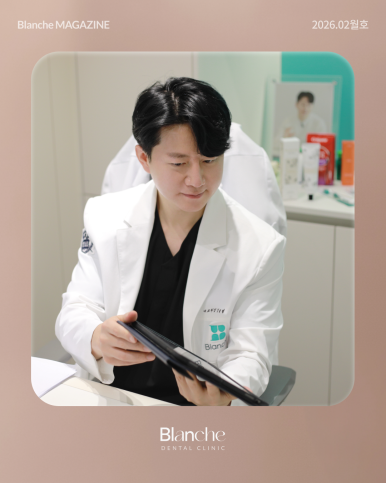
Blanche Dental Clinic does not force implant placement unconditionally.
After carefully analyzing the patient’s current bite condition and the health of the jawbone,
we honestly explain whether “treatment is needed now” or “it may be okay to wait a little longer.”
Our treatment principle is to suggest the optimal timing while preserving natural teeth as much as possible and preventing the overall oral balance from collapsing.
Leaving the space after a missing molar untreated is like placing a “time bomb” inside the mouth.
Before you go through greater trouble later, we recommend checking the changes in your mouth in advance through an accurate examination.
If you are wondering whether you should get a molar implant,
the Blanche Dental Clinic YouTube video will be very helpful in making your choice.
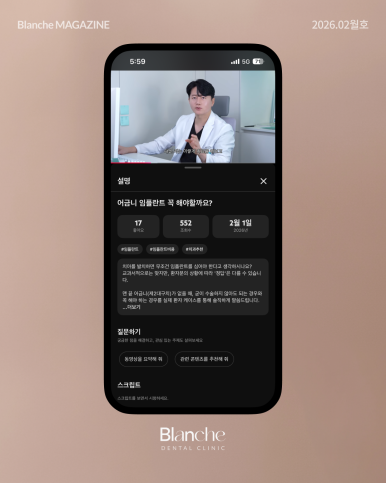
The content of this post was compiled based on a Blanche Dental Clinic YouTube video.