If you watch TV or social media, not only celebrities but also ordinary people are very interested in laminates.
There is even a saying, “The completion of plastic surgery is laminate.”
That is because just changing the shape and color of your teeth can completely change your image.
But during consultations, many people come in carrying as much worry as expectation.
“Doctor, if I get laminates, don’t you have to grind down a lot of my teeth, and won’t they become sensitive later?”
“When I get older, around 60, will I no longer be able to chew properly and have to get implants or dentures? Is that true?”
“I saw online that laminates just pop off—does that mean I can never eat taffy or gum again?”
Today, I’d like to clear up these common misconceptions and truths about laminates.
From no-prep laminates to lifespan and side effects, I’ve organized everything carefully, so please read to the end.

Do laminates mean all your teeth are ground down?
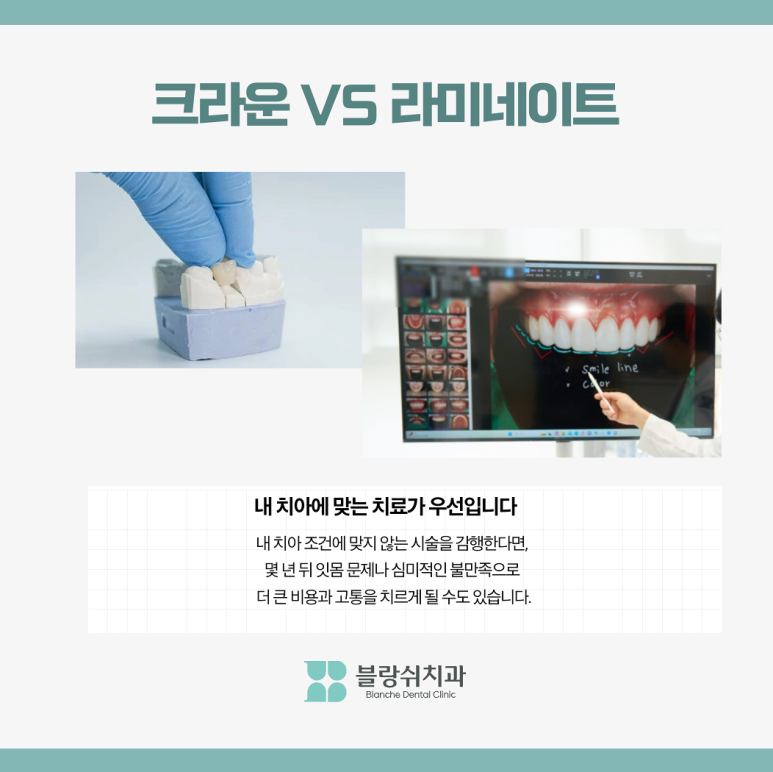
When some celebrities appeared on a past broadcast showing their laminates falling off, many people were shocked to see teeth left looking pointed and sparse.
But to give the conclusion first, that is more likely crown treatment, not laminates.
The tooth is ground down extensively all the way around 360 degrees so that the entire tooth can be covered. In many cases, root canal treatment is also involved.
This is a procedure in which only the outermost layer of the tooth, the enamel surface, is trimmed very thinly (0.1 mm to 0.5 mm), or a thin ceramic shell is added without grinding the tooth at all (no-prep). Think of it like applying an artificial nail over a natural nail in nail art.
At Blancsh Dental Clinic, we prioritize preserving natural teeth, so we aim for no-prep laminates that minimize the amount removed to as close to zero as possible.
Even when trimming is done, it is only about the thickness of a strand of hair, so you do not need to worry too much about tooth damage.
 Do laminates just pop off if you eat taffy or gum?
“After getting laminates, can I not bite into an apple with my front teeth?”
Many patients worry about durability.
But properly bonded laminates become almost “one body” with the tooth.
The key to bonding is the enamel.
The outermost layer of the tooth, enamel, contains almost no moisture, so it bonds extremely well with laminates.
However, if too much of the tooth is ground down and the inner dentin is exposed, bonding strength drops significantly because of moisture.
In other words, the less tooth you remove and the more enamel you preserve, the more securely the laminate stays in place.
(According to actual research papers, there are even cases reported to have stayed well bonded for 50 years.)

“You have to replace laminates every 10 years.”
You may have heard this.
This is often not because of the laminate itself, but because of gum aging.
As we age, the gums naturally recede little by little, and at that point the boundary between the laminate and the gum may become visible, which can look unaesthetic.
In such cases, replacement may be considered, but the laminate itself does not rot, melt, or become unusable.
In fact, because laminates cover the tooth surface with smooth ceramic, plaque and tartar may not build up as easily, making them easier to manage.
If you take care of them properly with regular scaling and correct brushing, you can still enjoy delicious food with healthy, beautiful teeth even in your 60s and 70s.
I don’t want artificial-looking teeth like xylitol!
One of the failures of laminate treatment is the unnatural look, as if xylitol gum were stuck on.
Transparency, texture, surface contour, and the gradient at the edges all need to come together for them to look like real teeth.


This depends entirely on the technician’s skill and the medical team’s aesthetic sense.
Cheap, mass-produced laminates from factory-style dental clinics are inevitably unnatural because the same shape is applied to everyone.
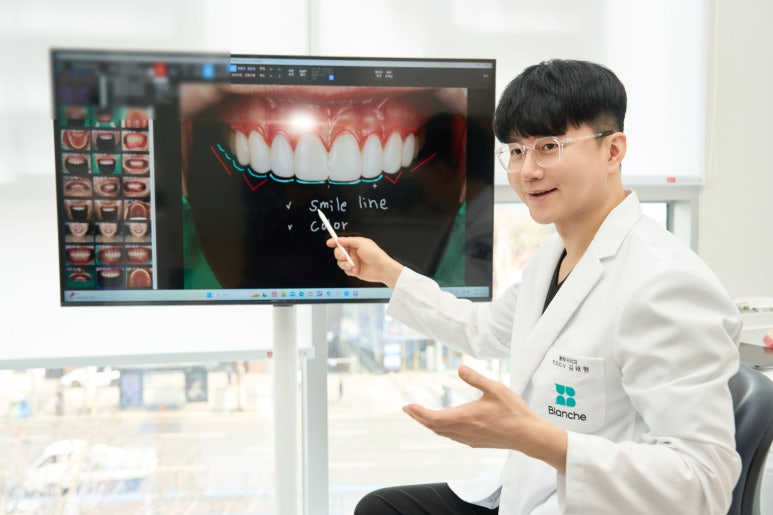
At a good clinic, an experienced dental technician and I personally consider the patient’s face shape, skin tone, and lip line to carry out a one-on-one customized design.
The result is a natural, refined appearance that makes people think, “Those look just like my original teeth.”
Cheap but poor quality? Why cost matters
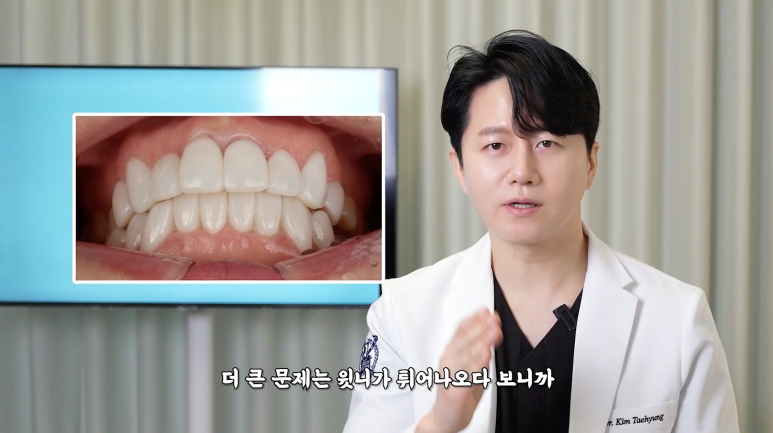



To be honest, laminates are one of the dental treatments that require the most delicate technique and expensive materials.
To match a low price, clinics have to use lower-grade materials or have inexperienced clinicians perform the procedure quickly.
In this process, the chances of side effects such as excessive tooth reduction, incomplete bonding, and gum inflammation increase.
Once a tooth has been ground down, it cannot be restored.
I hope you do not take a gamble with your precious teeth just to save a few hundred thousand won today.
If you have any questions, please leave a comment anytime, and I will answer.
This was Gangnam Blancsh Dental Clinic. Thank you.



Compliance with Medical Law and Notice This post was written directly by Blancsh Dental Clinic for the purpose of providing correct information about laminate procedures. The amount of tooth reduction for all procedures may vary depending on the individual’s oral condition (dentition, bite, etc.), and side effects such as temporary tooth sensitivity, pain, fracture, and detachment may occur after the procedure. Therefore, before treatment, please make sure to consult thoroughly with an experienced medical professional and decide carefully.