"Doctor, at some places it’s 800,000 won,
and at others it comes out to more than 2 million won.
I don’t know which place I should trust."
This is Kim Taehyung, chief director of Blanche Dental Clinic.
I see several implant consultations a day, and this question comes up almost every time.
To be honest, it’s only natural for patients to feel confused.
Even though everyone calls it the same thing—"one implant"—the estimates vary widely from one clinic to another.
But as a dentist, I can say bluntly that there is a clear reason for the price difference.
Today, I’ll organize where that cost gap comes from, in the same way I explain it in the treatment room.
Partial implant: why does the price differ so much for just one tooth?
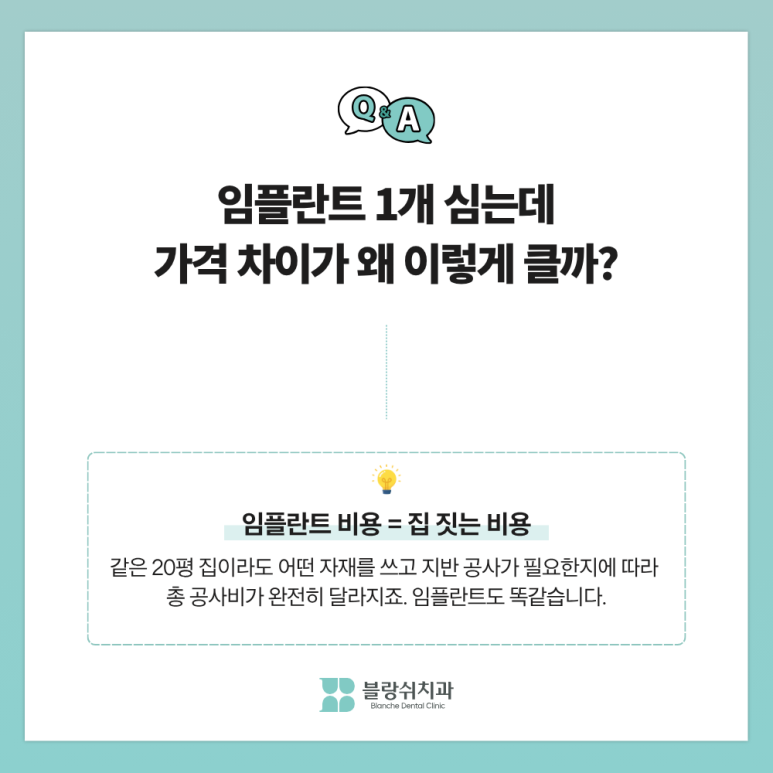
It’s easier to understand if you think of implant costs as the cost of building a house.
Even for a house of the same size, the total construction cost can change completely depending on what materials are used and whether ground reinforcement is needed.
Implants are the same.
There are three major variables that determine the cost.
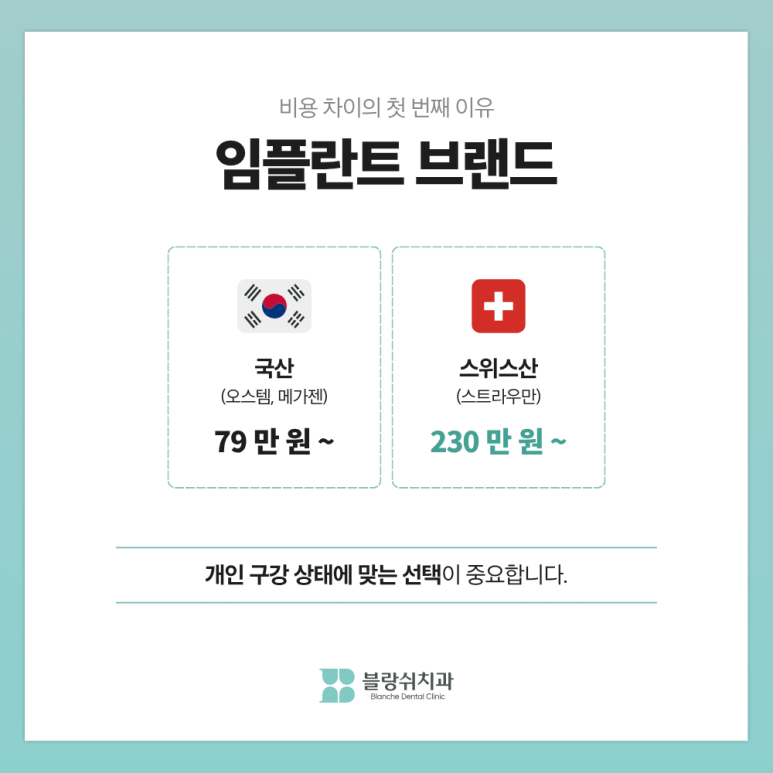
First, the implant brand.
Korean implants (Osstem, Megagen) start at around 790,000 won, while the Swiss Straumann costs 2.3 million won.
Straumann has different surface treatment technology and faster osseointegration, which is why the price differs.
Of course, Korean brands are also products with sufficiently verified clinical data,
so I would never say that the more expensive one is always better.
The right brand depends on the condition and location of the patient’s jawbone and gums.
It can vary depending on each person’s oral condition, so the most accurate approach is to decide after a detailed examination.
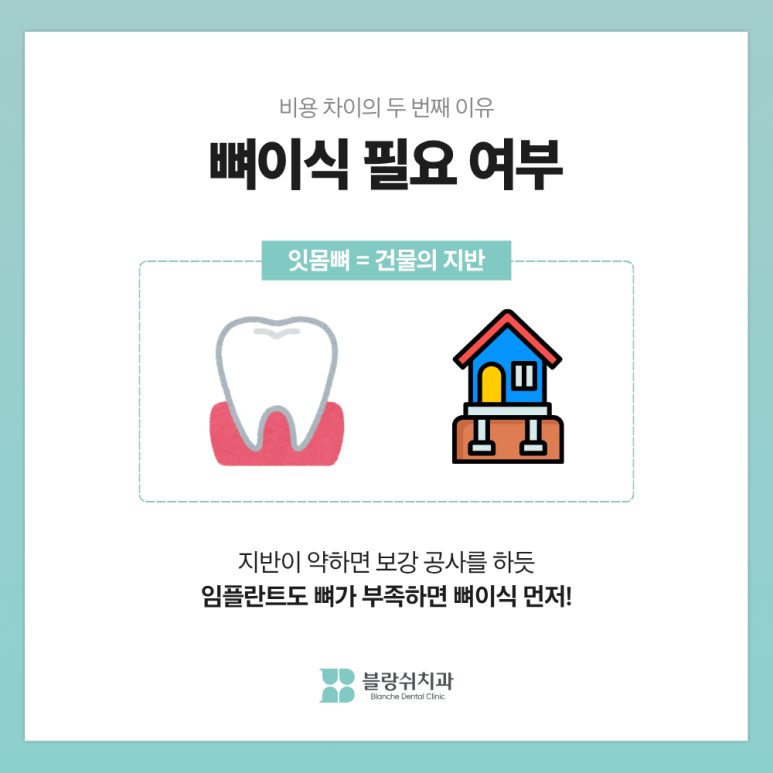
Second, whether bone grafting is needed.
You can think of the jawbone as the foundation of a building.
If the foundation is weak, you have to reinforce it before you can set up the pillars.
The same goes for implants: if there isn’t enough bone, a bone graft must be done first,
and in simple cases this can cost 300,000 won, in complex cases 500,000 won, and if a sinus lift procedure is also needed in the upper molar area
(a procedure that fills the empty space above the jawbone), an additional 500,000 to 2 million won can be added.
When I take a CT scan, some people have sufficient bone, while others have bone that has become as thin as paper.
That one difference alone can nearly double the total cost.
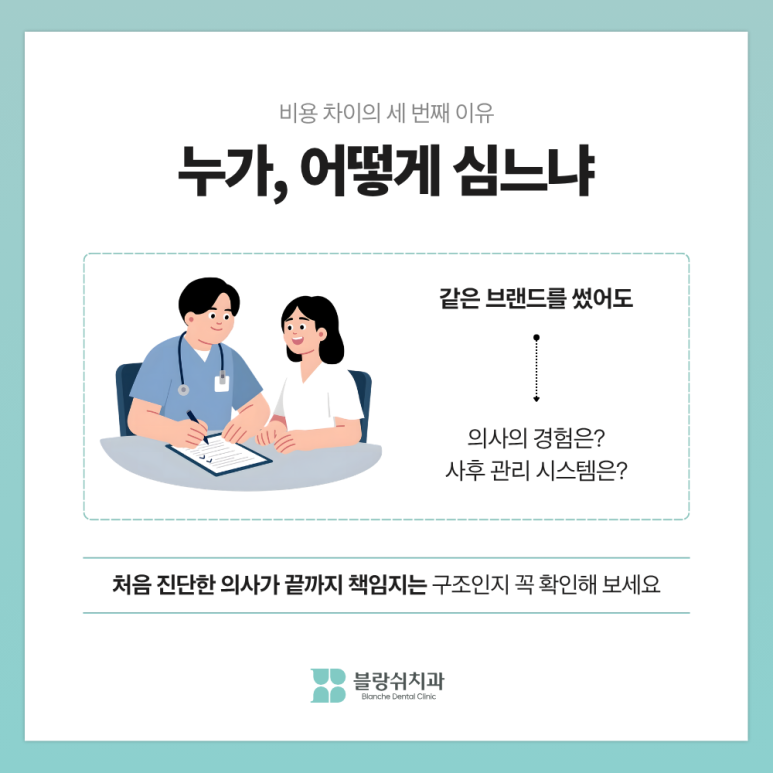
Third, who places it and how it is placed.
Even with the same brand, the outcome can differ completely depending on the surgeon’s experience and the follow-up care system.
To be honest, in a structure where a different doctor sees you each time, it is difficult to continuously understand the condition of your jawbone and gums.
You should definitely check whether the doctor who made the initial diagnosis is the one responsible all the way through.
Then does that mean you should avoid the cheaper places?

I get this question very often too.
To answer first: something being cheap does not mean it is bad, and something being expensive does not mean it is good.
The key is to check what is included in that price.
The lowest price shown in advertisements often does not include bone grafting costs.
In the treatment room, there are quite a few people who say, "I clearly went because it said 800,000 won... but once all the extras were added, it ended up being over 2 million won."

That is why, during consultations, I first explain the total cost including bone grafting.
In fact, with just one 3D CT scan, we can immediately check whether bone grafting is needed and which brand would be suitable.
Partial implant: if you miss the timing, the cost goes up
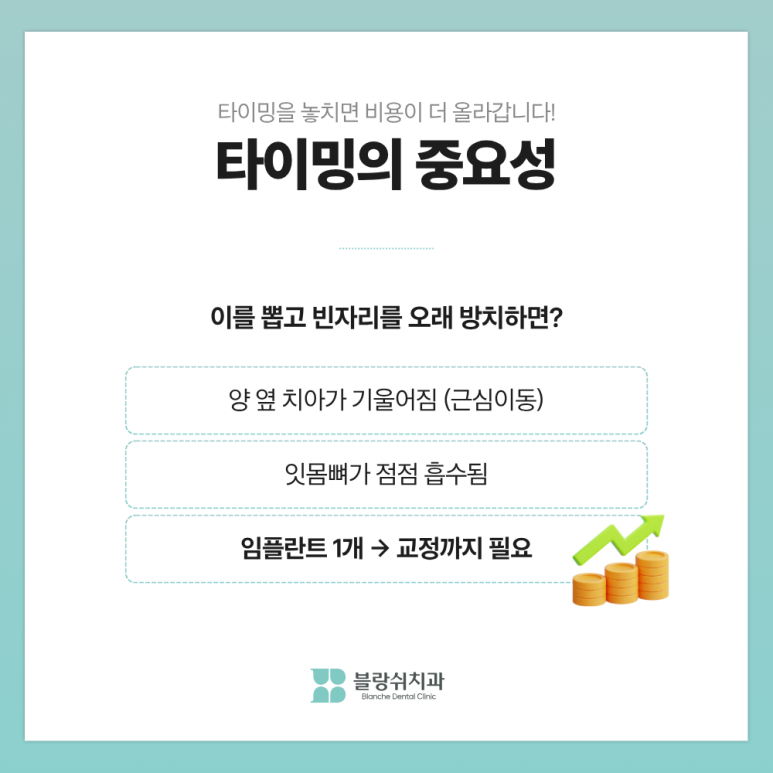
This is something you really need to know. If a tooth is extracted and the empty space is left alone for a long time, the teeth on both sides lean toward the gap.
In dentistry, this is called Mesial Drift,
and the principle is the same as when people shift toward the space left by one person getting off a packed subway train.
Once this leaning starts, a problem that could have ended with just one implant can grow into a situation that also requires orthodontic treatment.

This is why I strongly advise patients, "Don’t leave the gap open for too long."
Cases that could have been finished simply without bone grafting if treated early,
I have seen countless times where delaying 1 to 2 years led to bone resorption and the adjacent teeth shifting, causing the cost to double or even triple.
If you’ve been putting it off because of cost concerns, now may actually be the time when it costs the least.
With just one 3D CT scan, I can immediately check the current condition of your bone and whether it can be done without bone grafting.
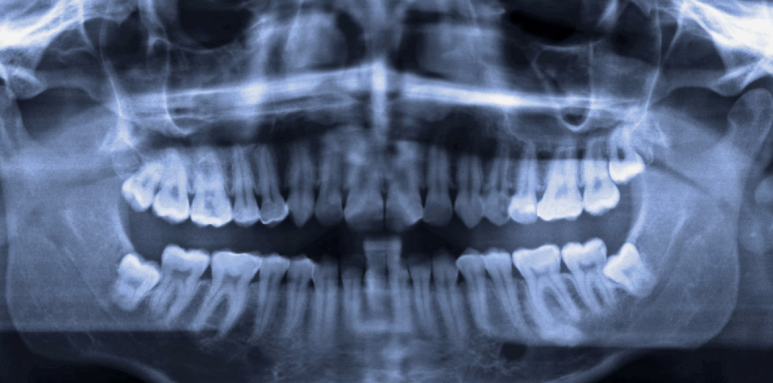
Whether bone grafting is truly necessary for your bone condition, and which brand is suitable—
you can see all of that right away with a single CT scan. I personally review the results and tell you honestly.
If you have any questions, feel free to ask in the comments or by phone.
This has been Blanche Dental Clinic in Banpo. Thank you.
✅ Other articles you may find helpful