Hello.
I am Kim Tae-hyung, the chief director of Gangnam Blanch Dental Clinic, and I provide treatment while thinking about my patients’ teeth in terms of 10 years and 20 years of lifespan.
These days, there are 정말 many people who buy a mouthguard for a few thousand won from Coupang or an online shopping mall and wear it to sleep because of teeth grinding. Just by searching, dozens of products come up, and the price is not burdensome, so people buy one with the mindset of at least reducing wear a little.
However, at our clinic, there are always three or four patients a month who say that after trying one for a few days, their jaw hurt more, or their teeth felt sensitive so they could not keep wearing it. To be honest as a dentist, a wrongly made device does not prevent teeth grinding; it can actually leave greater damage to the temporomandibular joint and teeth.
Today, I’ll organize the differences among three similar-looking devices — mouthguards, night guards, and splints — and point out the three criteria we always check when recommending a device to a patient at the clinic.

Mouthguard, night guard, splint — first, let’s sort out the confusing names

To start with the conclusion, these three words are different names for devices in almost the same category. However, depending on how they are made, their use can be completely different.
Products sold online as a “bruxism mouthguard” are mostly prefabricated. They are soft materials that you soften in hot water and bite into to shape. They belong to the same category as sports mouthguards.
A night guard is a general term for any device worn at night to prevent teeth grinding, and because there are both prefabricated and custom-made dental versions, the terms are often used interchangeably.
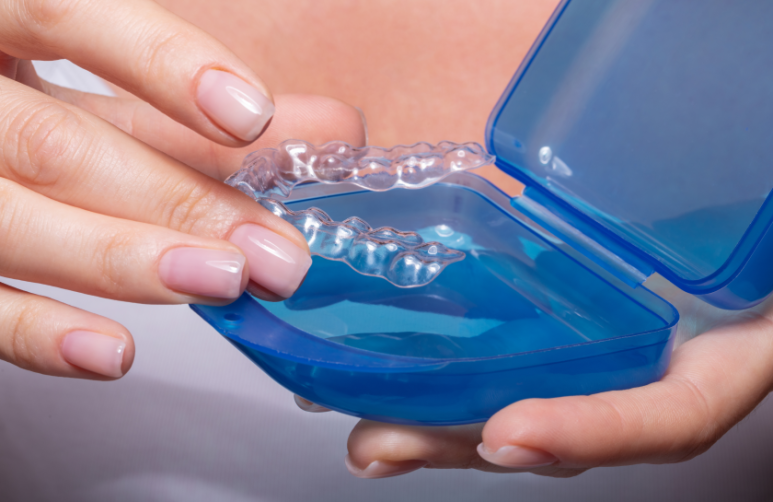
What dentists call a “splint” is a completely different concept. It is a custom-made occlusal stabilization device, made after taking an impression of the patient’s teeth or scanning them precisely with an intraoral scanner and calculating the bite. If you do not know this difference and use a prefabricated product thinking, “A mouthguard and a splint are basically the same thing,” that is where the problems begin.
Criterion 1 — Is it made to fit my teeth exactly?

The first thing to check when choosing a device is whether it was made to fit your teeth.
A prefabricated mouthguard is shaped by softening the material in hot water and biting into it. But every person’s teeth are arranged differently and have different heights. In particular, the height of the cusps on the chewing surfaces of the back teeth — the peaks of those little mountains — differs subtly, so a prefabricated product can never fit exactly.
If you sleep while wearing a poorly fitting device all night, the upper and lower teeth receive uneven force. One side’s molars may be pressed too much, only the front teeth may contact excessively, or the jaw may be held in a position that is misaligned forward or backward from normal. Even wearing it for just a few days can strain the temporomandibular joint and cause pain. Most of the patients mentioned earlier fall into this category.
When I look at a patient’s prefabricated device in the clinic, I can immediately see which areas are high and which areas are floating. In fact, just biting down on articulating paper gives the answer right away.
Criterion 2 — Is it designed with bite adjustment in mind?

The second criterion is whether the device is merely a cover for the teeth or a therapeutic device that is adjusted for the bite.
A prefabricated mouthguard is protective gear that simply prevents the teeth from directly contacting each other. In other words, it only reduces the wear caused when teeth grind against each other. On the other hand, a custom splint made at a dental clinic is designed with the contact position of the upper and lower teeth and the distribution of force in mind.
People who grind their teeth usually have a subtle misalignment in their bite. This misalignment can be a trigger for bruxism and also a cause of temporomandibular joint disorders, but prefabricated products cannot correct it, so they leave the grinding habit unchanged. In severe cases, wearing a prefabricated device can even make the grinding worse.
A custom splint takes into account the patient’s chewing habits, jaw joint position, and tooth wear pattern and readjusts the bite accordingly. So beyond simply protecting the teeth, it helps disperse the force of grinding and stabilize the temporomandibular joint.
Criterion 3 — Are the material and thickness suited to the strength of my grinding?
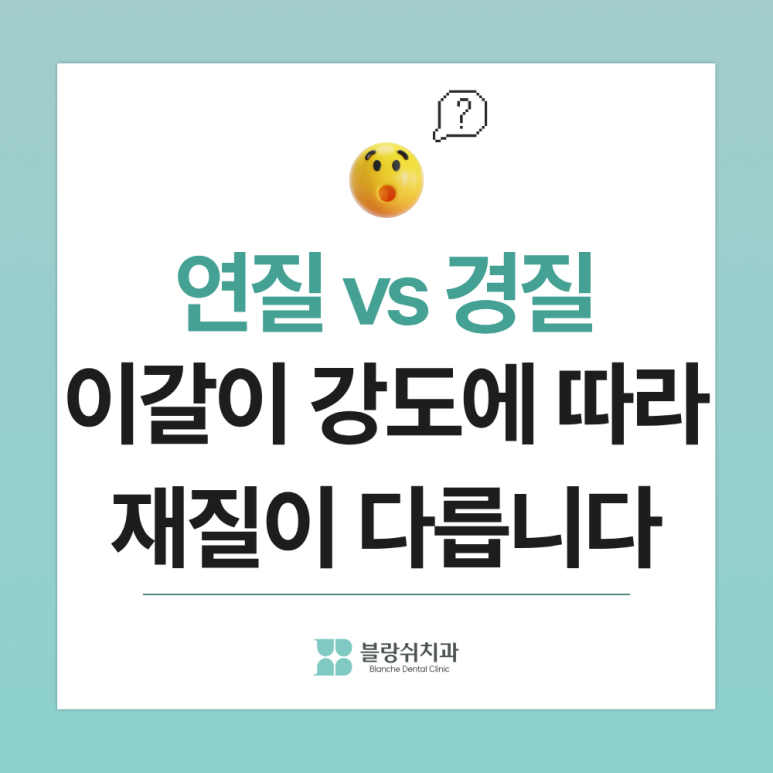
The third criterion is the material of the device. Even splints come in soft type and hard type, and which one is used depends on the strength of the grinding.
Soft types are comfortable to wear because the material is pliable, but with strong teeth grinding they can be chewed through quickly. Among the patients I have seen, there was even someone who came in after completely wearing down a soft splint in just three months. For such patients, a hard material is the right choice.
On the other hand, if the grinding is mild and the person mainly clenches their teeth, a soft type may be enough. In the clinic, we make a judgment by comprehensively considering tooth wear, fracture 여부, and the size of the masseter muscles (the chewing muscles). Since the force of grinding during sleep is 3 to 5 times the force used when chewing while awake, choosing the wrong material can cause the device to break down within one or two months or even accelerate tooth wear.
For reference, if someone has had long-term teeth grinding and already has cracks or fractures in the teeth, a device alone is not enough; we also need to look at how to preserve the remaining teeth. If you are curious about that, please also refer to this article.
→ 「If a broken tooth is left untreated, will extraction be necessary? Treatment for cracked teeth and first aid」
Prefabricated vs custom-made: how much difference is there?
Although they are grouped under the same name of “bruxism device,” they are actually completely different products. To summarize:
| Category | Prefabricated mouthguard | Custom dental splint |
|---|
| Method of production | Soften in hot water and bite to mold | Custom-made after tooth scan or impression |
| Bite adjustment | None (simple cover) | Includes bite design |
| Material selection | Mostly soft (fixed) | Soft and hard options available |
| Temporomandibular joint burden | Can worsen if it does not fit | Designed to stabilize the jaw joint |
| Lifespan | Several weeks to several months | Several years (with care) |
| Effect on grinding | Partially reduces tooth wear only | Helps prevent wear, cracks, and progression of jaw joint problems |
Prefabricated mouthguards are inexpensive and easy to obtain, but they do not consider the bite at all, may strain the temporomandibular joint, and have a short lifespan.
A custom dental splint is relatively more expensive, but it fits the teeth accurately, the bite is adjusted, and material selection is possible. Above all, it is genuinely effective in preventing the progression of tooth wear, cracks, and temporomandibular joint disorders caused by bruxism. However, the method of application and the results may vary depending on the individual’s oral condition and the strength of the grinding.
In the end, the biggest difference is whether the bite has been designed. If you remember only one thing, let it be that the core of a bruxism device is not the cover, but the design; choosing becomes much easier.
Bruxism is repeated every night without the person even knowing.
And how that force is being applied to the teeth, and where strain is accumulating in the temporomandibular joint, can only be determined by directly looking at the wear pattern of the teeth and the bite condition. I wrote this article because I have seen too many cases where people tried to put out the immediate fire with a prefabricated mouthguard only to end up damaging the jaw joint as well.
If you are currently looking into a bruxism device online, or if you are already using a prefabricated product and feel that something seems off, please feel free to contact me by comment or phone. I will check it personally and answer sincerely.
I support your precious teeth.
This has been Gangnam Blanch Dental Clinic. Thank you.
✅ Recommended reading