Hello,
I’m Kim Tae-hyung, the head doctor of Blanše Dental Clinic.
Before coming in for surgery, there is something patients cautiously bring up.
“Doctor... does an implant hurt a lot...?”
When patients ask this, their expressions are all quite similar. It’s the kind of expression that says it feels awkward to ask, but impossible not to ask.
In fact, the biggest reason patients keep postponing implants until they finally come in for surgery is this fear of pain. They say things like, “A friend was in pain for days,” or “I looked it up online and it seemed scary.”
It’s only natural for many people to have a vague fear of dental treatment.
But speaking from the perspective of having placed more than 30,000 implants myself, 90% of the pain patients believe in is different from the truth. Old-style implants and today’s implants are not the same procedure.
Today, I’ll explain in writing exactly how painful implant surgery actually is, how long recovery takes,
and what the most commonly misunderstood facts are, just as I would tell you honestly in the clinic.
Misconception 1. “Implant surgery is always very painful”

Let me start with the most common misunderstanding.
Many people think, “An implant means putting a screw into the jawbone, so of course it must hurt a lot.”
To give the conclusion first: if anesthesia is properly administered, the pain during surgery is almost zero.
What patients are actually more afraid of than the surgery itself is the anesthesia injection.
That sharp little sting when the anesthetic needle goes into the gum is the strongest sensation.
Once the anesthesia takes effect, you’ll feel only pressure from that point onward, with almost no pain.
More and more dental clinics are using a device called a painless anesthesia injector.
This device slowly injects the anesthetic solution at a steady rate, so the sharp stinging sensation is barely felt.
Our clinic has also recently introduced the most advanced painless anesthesia injector.
Since this device was introduced, even patients who had been putting off implants because they were afraid of the anesthesia shot have been able to undergo surgery without much 부담.
To put it another way:
Many people remember old wisdom tooth extractions as painful and frightening, but wisdom tooth removal today is not as painful as it used to be. Implants are the same way—equipment and techniques improve every year.
Misconception 2. “You have to suffer for several days after surgery”

The second misunderstanding is about recovery time after surgery.
Many patients come in already scared after hearing that a friend or acquaintance struggled for days after getting an implant.
In most cases, patients experience some throbbing pain and swelling on the day of surgery, and this is usually well controlled with one or two prescribed painkillers. In general, daily life is possible after about 2 to 3 days, and by one week, it has mostly settled down.
Of course, there are cases where recovery takes longer. This is true when there is not enough jawbone and bone grafting is performed together, when several implants are placed at once, and when the patient has not been able to quit smoking.
Smoking, in particular, is the biggest enemy of implant recovery. If someone in your family is scheduled for implant surgery, please strongly encourage them to stop smoking. Otherwise, there can even be cases where an implant has to be placed, removed, and placed again.
| Time | Typical condition | Recommended action |
|---|
| Day of surgery | Slight throbbing and swelling after the anesthesia wears off | Take prescribed painkillers, eat soft foods, use cold compresses |
| Days 1–2 | Swelling peaks; pain can be controlled with painkillers | No smoking or drinking; brush teeth except around the surgical area |
| Days 3–4 | Swelling begins to decrease; pain almost gone | Can return to daily life |
| Week 1 | Gums have mostly returned to normal; sutures removed | Normal eating possible; brush the surgical area carefully |
| 2–3 months | Osseointegration between the implant and jawbone is complete | Proceed to the prosthetic placement stage |
※ Recovery time may vary depending on the condition of the jawbone, whether bone grafting was performed, and whether the patient smokes.
So “suffering for several days” is not the general case, but a specific case.
Recovery speed can be sufficiently managed depending on the condition of the patient’s jawbone and lifestyle habits.
Misconception 3. “Sedation anesthesia is dangerous”

The third misunderstanding is about sedation anesthesia.
Many people worry, “I heard sedation anesthesia is dangerous,” or “I’m scared of propofol—is it okay?”
First, there is something that needs to be made clear.
What is done in dental sedation is more precisely called conscious sedation.
It is a method in which the patient does not completely lose consciousness, but remains in a light sleep-like state while continuing to breathe on their own.
Because of that, there is almost no strain on the patient’s body.
At our clinic, we do not use propofol for sedation anesthesia.
We use a combination of midazolam and ketamine in minimal doses to achieve the maximum sedative effect,
and this combination preserves breathing function well and carries almost no risk of dependence.
In addition, we monitor oxygen saturation, heart rate, and blood pressure in real time,
so you can feel reassured about safety.
There are also people for whom sedation anesthesia is especially helpful.
Those who break into a cold sweat at the sight of a needle, those whose heart races at the sound of dental equipment, and those who find it difficult to keep their mouth open for a long time. For these patients, if the procedure is done with sedation anesthesia, they can finish implant surgery with almost no memory of having gone through it.
There is something more important than pain

Finally, there is one more point I’d like to mention.
In fact, the biggest variable in implant pain is not the anesthesia device or the medication. It is the surgeon’s accuracy.
Even if the same implant is placed in the same area, there is a big difference in surgery time, gum injury, and recovery speed between placing it into the jawbone at the correct angle in one attempt and placing it after repeatedly adjusting the position. Fast and accurate surgery is the way to reduce patient pain.
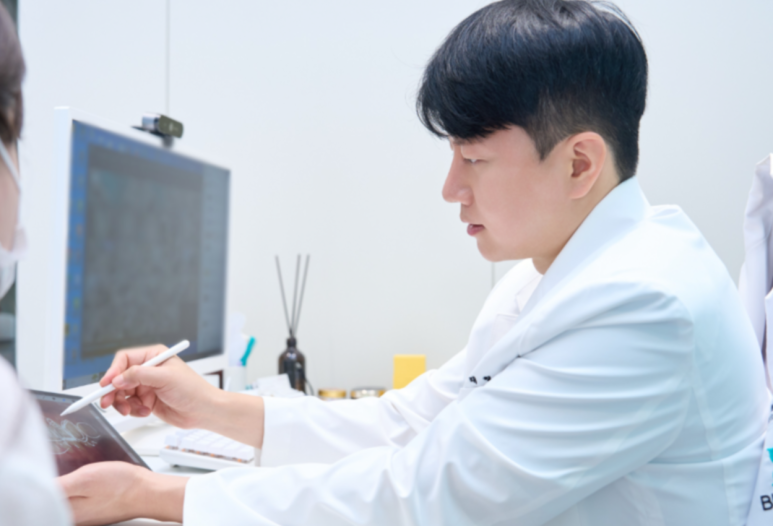
So when deciding on implant surgery, rather than fearing pain, it is better to first check the doctor’s experience with implant placement. If sufficient clinical experience and precise diagnostic equipment are in place, the surgery itself becomes shorter, and when it is shorter, recovery is faster.
Implants are not a frightening surgery; they are a comfortable procedure when performed correctly. If you keep postponing, the jawbone can continue to deteriorate, and then the surgery really does become more difficult and more painful.
If you’d like to start by sorting out implant prices, the previous post may be helpful.
Implant types, prices, and pain. In this series, I’ve organized the three main things patients worry about most before deciding on implants. If you’ve been putting it off because of vague fear, I hope today’s post could ease that fear even a little.
If you have questions or concerns about surgical pain or anesthesia, please feel free to leave a comment.
I’ll give you the most honest answer, just as if I were looking at your condition directly in the clinic.
This has been Gangnam Blanše Dental Clinic. Thank you.