Hello, I’m Kim Tae-hyung, director of Gangnam Blanche Dental Clinic.
You may notice that your child’s permanent teeth are coming in crooked while you are helping them brush their teeth, or that the way their upper and lower teeth meet looks somewhat unusual. Orthodontic treatment is often the first thing parents think of at that moment, but then questions such as “Should we start now? Is it okay to wait until all the permanent teeth have come in? Is treatment really necessary?” can feel overwhelming.
Timing accounts for half of children’s orthodontic treatment.
The same problem may be resolved with a simple appliance when addressed between the ages of 6 and 10,
but if treatment begins after all the permanent teeth have come in, tooth-extraction orthodontics is often required.
Today, I’ll explain the best time to begin children’s orthodontic treatment, the signs parents should not overlook,
and what Invisalign First, which many parents are looking into these days, is.
There Are Two Starting Points for Children’s Orthodontic Treatment
Children’s orthodontic treatment differs fundamentally from adult orthodontic treatment, which begins after all the permanent teeth have come in, in one important way.
There are two possible times to begin orthodontic treatment.
The first is between the ages of 6 and 9. This is the period when primary and permanent teeth are present together.
At this age, the jawbones are actively growing, making it the best time to guide the shape of the jaws themselves.
If the lower jaw appears to project farther forward than the upper jaw, suggesting an underbite,
if the upper jaw appears narrow,
or if the lower jaw appears to be positioned inward, suggesting a receding-chin tendency,
starting treatment during this period can help guide the direction in which the jaws grow.
The second is between the ages of 10 and 13. This is when most of the permanent teeth have come in, making it the appropriate time for comprehensive orthodontic treatment to straighten crooked teeth. Treatment is performed in a way similar to adult orthodontics, but because the supporting jawbone is still relatively soft, the teeth move faster and discomfort is often less than in adults.
The problem arises when the first period is missed and the child visits after all the permanent teeth have come in.
If the shape of the jawbones themselves is misaligned, orthodontic treatment alone may no longer be sufficient at that point,
and orthognathic surgery to reposition the jawbones may need to be considered.
5 Timing-Related Signs Parents Should Not Overlook
When we review cases involving people who came in for an orthodontic consultation later than ideal, the signs are often similar.
Here are five common signs seen in cases that might have been completed more easily if identified earlier.
First, the upper and lower front teeth meet in the opposite way from normal.
Normally, the upper front teeth slightly overlap the lower front teeth. If the lower front teeth project farther forward than the upper front teeth instead,
this is a sign that should not simply be left untreated. In these cases, earlier treatment is generally preferable.
Second, a permanent tooth has come in, but there is an empty space next to it.
As mentioned in a previous post, this may indicate a missing permanent tooth or a permanent tooth that is embedded in the gum and has not erupted.
Third, when the mouth is closed, the upper front teeth cover the lower front teeth so much that the lower teeth are barely visible.
If left untreated, the upper and lower front teeth may collide, potentially damaging the gums or teeth.
Fourth, habits such as thumb-sucking or tongue-thrusting remain after the age of 7.
These habits can directly contribute to gaps between the front teeth or narrowing of the upper jaw.
Fifth, the child habitually breathes through the mouth.
Breathing through the mouth instead of the nose can alter the direction in which the upper jaw grows, resulting in a narrow, elongated facial shape,
and can also reduce the space available for the teeth to grow into proper alignment. Establishing the habit of breathing through the nose can sometimes be more important than any orthodontic appliance.
Children’s Orthodontic Appliances Vary by Timing and Purpose
Orthodontic appliances for children differ somewhat from those used for adults. The appliance selected depends on the timing and purpose of treatment.
Appliances used during the first period, from ages 6 to 9, are mainly intended to guide the direction of jaw growth.
Examples include the Frankel appliance, the Friolso appliance, palatal expanders, and facemasks.
Many of these appliances are worn only while sleeping or for a few hours a day, rather than all day.
From the second period, between ages 10 and 13, comprehensive orthodontic appliances are used to properly align crooked teeth.
Traditionally, fixed brackets such as Clippy-C have been used. However, over the past 5 to 10 years, the introduction of Invisalign First—a removable clear orthodontic appliance for children—has expanded the available options.
Invisalign First Makes Clear Orthodontic Treatment Possible for Children

When parents think of orthodontic treatment for children, they often picture metal wires attached to the teeth.
These days, however, clear orthodontic treatment is also possible for children. Invisalign First is a representative example.
Invisalign First is a clear orthodontic appliance designed specifically for children and manufactured using AI-based technology by the company’s headquarters in the United States.
Unlike standard Invisalign for adults, which is used after all the permanent teeth have erupted, it is designed to fit a child’s mouth while primary and permanent teeth are present together. This allows treatment during the first and second periods to be continued with a single type of appliance.
Invisalign First has several clear advantages.
Because it is transparent, it is not very noticeable to classmates at school. It can also be removed while eating, so there are no dietary restrictions, and brushing can be done as usual. Naturally, there is no discomfort from the inside of the mouth being poked or cut by wires. Most importantly, because the appliances are simply replaced according to the prescribed sequence, there is no need to visit the dental clinic each time to have wires tightened.
One disadvantage, however, is that it must be worn by the child for at least 20 hours a day to be effective, and some children may find it difficult to adjust to this. It is also not suitable for every case. Rather than considering only its advantages, you should visit a qualified dental clinic for a detailed examination to first determine whether your child is a suitable candidate for Invisalign First.
The cost of children’s orthodontic appliances varies considerably depending on the type of appliance.
Appliances used during the first period to guide jaw growth are relatively less expensive,
while the cost of comprehensive orthodontic treatment during the second period depends on whether standard brackets or Invisalign First are used.
Invisalign First generally costs more than standard brackets,
but the exact cost varies depending on the child’s condition and treatment duration, so it is best to receive a specific estimate after a detailed examination.
One Checkup at Ages 6–7 Can Change the Course of Treatment
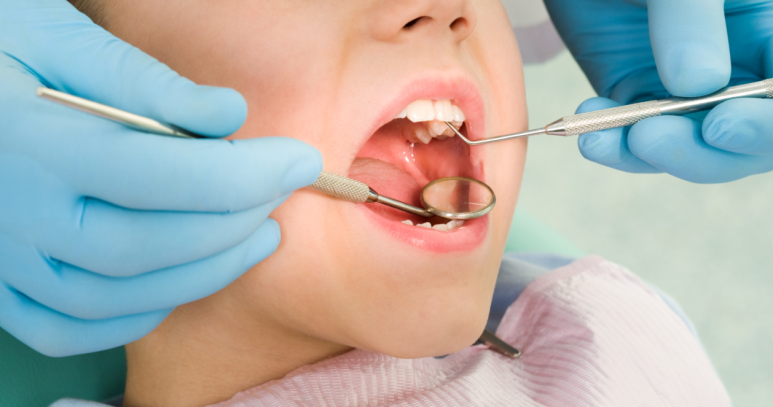
That summarizes the timing and appliances used in children’s orthodontic treatment, but the real key is to have a checkup once around the age of 6 or 7. A single X-ray at that age can show at a glance whether the permanent teeth are developing properly, whether the jaws are growing well, and whether there are problems with the tooth alignment.
Even if orthodontic treatment is not immediately necessary, a checkup at age 6 or 7 can clarify whether your child is a case that should begin treatment now or whether it is safe to wait until all the permanent teeth have erupted. This one checkup may help prevent a situation that eventually requires orthognathic surgery.

From signs of permanent teeth and cavity treatment to the right time for orthodontic treatment,
I hope these posts will be helpful as parents care for their children during the ages of 5 to 13, when the foundation for lifelong dental health is established.
When the right time for children’s orthodontic treatment is missed, the available options become more limited.
If you are wondering what stage your child is currently in or which appliance would be appropriate, please feel free to contact us.
This was Gangnam Blanche Dental Clinic. Thank you.