If you had the same cavity treated as a friend sitting next to you, but your friend paid KRW 100,000 while you paid KRW 400,000, anyone would feel suspicious at least once.
When you start searching for information about composite resin and inlays, wondering, “Did I get taken advantage of?”,
having information scattered across different sources can sometimes leave you even more confused.
From the conclusion first: There is a sufficient reason for the price difference between these two treatments,
and more expensive does not always mean better, nor does cheaper mean worse.
The answer depends on which treatment is right for you based on the size and location of your cavity and the condition of your tooth.
Hello. I’m Tae-hyung Kim, director of Banpo Blanche Dental Clinic.
Today, I’ll summarize the real differences between composite resin and inlays, including their price, lifespan, and insurance coverage.
I hope this helps you determine whether the treatment fee you paid was reasonable and which option may be right for your case in the future.

Composite Resin vs. Inlay: The Real Difference Is How They Are Made
The most fundamental difference between composite resin and an inlay is how they are made.
With composite resin, the dentist directly fills the area where the cavity was removed with a white filling material and hardens it with light to finish the treatment.
The procedure is completed in one visit while you are sitting in the dental chair. As a result, treatment takes approximately 20–30 minutes per tooth.
In contrast, an inlay is made by taking an impression of the exact shape left after the cavity is removed, having a custom restoration fabricated at an external dental laboratory or an in-house laboratory, and then bonding it to the tooth.
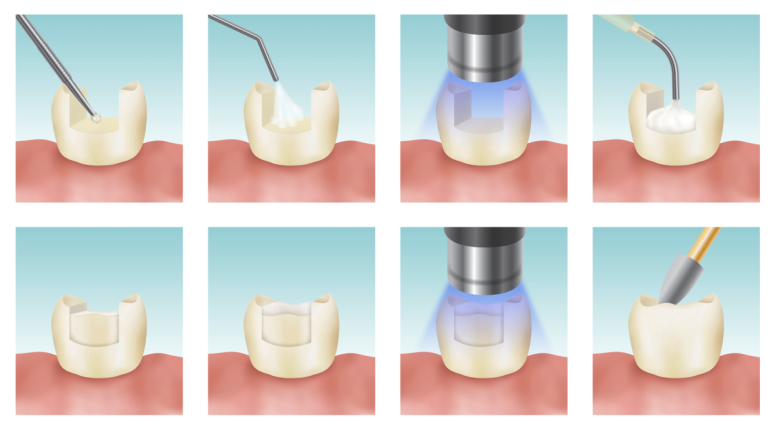
Therefore, treatment usually requires two visits—one to take the impression and one to attach the inlay—and it is generally necessary to wait about a week after the first visit. These days, digital inlays can also be milled in-house and completed on the same day, so some cases can be finished in a single visit.
To put it simply, composite resin is like immediately filling a crack in a wall with cement, while an inlay is like making a puzzle piece that precisely fits the crack and inserting it separately.
When Should You Use Composite Resin, and When Should You Use an Inlay?

The first thing a dentist assesses when examining a cavity is its size.
If the cavity is small or moderate in size, composite resin is usually sufficient. In particular, composite resin is the answer for most cavities in the front teeth or small molars. The price of composite resin for front teeth is usually slightly higher than for molars, because treatment of the front teeth requires greater aesthetic precision.
The issue arises when the cavity is large or has progressed deeply in a molar. Molars are exposed to the greatest chewing forces, so filling a large cavity with composite resin may not provide sufficient strength, increasing the risk that it will come loose or fracture.
In such cases, an inlay made from a stronger material is the appropriate choice.
A considerable number of people who search for the cost of molar cavity treatment fall within the range where an inlay is indicated.
In summary, think of composite resin as being suitable for small to moderate cavities, and inlays as being suitable for large cavities or deep cavities in molars.
However, an accurate decision requires considering not only the size of the cavity but also the condition of your tooth, your chewing habits, and the condition of adjacent teeth.
Price Differences Vary Further Depending on the Type
Now, let me organize the pricing information that patients are most curious about.
First, the cost of cavity treatment varies considerably depending on the material and type of treatment.
The price of composite resin is generally around KRW 100,000 for a molar, while composite resin for a front tooth usually costs around KRW 150,000–200,000. This is the price for treating one small cavity, so it is much less burdensome than an inlay.
The price of an inlay depends on the material. Ceramic inlays are the most commonly used, and ceramic inlays generally cost around KRW 300,000–400,000. They offer good aesthetics because their color is similar to that of natural teeth and also have excellent strength, but they are generally the most expensive option.
The price of a gold inlay varies according to the market price of gold, but is generally around KRW 300,000–500,000. Gold offers the greatest strength, but it is not often chosen unless the tooth is a molar that is not visible.
Hybrid inlays generally cost from the high KRW 200,000s to the low KRW 300,000s, placing them somewhere between ceramic and composite resin.
The reason the price of a molar inlay can be two or three times that of composite resin for a front tooth is the cost of the material itself and the custom fabrication process.
Even for the same cavity, it is important to know in advance that the price can rise significantly when the cavity has developed in a molar and requires an inlay.
Lifespan Differences: Typical Duration of Use

The lifespan of composite resin and inlays varies considerably depending on how well they are maintained, but generally speaking:
Composite resin lasts an average of 5–7 years, although some cases last up to 10 years with good care. However, over time, discoloration may occur, or the edges may lift slightly, often making retreatment necessary.
In the dental office, it is common to see composite resin that has been in place for 7–10 years develop black lines along the edges or have new decay underneath.
Inlays last an average of 7–10 years, while ceramic or gold inlays can sometimes last more than 15 years with proper care.
Their strength and durability are superior to those of composite resin, allowing them to withstand pressure for a long time in areas such as molars.
However, inlays are not permanent either, so they can sometimes fracture or come loose. There is a lot more to say about this, so I’ll explain it in detail in a separate post. Please be sure to read it, too!
Insurance Coverage: The Age of 12 Is the Cutoff
Insurance coverage is another important point to address.
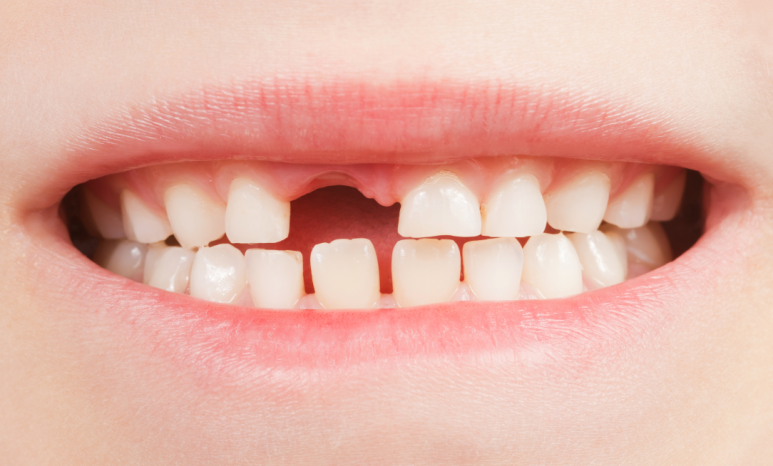
First, national health insurance covers cavity treatment with composite resin for permanent teeth in children under 12 years of age. This can significantly reduce the out-of-pocket cost. However, from age 12 onward, it becomes a non-covered treatment, meaning the patient must pay the full cost. For this reason, I advise parents of child patients to have cavities discovered before age 12 treated as soon as possible.
Inlays are not covered by national health insurance at any age. Since they are fully non-covered treatments, the out-of-pocket cost is relatively high. However, cavity treatment, including inlays, may be covered by private indemnity insurance in some cases, so it is a good idea to check the terms of your own policy. If you have a dental prosthesis treatment rider, you may be eligible for partial reimbursement.
In summary, remember it this way: Composite resin is suitable for small to moderate cavities, is less expensive, has a shorter lifespan, and is covered by insurance only for children under 12. Inlays are suitable for large cavities in molars and offer greater strength and a longer lifespan, but they are more expensive and are not covered by national health insurance.
As I mentioned earlier, in the next post I’ll explain in detail how to respond if your tooth becomes sensitive, fractures, or discolors after treatment with composite resin or an inlay. This is also something you should know, so please be sure to check it out.
If you are wondering which material is right for your cavity, an accurate answer requires directly examining the size and location of the cavity and the condition of your tooth. Please leave a comment or visit the dental clinic, and we will be happy to guide you.
Wishing you all bright smiles,
This was Banpo Blanche Dental Clinic. Thank you.
✅ Recommended reading