You’ve had a cavity treated, but a few days later, did the area start to feel sensitive,
or have you ever felt something crack while chewing, or noticed the area becoming yellowish one or two years later?
These are moments when you may start to worry that something went wrong with the treatment.
Some symptoms that occur after cavity treatment gradually improve on their own over time,
while in other cases, failing to address them promptly can eventually lead to root canal treatment or even extraction.
That is why it is essential to distinguish between the two.
Hello. I am Kim Tae-hyung, the director of 강남 블랑쉬치과의원.
In my previous post, I explained the differences between resin and inlays, right?
However, the symptoms that patients most commonly search for afterward include inlay sensitivity, a chipped inlay, and resin discoloration.
So in this post, I would like to organize some additional information that is essential for those who are unsure why each symptom occurs, whether it is at a stage that can simply be monitored,
or whether they need to visit the dentist again.

If Your Tooth Is Still Sensitive After Treatment: Why Does Inlay Sensitivity Occur?

The most common complaint after inlay treatment is sensitivity. Many people say that the area feels sensitive for several days to several weeks after visiting the dentist.
Inlay sensitivity occurs because, when the cavity has progressed close to the nerve, the area around the nerve may become temporarily sensitive after being stimulated during treatment.
While the cavity is being removed, the nerve area receives microscopic stimulation, and it takes some time for that irritation to settle down. The deeper the cavity was, the longer the sensitivity tends to last.
It is generally normal for sensitivity to gradually decrease within two to four weeks. During this period, avoid foods and drinks that are excessively cold or hot, and temporarily use toothpaste for sensitive teeth, which may help.
However, if the sensitivity does not subside after two to three months or gradually becomes worse, it may be a sign that nerve damage is progressing. At this point, it is a good idea to have an examination rather than putting it off any longer. If you wait too long, it may become difficult to avoid root canal treatment.
If It Feels Dull and Painful Every Time You Chew

There is one point to clarify: sensitivity and pain are somewhat different signals.
If a sharp sensation caused by cold stimulation is sensitivity, a dull ache every time you chew—or even while you are resting—is pain.
A dull ache for one or two days immediately after treatment is within the normal range. However, if it does not settle after a week, or if you experience throbbing pain even while resting, several possibilities should be considered.
The first is that the inlay may be slightly too high.
It may not align perfectly with your natural tooth, causing pressure to become concentrated in that area.
The second is that nerve damage may be progressing,
and the third is that a microscopic gap may have formed inside the inlay, allowing stimulation to reach the nerve.
In particular, if you experience throbbing pain while resting or wake up in the middle of the night because of pain, it may be a sign that root canal treatment is approaching.
The sooner you visit the dentist at this stage, the greater the possibility of preserving the nerve.
When an Inlay Suddenly Breaks or Comes Out
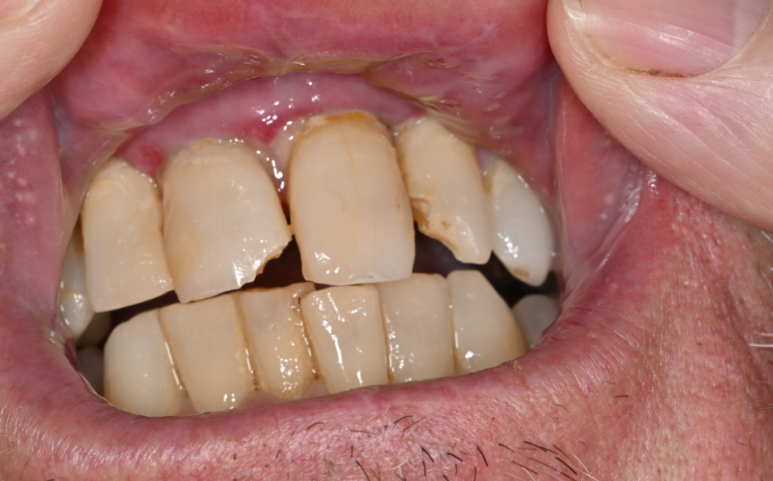
Sometimes an inlay suddenly breaks while you are chewing, or the bonding material comes loose and the entire inlay falls out.
There are surprisingly many people who find this page by searching for a chipped inlay.
The most common cause of an inlay chipping is external force from chewing hard or sticky foods. Typical examples include frozen foods, nuts, caramel, rice cakes, and pulled taffy. An inlay is made from a material that is stronger than a natural tooth, but it is not permanent, so repeated strong pressure can cause it to break or become loose.
The most important thing when an inlay comes out is to keep the piece instead of throwing it away and bring it with you. If you clean it carefully and place it in a small container, it may be possible to reattach the same piece. Even if it cannot be reused, the piece can serve as a reference, making it possible to create a new one that more closely matches the original shape.
If the empty area is left untreated, food can become trapped there and the cavity can progress quickly, so you should visit the dentist and receive treatment within one to two weeks. If you leave it as it is, the tooth underneath may become damaged or an additional cavity may develop, leading to more extensive treatment.
If Resin Discoloration Starts to Appear After One or Two Years
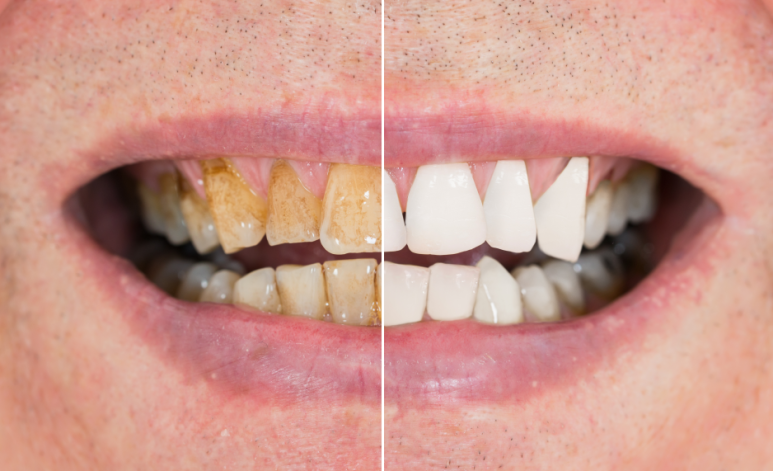
In some cases, the area may become slightly yellowish or brown about one to two years after resin treatment. Resin discoloration does not occur because the treatment was performed incorrectly; it is a characteristic of the material itself.
Over time, microscopic scratches develop on the surface of resin, allowing pigments from coffee, tea, and cigarettes to settle into them. It is also a material that picks up color more easily than natural teeth. After about five to seven years of use, the edges may become microscopically loose, allowing pigments to penetrate more deeply through the gaps.
If you can see a black line along the edge, or if the resin area is noticeably more yellow than the other teeth, it means the time for retreatment may be approaching. If you simply leave it alone, a new cavity can easily begin through the gap along the edge. If this is caught early during a regular checkup, replacing only the resin may be enough, but if it is discovered late, cavity treatment will need to be performed again first.
Do Not Put Off Visiting the Dentist in These Situations
We have looked at four signals so far.
Now, I will summarize when you should visit the dentist, so check which condition applies to you.
If even one of the following signs applies, you need an examination promptly.
Sensitivity that continues or gradually worsens after two to three months,
throbbing pain that continues for more than a week even while you are resting,
an inlay that has chipped or fallen out (preferably within one to two weeks),
or a black line along the edge of the resin or clearly progressing discoloration.
In particular, the longer you wait when something has chipped or fallen out, the greater the disadvantage. Food can become trapped in the empty space and the cavity can begin progressing again, potentially leading to root canal treatment or a larger restoration, so you should visit the dentist promptly.
In fact, you cannot be reassured forever simply because your cavity treatment is complete.
Because signs such as sensitivity, pain, chipping, and discoloration can appear at any time, carefully checking the next messages your teeth are sending you is more important than the treatment itself.
Whether your symptoms are at a stage where you can simply monitor them or at a stage requiring prompt treatment
can only be determined accurately through a direct examination, so please feel free to contact us if you have any questions.
This has been 강남 블랑쉬치과의원. Thank you.
✅ Recommended Related Reading