"Doctor, once I get dental implants, can I use them for the rest of my life?"
Hello. I’m Kim Tae-hyung, the medical director of Banpo Blanche Dental Clinic.
I’m asked this question very often during dental implant consultations.
Since it is a treatment that takes considerable commitment, I completely understand why people hope that once it is done, it will last for good.
But speaking honestly as a dentist, getting an implant is not a treatment that ends the moment it is placed.
What happens afterward is just as important as placing it properly—or even more so.
Today, I’ll explain why some people use the same type of dental implant for a long time while others develop problems after only a few years,
and where that difference comes from.

Dental implants are not “for life”—their longevity depends on how they are maintained

First, let’s clear up a common misunderstanding. Dental implants are not permanent simply because they have been placed once.
Because they are artificial teeth, they do not develop cavities, but the gums and bone supporting the implant still require proper care.
The implant itself does not decay, but if the jawbone supporting it breaks down, even an otherwise healthy implant can become loose and fall out.
So, when we talk about the “lifespan of a dental implant,” we are actually referring less to the lifespan of the implant components and more to the healthy lifespan of the gums and bone surrounding them.
That is why some people use their implants for more than 10 years with proper care, while others develop problems after only a few years.
The period before and after surgery determines how long it lasts
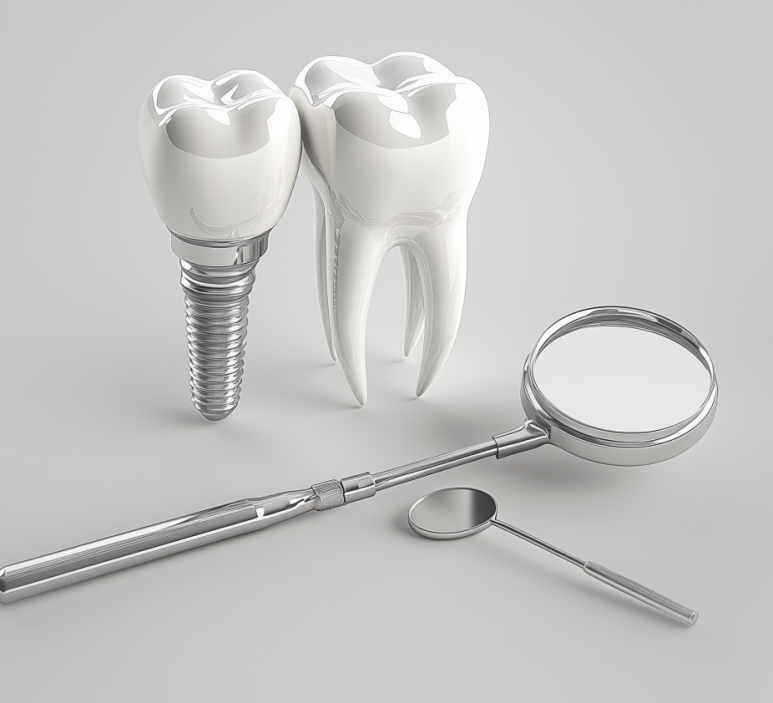
The conditions that help an implant last a long time are not determined by surgical skill alone. What happens before and after surgery is even more important.
Before surgery, it is necessary to precisely assess how much bone is available and determine the position and angle at which the implant should be placed so that it can withstand chewing forces effectively. At Blanche Dental Clinic, we use 3D CT imaging to examine the amount of bone and the location of the nerves in three dimensions before planning the implant position. This process has a significant effect on the implant’s longevity. If there is not enough bone, bone grafting may also be considered.
After surgery, the condition of the gums and bone must be checked and managed regularly.
If follow-up care is neglected after the implant has been placed properly, the careful work invested in the surgery can be undermined.
Dental implants can also develop gum disease

Many people are surprised to learn that dental implants can also develop gum disease.
This is called peri-implantitis, an inflammation of the gums around an implant.
Although it is similar to periodontal disease around natural teeth, it often progresses more quickly.
In addition, because implants do not have nerves, they may not cause much pain, allowing the bone to deteriorate without the person realizing it.
In the clinic, we unfortunately see quite a few people who assume that getting an implant is the end of the process and stop coming in for checkups,
only to visit after the peri-implantitis has progressed deeply.
That is why I strongly recommend regular checkups even after implant treatment.
In fact, a single checkup can help identify at an early stage whether the bone has begun to deteriorate.
| Category | Implants that last a long time | Implants that develop problems quickly |
|---|
| Before surgery | Position planned after examining the bone and nerves with 3D CT | Implant placed without precise planning |
| Jawbone care | Bone condition monitored through regular checkups | Left unattended without checkups after placement |
| Response to peri-implantitis | Detected and managed at an early stage | Progresses unnoticed because there is no pain |
| Doctor in charge | The doctor who placed the implant remains responsible for follow-up care | Responsibility for ongoing care becomes unclear |
| Daily care | Surrounding area kept clean with dental floss and interdental brushes | Carelessness, treating it like a natural tooth |
In the end, it comes down to who follows your treatment through to the end
As you can see, dental implant treatment lasts longer after the day of placement than it does on the day of surgery—often for the next 10 years.
Who takes responsibility for that long period and oversees your care ultimately determines how long the implant lasts.
The doctor who examined you when the implant was placed should continue to assess it during follow-up care, using the same perspective and understanding how and in what bone condition the implant was placed.
This is why Banpo Blanche Dental Clinic considers the period after placement more important than the moment of placement itself.

Dental implant treatment does not end with a single surgery; it is treatment that continues with you for a long time.
Placing the implant properly is only the beginning. Providing thorough care afterward is what truly completes implant treatment.
That is why I plan everything together, from before placement through the 10 years that follow.
If you have many concerns about getting a dental implant, I will take the time to carefully discuss which treatment plan is right for you.
This has been Banpo Blanche Dental Clinic. Thank you.