"Doctor, I was told I have some decay in my molar, and that simply filling it wouldn’t be enough—that it needs to be covered.
But I’m a little scared of having a seemingly healthy tooth shaved down all the way around. Is that really necessary?"
Hello. I’m Kim Tae-hyung, director of 반포 블랑쉬치과의원.
When you see several patients for cavity treatment every day, you meet many people who come in to double-check before undergoing molar treatment. I completely understand why people hesitate when they hear that a seemingly healthy tooth may need to be shaved down substantially. In fact, I think that concern is perfectly natural.
Molars are different from front teeth, so even with the same cavity, choosing the right treatment can be more complicated.
When you search online, you may find conflicting opinions—some say inlays are better, while others say crowns are safer—which can make things even more confusing.
So, as a dentist, I’ll lay it out for you.
Today, I’ll explain the criteria that determine whether your molar can be treated with an inlay or whether it needs to go as far as a crown.

Why Is Choosing a Treatment Method More Complicated for Molars?

Molars do the hardest work among all the teeth in your mouth. They handle most of the actual work of breaking food into small pieces. Each time we chew, the force placed on the molars can reach several dozen kilograms in adults, and they withstand this force hundreds of times at every meal.
That is why molar treatment has to satisfy two requirements at the same time.
One is being strong enough to withstand powerful chewing forces, and the other is preserving as much of the healthy tooth as possible.
Because these two goals can conflict, there is no single right answer for molars—neither always choosing the stronger option nor always shaving down as little as possible.
This is precisely where inlays and crowns differ.
Inlays and Crowns: The Real Difference Is “How Much Tooth Is Shaved Down”
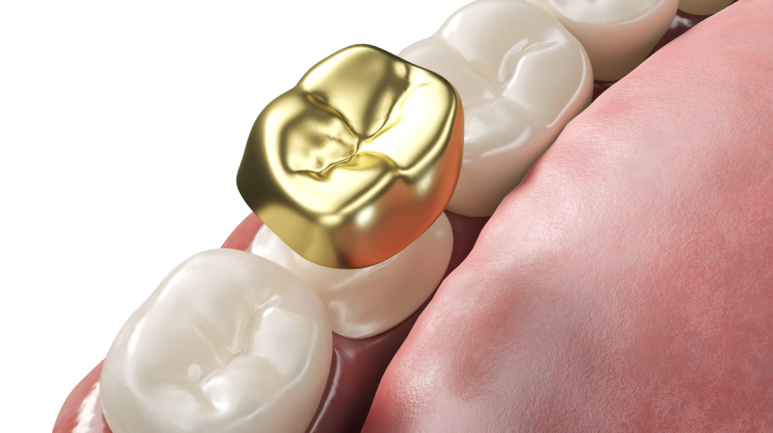
The biggest difference between the two treatments is how much of the tooth they cover—in other words, how much tooth needs to be removed.
With an inlay, only the area damaged by decay is precisely removed, and a custom-made restoration is fitted into that space.
It is similar to making a partial repair to a house by replacing only a few damaged floorboards. This allows more of the healthy tooth to be preserved.
A crown, on the other hand, involves shaving the tooth down all the way around like a post and then covering the entire tooth, as if placing a cap over it.
Because it surrounds the entire tooth, it provides greater strength and stability. However, this also means removing a considerable amount of healthy tooth structure.
Once a tooth has been shaved down, it does not grow back, so this decision should be made carefully.
In the clinic, there are cases where it is unfortunate to see a tooth that would have been adequately treated with an inlay covered with a crown. Conversely, there are also cases where insisting on an inlay despite the circumstances leads to the restoration breaking and ultimately requires a crown. For this reason, it is difficult to say that one option is always right.
So Which Option Is Right for My Molar?
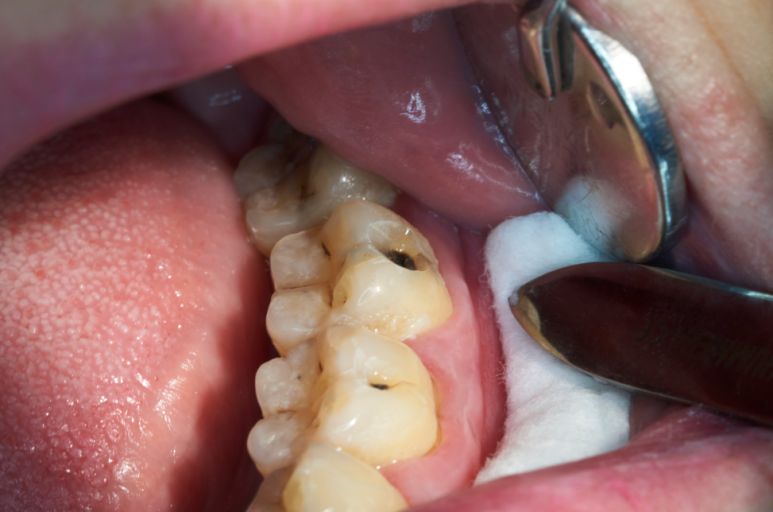
Ultimately, the deciding factors are how much healthy tooth structure remains and whether there are enough walls to withstand chewing forces.
| Category | When an inlay is appropriate | When a crown is appropriate |
|---|
| Extent of decay | Damage is limited mainly to the chewing surface | Decay has spread extensively to the side walls of the tooth |
| Remaining tooth walls | Strong walls remain to withstand chewing forces | The walls have become thin or are at risk of cracking and breaking |
| Root canal treatment | The pulp is still vital, so the tooth remains strong | The tooth has weakened after root canal treatment has left the inside hollow |
| Amount of tooth removal | Only the damaged area is removed to preserve as much as possible | The tooth is shaved down all the way around to secure strength |
| Priority | Remove less and preserve the natural tooth | Protect the tooth from breaking first |
Molars that have undergone root canal treatment are particularly weakened because their interiors become hollow. In such cases, protecting the tooth from breaking is often a higher priority than removing as little tooth structure as possible, making a crown more appropriate in many cases. Conversely, if the decay is limited to the chewing surface and the tooth walls remain strong, an inlay is usually the better choice rather than removing more tooth than necessary.
Why the Tooth Should Be Examined Once More Before It Is Shaved Down
Let me emphasize the most important point here.
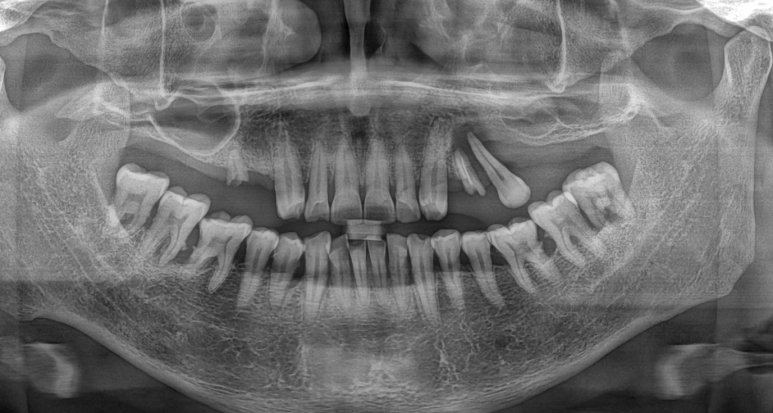
Whether a tooth can be treated with an inlay or needs a crown cannot be determined accurately simply by looking at the dark area visible on the surface.
To determine the treatment, we need to use an X-ray to check how far the decay has penetrated into the tooth and whether the remaining walls are cracked. Even if the same black spot is visible, the treatment can be completely different depending on how extensively the decay has spread inside the tooth.
If you are wondering how much of the tooth needs to be shaved down and whether there is truly no alternative to covering it,
「Should Every Cavity Be Shaved Down and Covered?」 may also be helpful to read.
Whether the tooth should be filled, fitted with an inlay, or covered with a crown is determined by the depth of the decay. The treatment should not be decided in advance and then forced to fit the tooth.
If a tooth is shaved down more than necessary when less would have been enough, that tooth cannot be restored to its original state. That is why the assessment before shaving it down is so important.
After examining the tooth carefully, if it does not need to be shaved down further, I always recommend preserving it rather than removing more tooth structure.
This was 반포 블랑쉬치과의원. Thank you.
✅ Recommended Reading