
Gangnam Nonhyeon-dong Dental Clinic: If tartar management is neglected
The risks that can arise
| Summary |
|---|
| 1. Tartar creates an environment where bacteria can thrive easily, and if left untreated, it becomes a major cause of inflammation and bad breath. |
| 2. At first, symptoms are mild, but if management is delayed, it can worsen into periodontitis, where inflammation spreads to the gum bone. |
| 3. Tartar formed below the gums is not visible, so regular checks through periodic examinations are essential. |
| 4. Even after tartar removal, proper brushing habits and lifestyle improvements must be maintained together for management to remain effective. |
| 5. Regular preventive care is the most efficient choice, preventing functional loss and reducing the long-term burden of treatment time and cost. |
Tartar forms naturally,
but if it is not managed,
it affects the overall oral environment.
In the early stages, there is little discomfort,
but as time passes, it can lead to inflammation, odor,
and functional decline.
Regular care and proper habits
are the key to reducing the risk.
Tartar forms when plaque that has not been removed by brushing hardens.
Although it may seem like a small deposit on the surface,
its rough texture creates an environment where bacteria can easily adhere.
If this condition continues,
the balance in the mouth gradually breaks down.
That is why it helps to understand tartar as something that has already passed the point for timely management once it becomes visible.

In the early stages, there may be no particular discomfort.
However, once tartar begins to build up,
inflammatory reactions are more likely to appear at the gum line.
If you notice bleeding when brushing,
or if the refreshed feeling after brushing does not last,
that may be a sign.
If care is not provided at this stage,
it progresses to the next stage.
As tartar increases, the space between the gums and the teeth becomes deeper.
As a result, food gets stuck more easily,
and bad odor may recur.
It is easy to dismiss this as a simple hygiene issue,
but in reality, it means the inflammation is moving inward.
Surface-level care becomes difficult to resolve the problem.

If the inflammation continues,
supporting tissues may weaken.
You may feel discomfort while chewing,
or a sense that pressure is concentrated in a specific area.
From this point on, even everyday meals can become a concern.
This is the turning point where tartar management leads to functional issues.
Neglecting care also affects the surrounding teeth.
Tartar in one area can easily spread to adjacent areas, allowing a localized problem to grow into a broader one.
Ultimately, the scope of care and the time burden increase.
The value of early response becomes clear here.
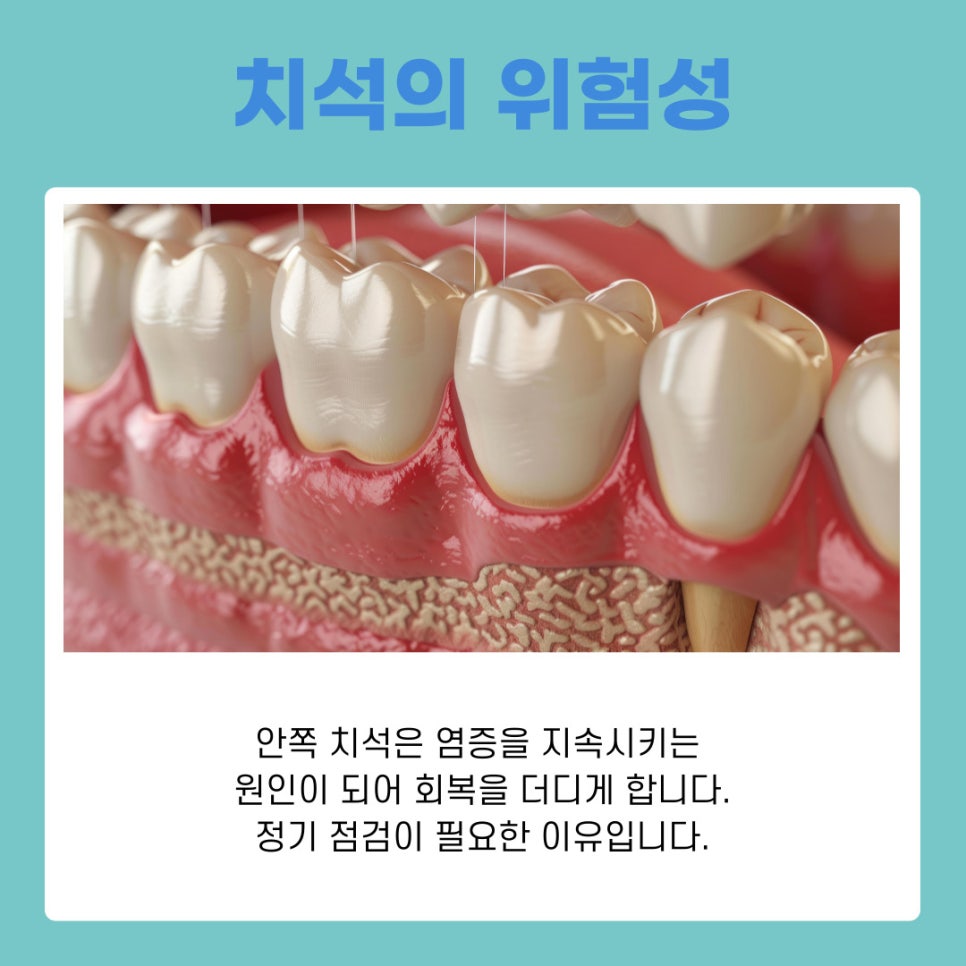
Tartar can also form below the gums.
In such cases, it is difficult to confirm with the eye,
and awareness of symptoms is delayed.
Tartar inside the gums becomes a cause of ongoing inflammation,
slowing recovery.
That is why regular checkups are necessary.
If left untreated for a long time, the gum line may appear to change.
Teeth may look longer, or the alignment may feel different.
This can lead not only to aesthetic changes
but also to functional discomfort.
A change in appearance is a sign that internal changes
have already progressed considerably.

Tartar management does not end with a single procedure.
After removal, habits must be adjusted
so that it does not build up again.
The method and angle of brushing matter more than the number of times you brush.
Care with awareness of the gum line is necessary.
Smoking and frequent consumption of staining drinks can speed up tartar reformation.
It is important to recognize that lifestyle habits are an extension of management.
Small changes accumulate and lead to big differences in results.
The more tartar there is, the more difficult it becomes to manage.
Problems that could have been handled simply at first may later require a step-by-step approach.
That is why the treatment scope and duration increase.
Prevention is the most efficient choice.

The purpose of regular care is to block risk.
Even if there are no noticeable symptoms,
periodic checks can help prevent major problems in advance.
Preventive care increases long-term stability.
Tartar management is not simply about saving money or time.
Rather, it is a way to reduce the additional burden caused by neglecting care.
A small amount of effort can help you avoid major discomfort.
The timing of care determines the outcome.

Q. If there is a lot of tartar, does bad breath get worse too?
A. It can be one of the main causes of bad breath.
Bacteria living in tartar break down food debris,
causing unpleasant odors.
It often leads not just to simple mouth odor,
but to persistent bad breath.
Q. If tartar is left untreated, does it develop into gum disease?
A. It can progress beyond gingivitis into periodontitis.
In the early stages, inflammation is limited to the gums,
but if not managed, it spreads to the bone that supports the teeth.
At this stage, tooth mobility or gum recession may occur.
If tartar management is neglected,
the problem gradually grows.
At first, discomfort is minimal, so it is easy to overlook,
but as time passes, the effort needed for recovery increases.
The most important prevention is to avoid missing small signs.
The key to management is consistency.
Regular checkups and habit improvement have a greater effect than a one-time intervention.
It is necessary to pay attention to changes that are not visible.
Tartar can either become a risk or remain a controllable factor depending on whether it is managed.
If you accurately check your current condition
and set a direction for care, you can reduce unnecessary pain
and complicated procedures.
In the end, the surest way to protect oral health
is to manage it now.