This post was written directly by New En Dental Clinic and
strictly complies with the provisions of Article 56 of the Medical Service Act and the Medical Advertising Review regulations,
and provides medical information through clinic and hospital blog content
that may be helpful to an unspecified number of patients.
Seocho-dong Teeth Whitening
Summary of the Principles and Procedure
| Summary |
|---|
| 1. Teeth whitening is a procedure that safely breaks down staining substances by applying a high-concentration whitening agent and a special light to discolored surfaces. |
| 2. After accurately analyzing an individual's dental condition and the cause of discoloration, the procedure is safely performed through the application of a gum protectant and a precise whitening agent. |
| 3. After the procedure, temporary sensitivity may occur, but it soon subsides. |
| 4. To keep teeth bright and white for a long time, you should avoid foods that cause staining, such as curry and coffee, and maintain regular scaling and checkups. |

Hello,
This is New En Dental Clinic.
There are many causes of tooth discoloration. If you frequently consume coffee, green tea, wine, or strongly pigmented foods such as curry or chocolate, pigment substances seep into the tiny pores on the surface and discoloration progresses.




Previous image
Next image
Such tooth discoloration can also cause a passive attitude in important business settings such as conversations, interviews, and meetings, as well as in everyday life.
For those who are troubled by yellowed teeth or want to regain a bright, radiant smile before an important event, whitening treatment is an excellent option.
Types of Teeth Whitening

The first is professional teeth whitening performed at a dental clinic. This method uses a whitening agent and special visible-light laser equipment.
Because it is performed after gum protection measures under the thorough control of medical staff, it is highly safe, and usually about 2 to 3 consecutive treatments are performed in a single visit so that the tooth color can be seen with the naked eye.
The second is at-home self-whitening. This method involves applying the whitening agent directly to a tray and wearing it for several hours a day, helping to maintain tooth color.
Step-by-Step Procedure
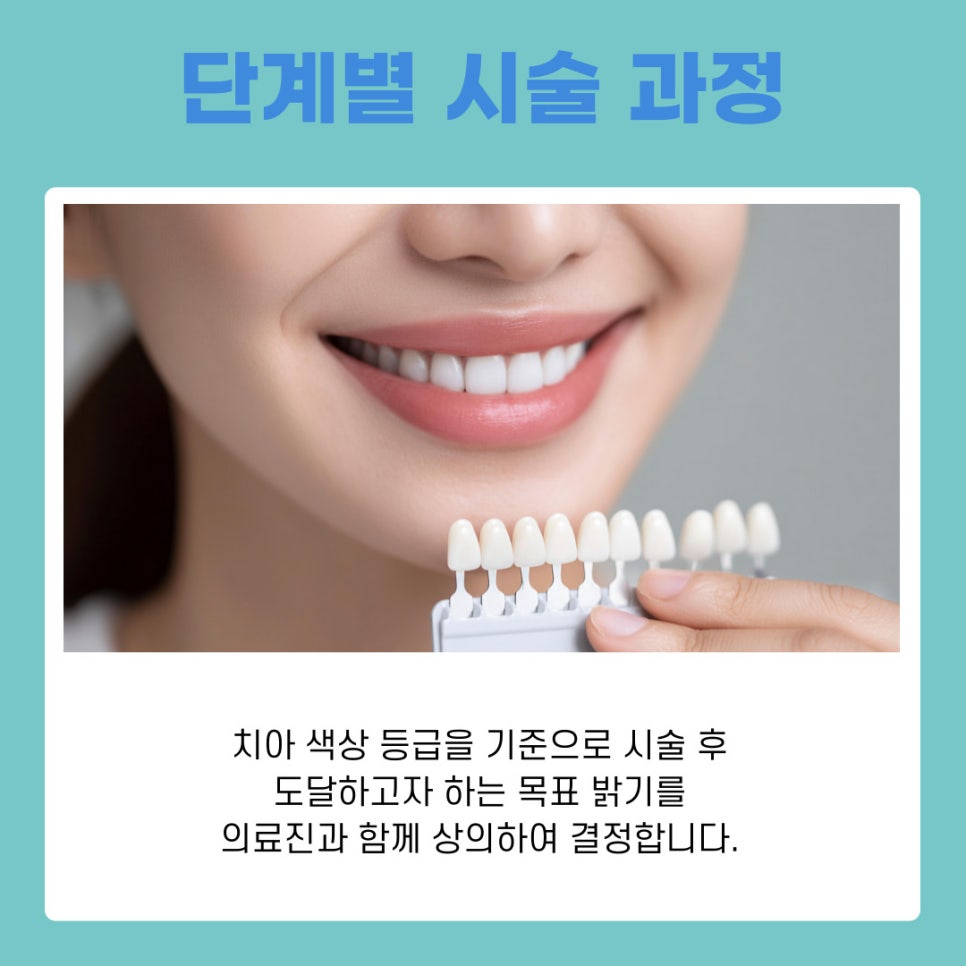
A thorough oral examination and color measurement are performed. Before treatment, the patient’s current tooth discoloration is precisely assessed, and the target brightness to be achieved after treatment is decided in consultation with the medical staff based on the current tooth shade level.
At this time, if severe cavities or gingival inflammation are found, the whitening agent may penetrate and cause severe pain or side effects. Therefore, it is advisable to treat cavities and gums first before proceeding with whitening.

If tartar, plaque, or extrinsic staining substances have built up thickly on the tooth surface, the whitening agent may not be absorbed evenly, resulting in patchy whitening.
Therefore, before the main procedure, scaling is performed to clean the tooth surface and create a clean environment where the agent can react evenly.
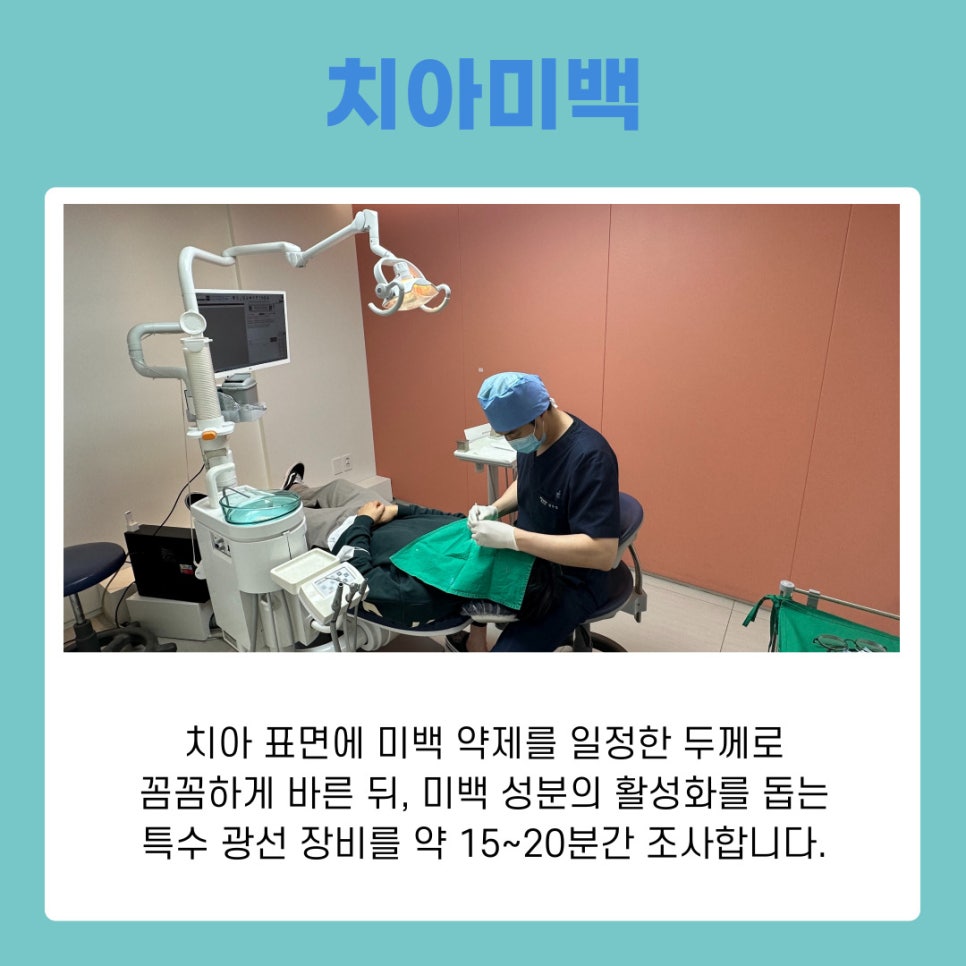
After carefully applying a special protective gel along the gum line and hardening it with a light-curing unit, the gums are completely blocked from the whitening agent.
Once preparation is complete, the whitening agent is carefully applied to the tooth surface in an even thickness, and a special light device that helps activate the whitening ingredients is applied for about 15 to 20 minutes.
When the planned number of treatment sessions is complete, the gum protectant and whitening agent are thoroughly washed away and removed. Afterward, the results are concluded by directly checking how much clearer and whiter the teeth have improved compared with the shade guide measured at the beginning.
Sensitivity After Treatment
This is a very natural and normal phenomenon that occurs because, during the process in which the whitening agent penetrates into the tooth, tiny channels connected to the nerves inside the tooth temporarily open and become easily stimulated.
In most cases, the symptoms naturally disappear within 24 to 48 hours after the procedure, so there is no need to worry too much.
Q. If whitening treatment is performed frequently, will the teeth become weak or damaged?
A. Many people worry that using whitening agents may corrode or thin the outer surface of the teeth and harm their health.
However, officially approved professional whitening agents do not damage or shave down the physical structure of the teeth. They selectively oxidize and break down only the organic staining substances attached inside.
Therefore, if the treatment is performed under the exact diagnosis of dental medical staff while following the specified dosage and the correct procedure, side effects such as weakness or damage rarely occur, so you can receive treatment with peace of mind.