The term “binary” surgery may still sound unfamiliar, since it is not yet a commonly used surgical name.
However, because it is a newly devised operation with sufficient clinical validation, has been accepted as a paper, and is soon to be published, I thought it would now be appropriate to open it up and introduce it.
Binary surgery is the name of a procedure meaning “Bidirectional Narrowing of Forehead and Lifting of Eyebrow,” and it is a surgical name for which we have completed trademark registration.
Its meaning is surgery that lowers the hairline to improve a broad forehead, while at the same time lifting a sagging eyebrow.
Simply put, it is a surgical method that performs “forehead reduction” and “eyebrow lift” at the same time.
The Background Behind the Birth of Binary Surgery
To explain the background of the binary surgery method, I think I need to tell you a somewhat long story that I actually experienced.
This is a story about an experience and a connection that are important and precious to me in many ways.
8 years ago, a young woman came to see me for lower eyelid fat removal. She had a pretty, somewhat aloof-looking face, but her personality was very easygoing and tomboyish.
Because she was young, it was a relatively simple and common procedure with a high satisfaction rate to remove the lower eyelid fat through the conjunctiva. She was extremely satisfied with the result, and introduced several people around her.
About a year later, she said she wanted facial contouring surgery and endoscopic eyebrow lifting. I tried to dissuade her, saying that facial contouring probably was not necessary, but she insisted on having it, so we performed facial contouring surgery and an endoscopic eyebrow lift.
Since the distance between the eyebrows and the upper eyelids was somewhat narrow, I thought this could be a good indication for an endoscopic eyebrow lift.
About 3 years after the endoscopic eyebrow lift and facial contouring surgery, she came back for a consultation.
Her forehead had originally been rather broad, but she said that after the endoscopic eyebrow lift, the hairline seemed to have moved even higher, and she wanted to narrow her forehead.
At that time, neither I nor our clinic was doing hair transplantation or forehead reduction, so I referred her to a hair transplantation clinic run by a friend of mine.
However, my friend, who consulted her about hairline hair transplantation at the hair transplantation clinic, said that forehead reduction would be better than hair transplantation, and in the end she came back to me.
At that point, I had never performed forehead reduction surgery before, so I was in a very difficult position.
From here, I will briefly describe it in dialogue form.
A: Doctor~~~ They said my forehead is too wide for hair transplantation, so it would be better to do forehead reduction!
Me: Ah~~~I have never done forehead reduction surgery before ㅠㅠㅠ
A: ㅠㅠㅠ ~ But you do know the procedure, right???
Me: I know the theory, but I’ve never actually done itㅠㅠㅠ
A: Then try it on me!!!
Me: Ah```this is really difficultㅠㅠㅠ A surgery I’ve never done before...ㅠㅠㅠ
A: It’s okay~ Please try it!!!
And that is how I ended up doing forehead reduction for the first time in my life.
Of course, I had nearly 15 years of experience with open forehead lift surgery, so there was nothing I was particularly worried about.
Since the distance from the eyebrow to the hairline was about 8 cm, I decided on a position to lower it by about 17 mm, removed the skin, dissected backward, and carefully finished the operation.
The surgery ended much more simply than expected.
A week after surgery, after removing all sutures from the forehead incision,
A: I think the surgery went really well~ I’m truly satisfied.
Me: That’s a relief~ The surgical process was very simple and clean, so I don’t think we need to worry too much about the recovery^^
At the 2-week follow-up,
A: Doctor~~~ This surgery is absolutely amazing!!! Please change specialties!!! I think you should specialize in forehead reduction rather than facial contouring!!!
Me: ......
Up to this point, things were good......
3 months later,
A: Doctor~~~ My eyebrows are so raised that I look stupid ㅠㅠㅠ The narrowed forehead and the surgical scar are very good though...
Me: Don’t worry~ Your eyebrows will come down soon! Since I didn’t dissect toward the forehead at all from the incision site and only dissected upward, the eyebrows will come down over time!
6 months later,
A: Doctor~~~ My eyebrows still haven’t come down ㅠㅠㅠ
Me: Let’s wait a little longer...
1 year later,
A: Doctor~~~~ My eyebrows still haven’t come down!!!! ㅠㅠㅠㅠ
Me: I didn’t even dissect toward the forehead, so why aren’t they coming down ㅠㅠㅠ
Even after 2 years, the eyebrows still had not come down.
So, as a last resort, we even injected Botox into the eyebrows and forehead....ㅠㅠㅠ
Going through this process, I reflected on it.
What exactly was the cause????
In the end, when I previously performed the endoscopic eyebrow lift, I had released the periosteum holding the eyebrow area in place, so once the forehead skin was removed and tension became tight, the eyebrows ended up lifting even more.
Based on that experience, when a patient has sagging eyebrows and wants forehead reduction, I tried a method in which part of the forehead side is dissected toward the eyebrows, while the area above the hairline is dissected outward, and obtained good results and good postoperative progress photos.
Based on these experiences, I organized many accumulated cases and submitted them as a paper on a new technique to an international academic journal, where it was accepted and publication was decided.
Binary Surgery Design and Schematic Diagrams According to Hairline Appearance
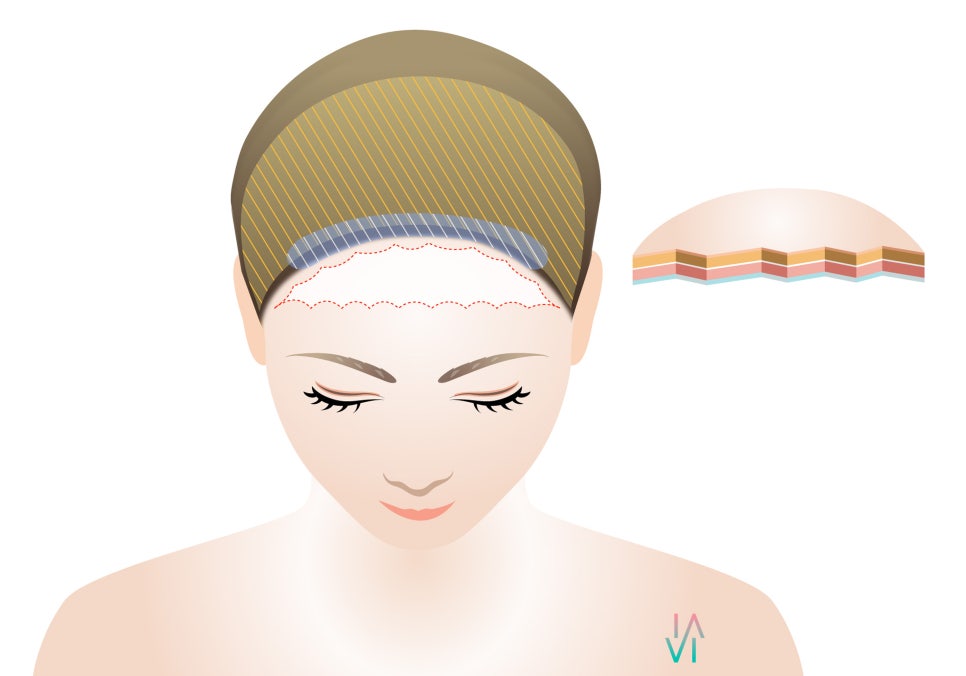
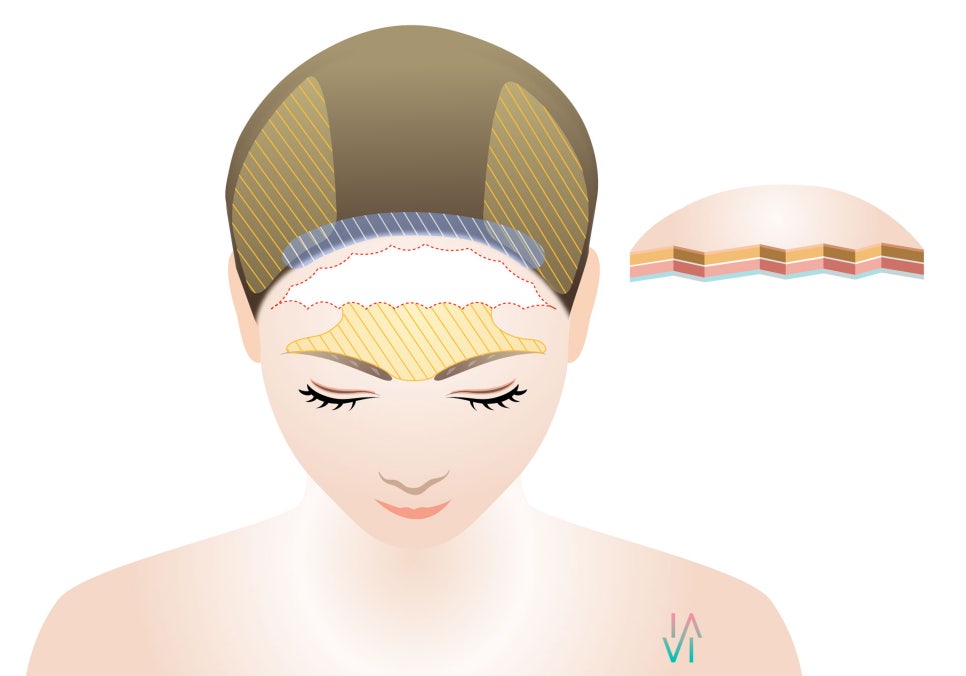
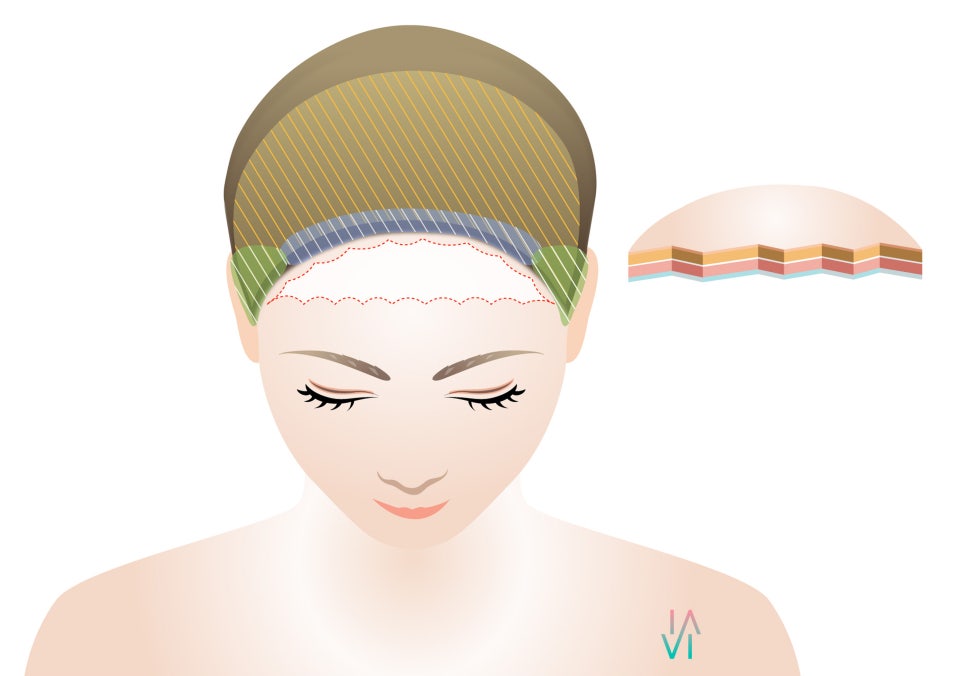
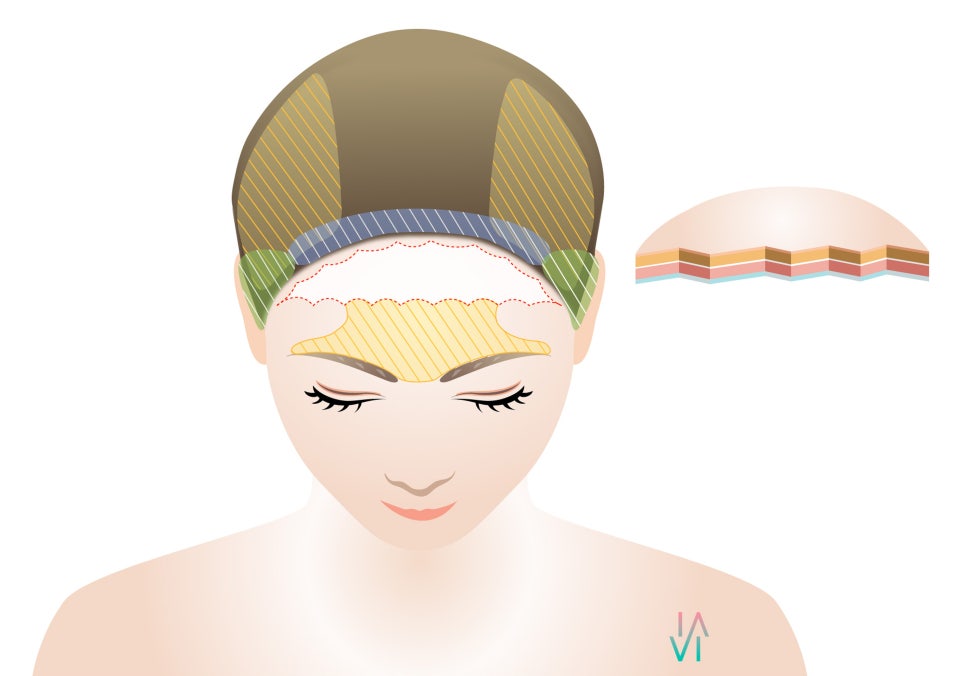
Binary surgery was recently accepted as a paper after one year of verifying photos and outcomes from several cases that had been operated on previously.
Therefore, since it has not been officially opened to academic societies or externally, it may be an unfamiliar surgery.
Many people who come to consult with me ask somewhat skeptically:
“Why is a surgery called binary not being performed anywhere else???”
I don’t really have a special answer to giveㅠㅠㅠ
Thinking back,
- There was someone who trusted me and entrusted me with a surgery that was my first time, based on trust.
- I was able to directly observe long-term follow-up for a long period of time.
- More than simply good results, it seems that new techniques are born and developed through the process of worrying while dealing with complaints arising from unexpected outcomes.
That may be how new techniques are born and develop.