Everyone goes through the aging process as they grow older.
Compared with the past, biological life expectancy has increased, and as the proportion of older adults in economic activity has risen, interest in ways to slow the aging process has also increased.
According to Statistics Korea’s “Results of the May 2019 Economically Active Population Survey Supplementary Survey of Older Persons,” the population aged 55 to 79 was found to have increased by 3% from the previous year. In other words, older adults account for 31% of the population aged 15 and over, which is counted as the economically active population.
However, since the concept of age has become much more diverse in modern society, it can be said that using biological age as a standard for social activity is somewhat unreasonable.
In the past, only chronological age was used as the 기준, but concepts such as physiological age and psychological age began to be added and supplemented.
"Chronological age" is based entirely on the passage of time, and has the limitation of not considering each individual's health-related variables.
"Biological age" represents the physical changes that come with aging. These physical changes can differ from person to person. Some people show age-related physical changes more quickly, while others experience slower physical aging compared with their chronological age.
"Psychological age" is based on how people behave and feel. For example, an 80-year-old person who works, plans, looks forward to future events, and participates in various activities is considered psychologically young.
While chronological age is a condition that cannot be changed no matter how hard we try, biological age and psychological age are areas that can be changed sufficiently through our efforts.
To slow the aging process in terms of biological age and find ways to maintain youth, it is important to first understand the causes and characteristics of aging that occur in the body.
Chronological age cannot be changed, but physiological age and psychological age can be adjusted to a considerable extent depending on one’s efforts.
Among the methods for keeping physiological age, also commonly called body age, young, interest in the face, which is the first place where aging becomes noticeable, is greatest.
The characteristics of aging that appear on the face can be summarized as follows.
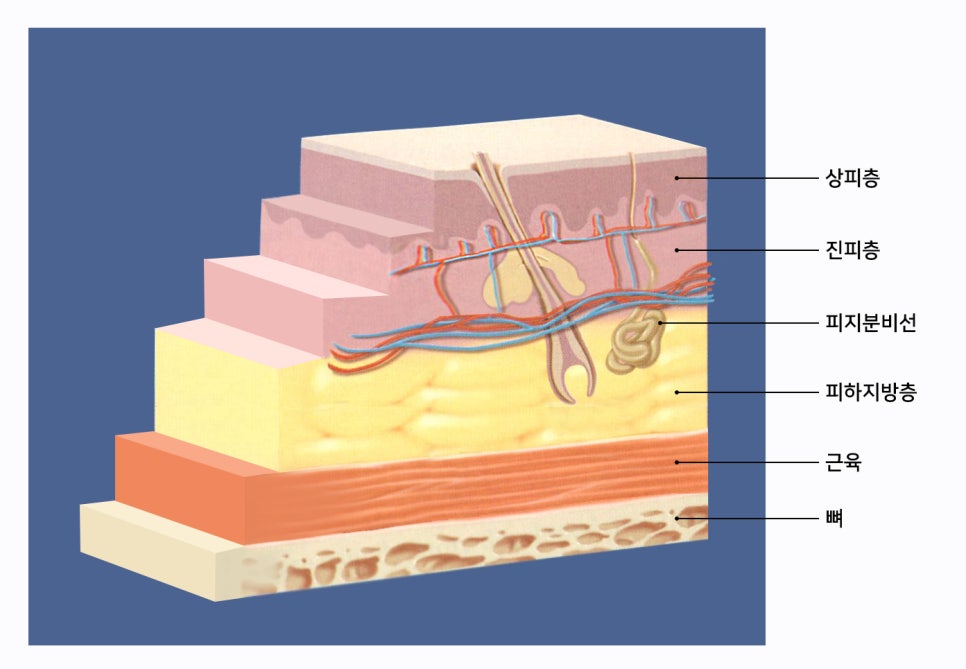
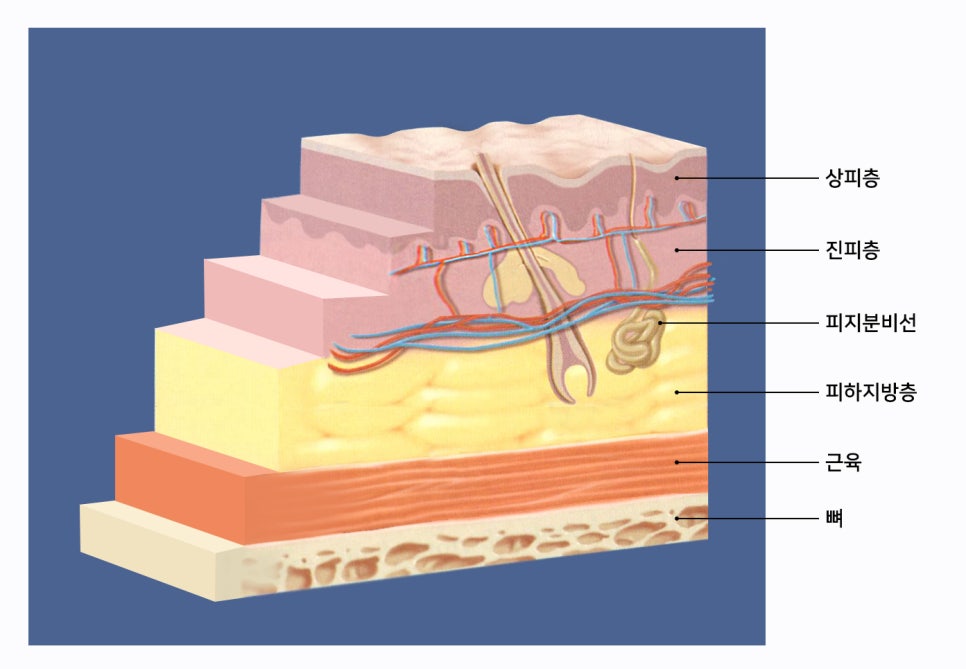
First, decreased secretion from the sebaceous glands inside the skin causes dryness. Second, repeated exposure to sunlight (ultraviolet rays) begins to form fine wrinkles. Third, changes in collagen and elastic fibers within the dermis gradually reduce skin elasticity. Fourth, the structures that support the skin (retaining ligaments, etc.) weaken, causing the facial skin to sag downward under the influence of gravity. Fifth, the decrease in the subcutaneous fat layer, which was firm and full when young, causes the cheeks to hollow and look gaunt.

Preventive methods
To prevent the skin from becoming dry due to reduced secretion from the sebaceous glands, 꾸준히 관리하는 것이 피부의 노화를 예방하는 데 도움이 되며, using moisturizers and various functional cosmetics can be considered. To prevent fine wrinkles caused by repeated sun exposure, the use of sunscreen and similar products is helpful.
As a way to supplement changes in collagen fibers and elastic fibers within the dermis, treatment by injecting skin boosters is helpful. A skin booster is a method of injecting into the dermis to supplement the components of connective tissue, and it plays a role in improving skin elasticity and tone.

Therapeutic methods
Therapeutic methods for improving wrinkles that have already formed can be thought of as being divided into "injection therapy," "simple procedures," and "surgery through skin incision."
The characteristics of aging that appear on the face can include sagging skin, deep wrinkles, and fine wrinkles. Fine wrinkles are typically caused by continuous ultraviolet exposure and the repeated use of facial muscles over a long period of time. To prevent fine wrinkles, there are methods such as blocking ultraviolet rays and a "Botox injection procedure" that reduces excessive use of facial muscles.
Deep wrinkles such as nasolabial folds or marionette lines around the bulldog jowls are caused by sagging skin, and the weakening of retaining ligaments that once withstood the effects of gravity can be considered the cause.
If the skin’s elasticity decreases and it begins to sag gradually, using "ultrasound lasers and radiofrequency lasers" to enhance the elasticity of the dermis, subcutaneous fat layer, and fascial layer can provide some preventive and improvement effects, but the effects last only about 6 months to 1 year.
If the cheeks look hollow due to a decrease in the subcutaneous fat layer and appear tired and older, methods such as "autologous fat grafting" or "filler injections" can help restore the missing volume.
Autologous fat grafting is a method of suctioning fat tissue from another part of one’s own body and injecting it; some of it is absorbed, but the fat that survives remains.
What should be noted in filler injection procedures is that, in the case of safe fillers, most are absorbed within one year, and fillers that remain in the body for a long time are more likely to cause other problems, so special caution is required.
If the sagging of the skin is not severe, a method of pulling the dermis, subcutaneous fat layer, and fascial area from the inside of the skin using threads may be helpful.
If the nasolabial folds and marionette lines have become somewhat deep due to sagging skin, it is necessary to consider a "facelift," which removes part of the sagging skin and tightens the fascial (SMAS) layer.
When performing a facelift, it is also effective to do liposuction in areas where fat has sagged and appears bulging, and to perform fat grafting in areas that have hollowed out.
The duration of facelift results is generally about 5 to 10 years, and if the skin sags again as time passes after surgery, it is entirely possible to perform another surgery to remove part of the sagging skin and tighten it a little more.

According to the American Society of Plastic Surgeons, the number of facelift procedures in 2020 increased by 75% compared with 2000.
In March 1995, the American Academy of Cosmetic Surgery held a landmark academic event in the field of facelift surgery.
It was an attempt to compare the results of surgeons with different source techniques (surgical methods) for facelifts according to their own methods. The process involved four board-certified plastic surgeons operating on two pairs of identical twins (a total of four people) using their own surgical methods. The surgery was broadcast live to all the plastic surgeons gathered at the conference, and the plan was to compare and verify the outcomes over time afterward. More than 10 years after the first surgery, the long journey was concluded by publishing preoperative and postoperative photos from 1 year, 6 years, and 10 years after surgery in a 2009 journal of international plastic surgery.
In the end, the results of the surgical competition by four verified plastic surgeons on identical twins were published as a paper 14 years later, and because cosmetic surgery does not allow for objective criteria for evaluating results, the conclusion was to leave the judgment to readers by showing photos from 1, 6, and 10 years after surgery.
At that time, the four surgeons each used different methods, and each had published multiple papers stating that their own method would be the most effective for facelift surgery.
Of course, the paper also introduced each surgeon’s views and interpretations regarding the long-term follow-up results after surgery.
Evaluations from doctors with extensive experience and recognition in the field of cosmetic plastic surgery, although they did not directly participate in the surgery, were also included.
When looking at the 10-year follow-up photos of the two pairs of identical twins who were operated on using different methods by the four surgeons, they still looked younger in the 10-year photos compared with their preoperative appearance, but there was no significant difference depending on the surgical method.
The conclusion was that the most important part of a facelift is not finding a more effective method, but rather considering how to minimize side effects and complications.
Preventing the aging process and managing it consistently is more important than anything else, and if surgical improvement is being considered, choosing a proven and safe method is most important.