Zygoma reduction surgery aims to reduce the width of the face when the midface contour appears somewhat prominent, while also softly improving the contour of the front cheekbone that protrudes beneath the eyes.
However, if the face becomes more flat after zygoma surgery, it is necessary to consider the method by which the surgery was performed.
As someone who focuses most intensively on facial contour surgery, I always see consultations for revision facial contour surgery from people with various concerns.
Although people consider revision surgery for many different reasons, when I listen to those considering revision zygoma surgery and analyze the condition of the bone,
I often think that, in many cases, the cause lies in the method used for the zygoma surgery.
What is a trapezoid face shape???
First, let me explain what is meant by a trapezoid face shape.
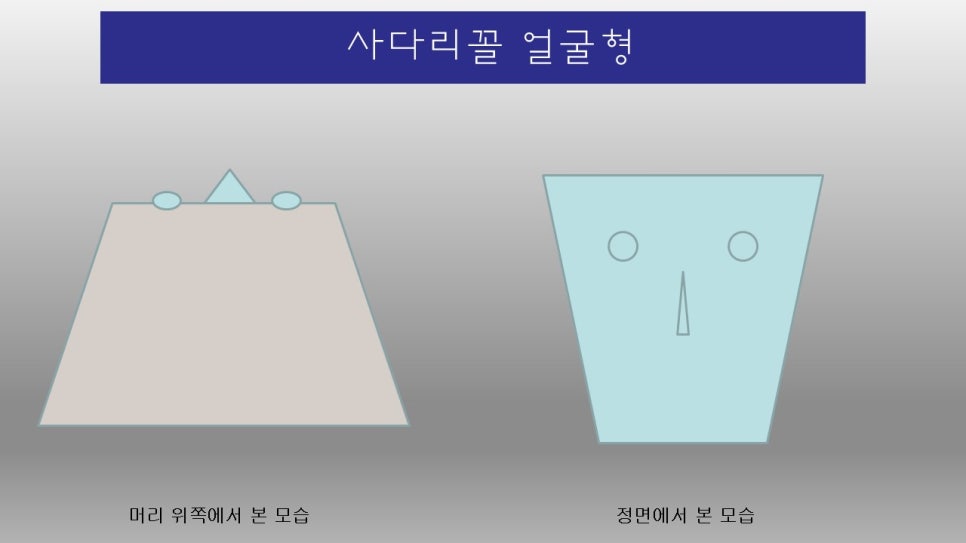
This is a somewhat awkwardly drawn schematic (haha),
A trapezoid face shape refers to a face shape that, when viewed from the front,
widens from the front toward the back — for better understanding in a flat illustration, please refer to the view from the top of the head — and at the same time,
when viewed from the front, means a face shape that is wide at the top and becomes narrower toward the bottom.
If surgery causes the face to change into this shape,
compared to before surgery, the face loses its three-dimensionality and becomes flatter, and
although the front cheekbone area is reduced, the pattern of widening toward the back can create an optical illusion that makes the face appear wider.
A trapezoid face shape that occurs after trapezoid resection...ㅠㅠㅠ
If, after zygoma surgery, the face becomes a trapezoid shape like the one described above, it is necessary to understand how the surgery was performed.
The 3D animation above is a video comparing zygoma surgery methods.
The left side shows the changes in the zygomatic bone when the surgery is performed by moving the broad posterior zygoma as far inward as possible without cutting the front cheekbone area,
while the right side shows the changes in the bone when the surgery is performed by cutting part of the front cheekbone into a trapezoid shape, moving it inward, and fixing the front and back.
As shown in the comparison video above,
if surgery is performed by cutting the front of the zygomatic bone into a trapezoid shape, moving the bone, and performing double fixation of the front and back,
compared with before surgery, the face may lose three-dimensionality and visually appear wider toward the back.
In conclusion,
in order to change prominent cheekbones into a three-dimensional shape and achieve a younger, more lively image,
an appropriate surgical method is necessary.
If,
the direction of the surgery is carried out in the wrong way,
it is because the face can lose its three-dimensionality and change into one that looks older.