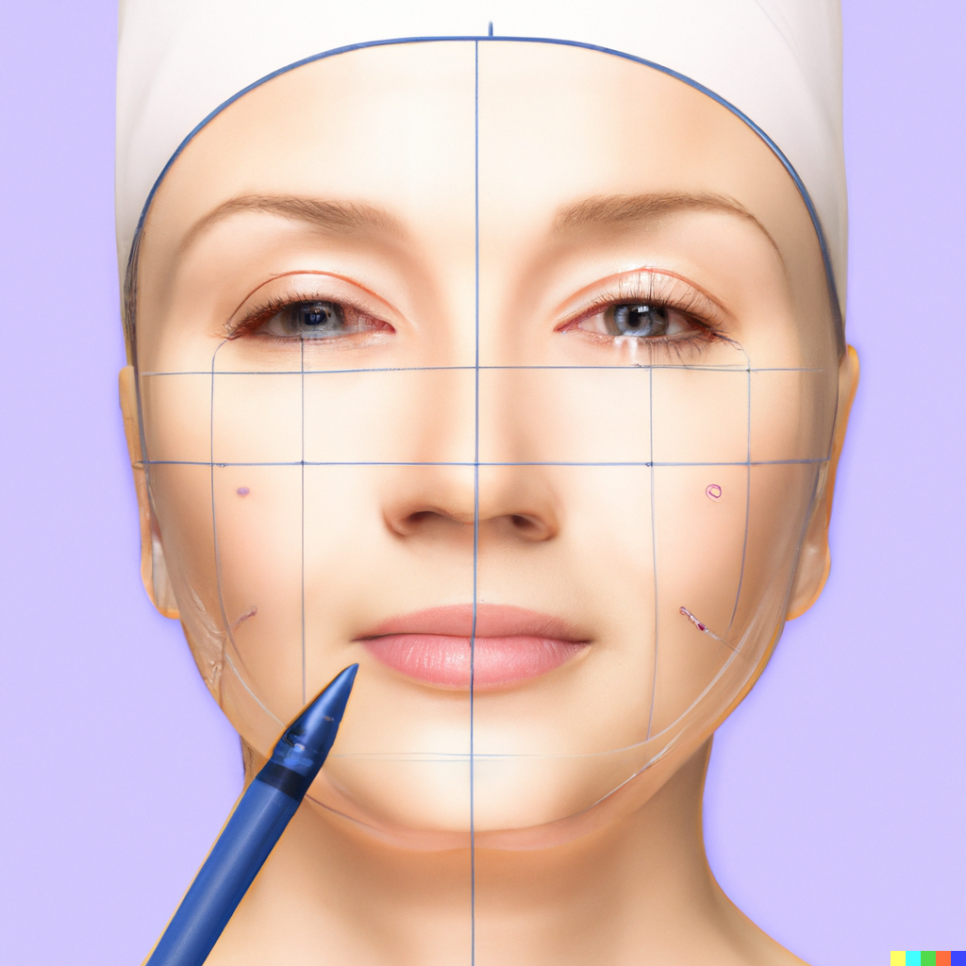
Cheekbone reduction surgery aims to reduce the width of the face when the midface contour appears somewhat prominent, while also gently improving the contour of the cheekbone area that protrudes below the eyes.
�
As I listen to the expressions used by people who come in for consultations about improving facial contour, I find myself thinking about many new concepts.
�
For example,
People who come in for consultations may say...
"I’m worried that I’ll end up with a mantis face shape after cheekbone surgeryㅠㅠㅠ"
Or,
They draw a picture by hand right in front of me and say,
"I’m worried that I’ll end up with a face shape like patterned earthenwareㅠㅠㅠ"
There are often people who say things like this.
�
Among them, quite a few people came in for revision surgery consultations because after having cheekbone surgery elsewhere,
they ended up with a mantis-like face shape or a patterned earthenware-like face shape, and they wanted to improve that area.
�
�
After speaking with so many people, I felt that it was necessary to revisit what exactly a "mantis face shape" or a "patterned earthenware face shape" means, and also to look at why there is concern that such a face shape may result after cheekbone surgery.
In addition, I will explain whether it is possible to improve such a face shape through revision surgery if it does end up that way after cheekbone surgery.
�
First, it would be helpful to understand what kind of face shape these are by looking at images of a mantis and patterned earthenware.
 Mantis face
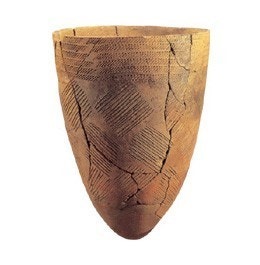 Patterned earthenware
As shown in the two images above, the common characteristic of a "mantis face" and "patterned earthenware" can be described as an "inverted triangle face."
It refers to a face shape that is wide in the midface, including the temples, and becomes narrower toward the lower part.
Of course, this can be described in a two-dimensional image viewed from the front, but if examined more three-dimensionally, it can also refer to a face shape that is wide in the back and becomes narrower toward the front.
Before explaining why there is a risk that a face shape like the inverted triangle above may appear after cheekbone surgery, it would be helpful to briefly organize the basic concept of cheekbone surgery first.
�
�
As shown in the CT image below, the cheekbone consists of the body (blue circle) and the arch (zygomatic arch, red circle).
The arch of the cheekbone has a structure that widens from the front to the back.
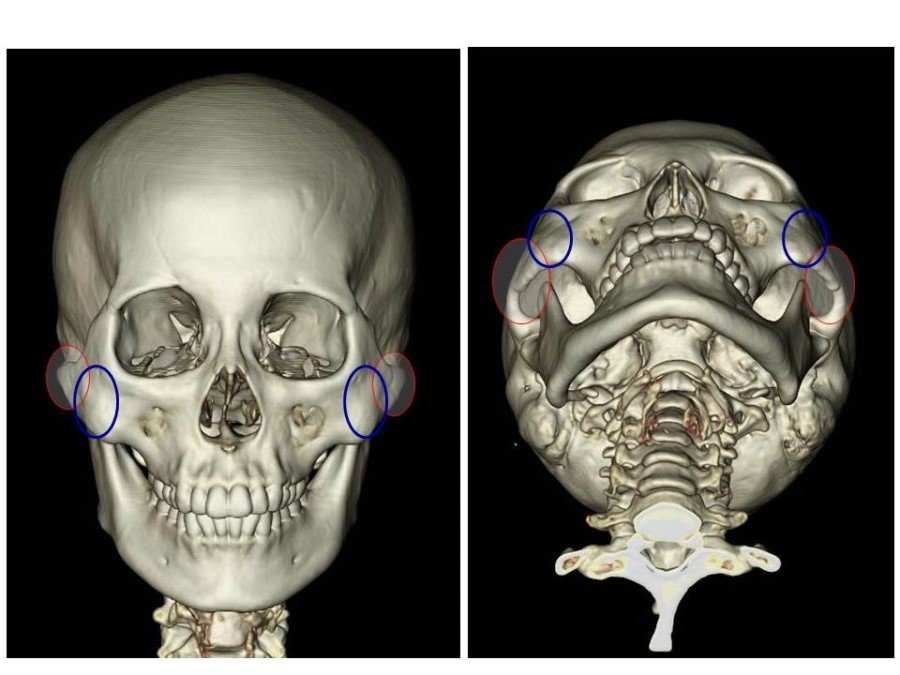
In a surgical method that reduces the contour of the cheekbone, if we want to reduce the width of the face when viewed from the front while preserving its three-dimensional appearance, we need to rotate the cheekbone arch, which widens toward the back, and move it inward.
�
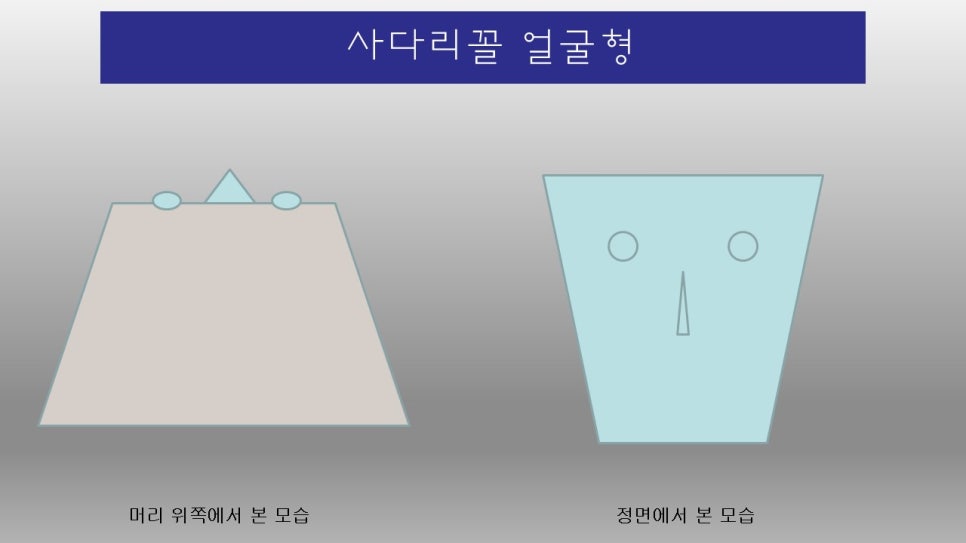
However, if surgery is performed by cutting out the cheekbone body, which is responsible for the front contour of the cheekbone, in a trapezoidal shape and fixing it in place, the front cheekbone will be reduced, but the contour of the cheekbone that widens toward the back will not be improved. As a result, the face after surgery may become flatter, and the front cheek area may often appear to sag downward.
�
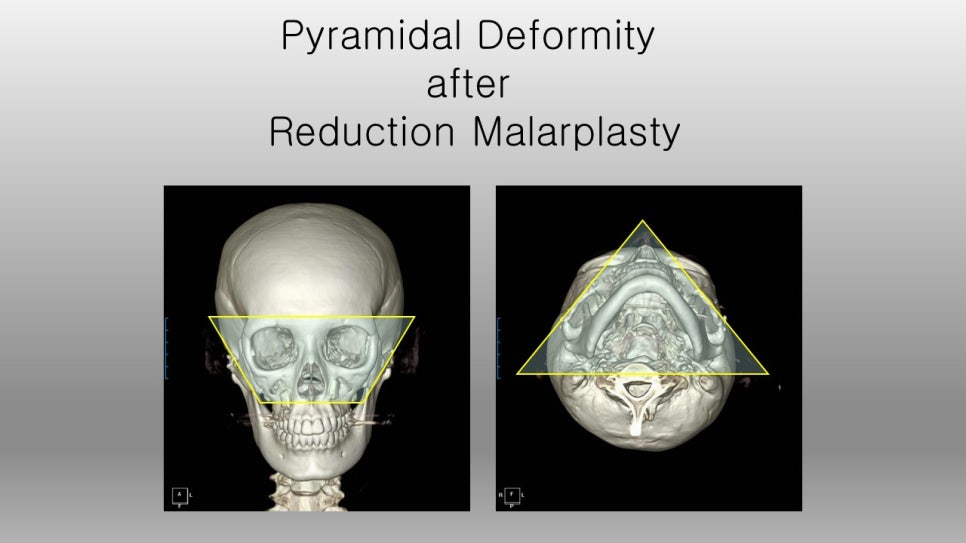 Inverted triangle appearance that occurs when the front cheekbone is cut down and reduced
To explain it with a more easy-to-understand diagram, this can unfortunately result in a trapezoidal (or inverted triangle) face shape like the one below.
�
In the 3D simulation below, the cheekbone area on the right shows surgery performed by resecting the body in a trapezoidal shape and using double fixation, while the cheekbone area on the left shows surgery performed by preserving the continuity of the cheekbone body and rotating and fixing the side cheekbone, including the posterior cheekbone.