Why do many people complain of a “broad, flat look” and a “loss of dimensionality” after conventional zygomatic reduction surgery?

Many patients expect their face to become smaller after cheekbone surgery, but after undergoing the commonly performed zygomatic reduction method (a technique that completely removes part of the bone), they instead feel dissatisfied and decide to undergo revision surgery. The main reasons are as follows.
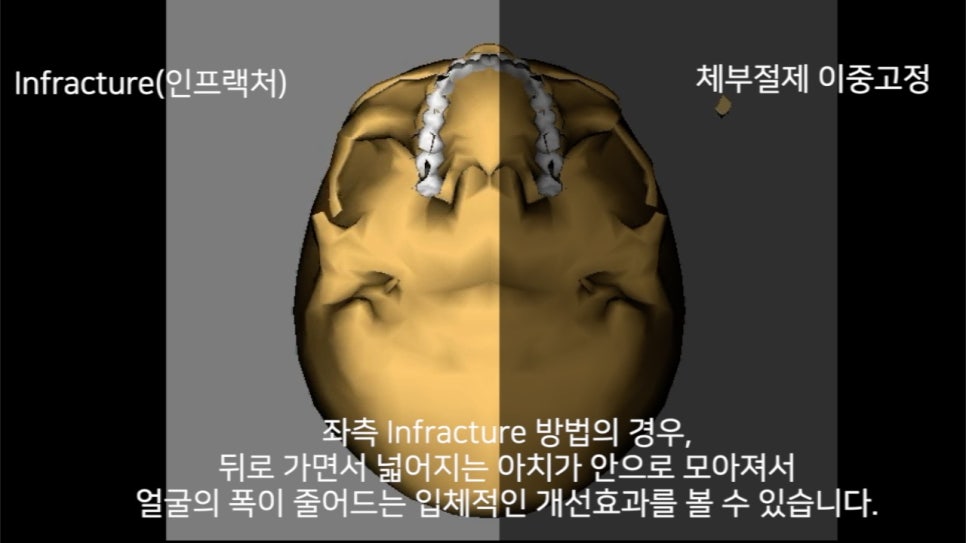
First, let’s understand the differences in zygomatic reduction methods through a 3D simulation video.
- Limitations of frontal width reduction and the “broad, flat look”
The widely used zygomatic reduction method often focuses on cutting and fixing the bone in the front cheekbone area. In this case, if the “side cheekbone (posterior arch)” area, which actually determines the frontal width of the face, is not effectively reduced, only the central part of the face becomes flatter while the overall width remains the same, making the face appear even wider and flatter.
- Loss of dimensionality due to hollowing of the front cheekbone
A dimensional face is completed when the volume of the front cheekbone is properly maintained while the side line becomes slimmer. However, if too much bone is removed using Method B:
-
Flat face: As the most protruding point of the face disappears, dimensionality is lost and the face looks dull.
-
Shadows and an aged appearance: As the area that should have volume sinks, the surrounding skin may appear to sag, which reduces vitality and makes the face look older.
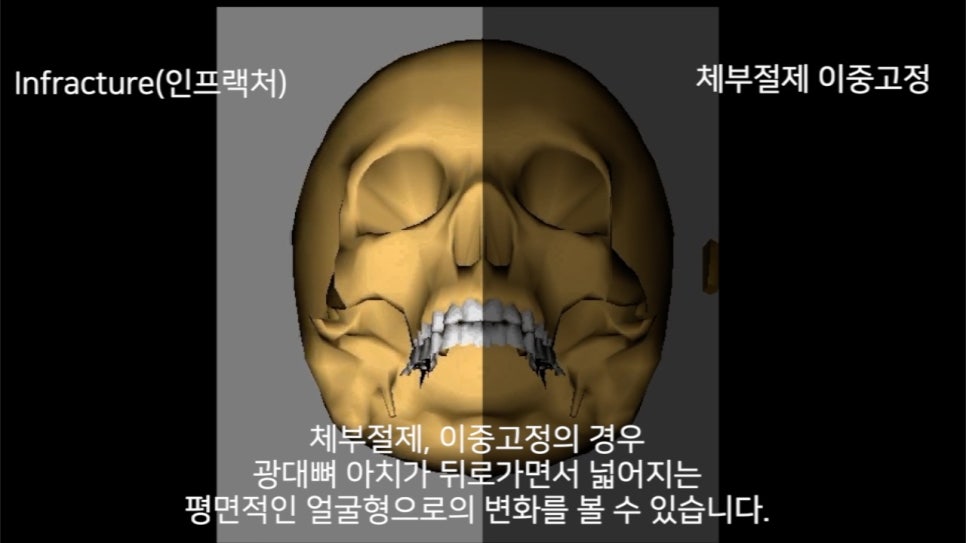
- The occurrence of “pyramidal deformity”
If the front portion becomes narrower but the rear arch area is not properly brought in, the face appears pyramid-shaped when viewed from the front, widening toward the back and significantly lowering aesthetic satisfaction.
A word for those considering revision surgery
“Simply cutting away more bone is not the answer. If you are experiencing a loss of dimensionality and a face that looks larger after Method B, revision approaches such as rotational osteotomy, which readjust the overall curve of the face and the position of the arch, can restore a dimensional and smaller-looking face shape.”
In this post, I briefly introduced the main reasons why people consider revision surgery after zygomatic reduction surgery.
For more detailed content, I will cover the specifics in a separate follow-up post later on.