"Doctor, use me as your Maruta!"
�Hello. Today, I’d like to share a slightly special story. It is about how our hospital’s pride and joy, the ‘Bi-NALI surgery,’ came into the world.
In fact, the name ‘Bi-NALI’ was coined by us and even registered as a trademark, so it’s only natural that it may be unfamiliar at first. This surgery, which was also published as a paper in an international academic journal, began 15 years ago with a ‘reckless promise’ made with one patient.
"I’ll introduce the paper at the very end of the post with a link."
"Forehead reduction? I’ve never done it before..."
15 years ago, a regular patient with a very easygoing personality came to see me. She had already been satisfied after receiving facial contouring surgery and endoscopic brow lift surgery from me. Then one day, she said she was worried about her wide forehead and asked me to perform a ‘forehead reduction surgery.’
At the time, I had no experience with forehead reduction surgery at all. I told her honestly.
Me: "Ah... I’ve never done forehead reduction before, so it would be difficult."
Patient: "Oh come on, with your skill, you know all the methods!"
Me: "I understand the theory, but actual surgery is different. Please go to a place with experience."
Patient: "No! Just try your first surgery on me. I trust you!"
Thanks to the patient’s boundless trust (?), I ended up performing my very first forehead reduction surgery. Fortunately, thanks to the skill I had built over more than 10 years of performing forehead lifts, the surgery went smoothly, and the patient was full of praise, saying, "Amazing! You should change specialties."
But the real incident happened three months later.
"Doctor, my eyebrows won’t come down!"
Three months after the surgery, the patient returned with an unhappy expression.
"My forehead is narrower, but my eyebrows have lifted too much, so I look silly!"
I was flustered. In theory, the eyebrows should have naturally lowered over time. But even after 6 months, 1 year, and even 2 years, the eyebrows remained completely unchanged. Botox did not help either.
I spent day and night thinking and began looking for the cause. I came to one conclusion. The tissue loosened by the ‘endoscopic brow lift’ I had performed on her before had met the tension of the forehead reduction and firmly held the eyebrows upward.
✨ Turning a crisis into an opportunity: the birth of ‘Bi-NALI’
This painful(?) experience became my best teacher. Based on this case, I devoted myself to research.
This surgery is what we call ‘Bi-NALI.’
[Bidirectional Narrowing of Forehead and Lifting of Eyebrow] In other words, it means a bidirectional surgery that narrows the forehead and lifts the eyebrows.
It is not simply about reducing the forehead; it is a technique that addresses forehead reduction and brow lift at the same time while considering the overall facial proportions.
Through numerous clinical results and follow-up observations of more than one year, its effectiveness was proven, and it was finally recognized for its originality at an international conference.
"Why doesn’t any other hospital have this surgery?"
This is a question people often ask during consultations. My answer is this:
-
There was a brave patient who trusted me and let me perform the first surgery,
-
I was able to follow the progress for two long years and think through it together,
-
And because I did not avoid the unexpected result (the complaint), but transformed it into a new technique.
‘Bi-NALI’ is not just the name of a surgery. It is the result of trust between patient and doctor, and the time spent 고민 together. From now on, I will approach you not with unfamiliarity, but with trust. If you are worried about a wide forehead and sagging eyebrows, the answer is ‘Bi-NALI.’
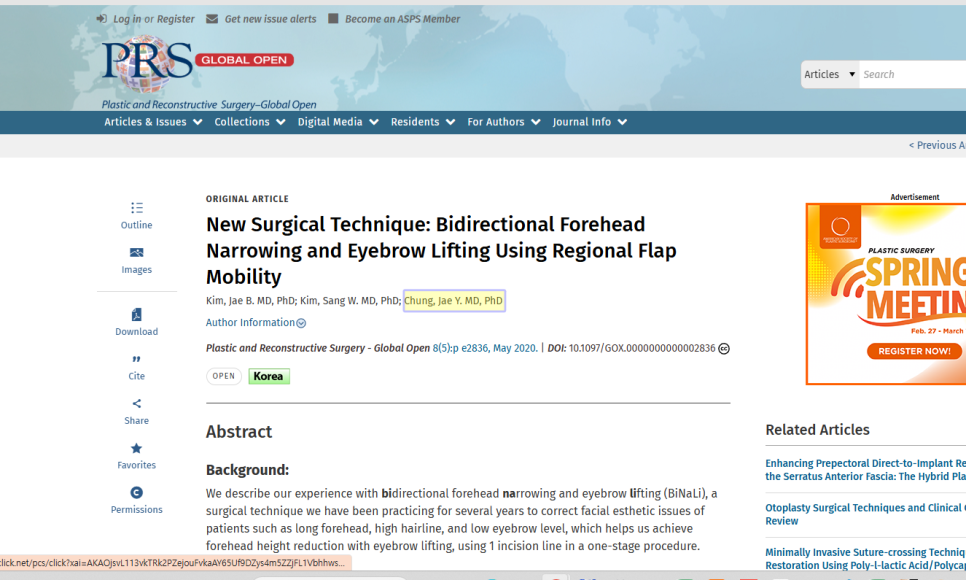
Paper link (https://journals.lww.com/prsgo/fulltext/2020/05000/new_surgical_technique__bidirectional_forehead.10.aspx)