When considering deep buccal fat removal, an understanding of what role deep buccal fat plays in determining facial contours is necessary first.
In other words, it is important to fully understand which areas of your own face are affected by deep buccal fat.
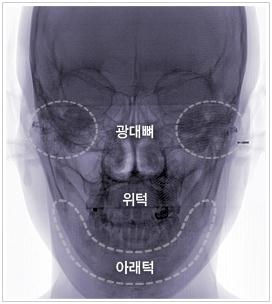
In determining facial contours, the facial bones that establish the foundation of the underlying skeletal structure play an important role, and they are also greatly influenced by the composition and condition of the soft tissue covering the facial bones (muscles, fat, skin, etc.).
In the figure below, the parts shown in black are the contours of the facial bones, and the parts shown in a slightly lighter color are the soft tissue covering the bones (muscles, fat, skin, etc.).
As shown in the figure below, deep buccal fat has a structure that extends from the front of the masticatory muscles covering the angular portion of the lower jaw to the temporal region.
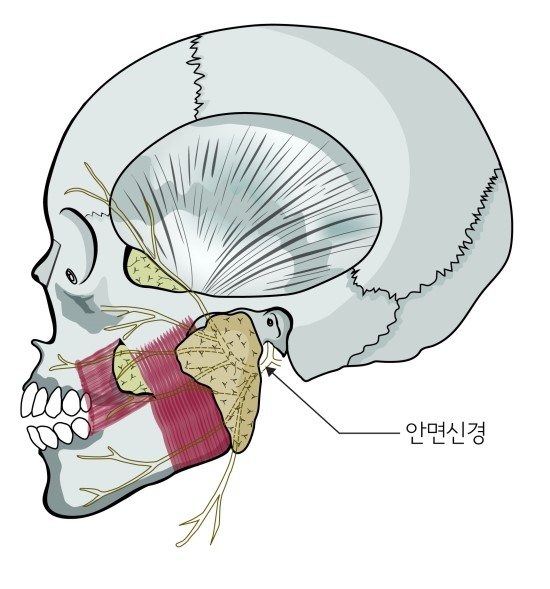
Therefore, it is most accurate to understand deep buccal fat as playing a role in maintaining the full volume of the cheek area outside the lips.
On average, the amount of deep buccal fat on one side is about 9 cc, but there can be significant individual variation.
In a typical deep buccal fat removal procedure, removing about 4 to 5 cc from each side is considered most appropriate.
The area that changes after deep buccal fat removal is the cheek area outside the lips, and if a larger amount is removed, some of the fuller area extending toward the temple may also be reduced to some extent.
However, if the facial bones are angular and well developed, or if the masticatory muscles are overly bulky, making the facial contour appear large, the expected results may not be achieved even after deep buccal fat removal.
If you expect a dramatic change in the front view in photos from deep buccal fat removal, that may be somewhat unrealistic.
This is because, in the front view, the angular area of the lower jawbone behind the deep buccal fat and the role of the masticatory muscles covering that angular area are important.
In conclusion, it is realistic to understand deep buccal fat removal as a procedure to somewhat reduce the fuller area of the cheeks outside the lips, and if the masticatory muscles are developed or the jawbone is developed, appropriate correction according to the condition is necessary.