In the past, people tended to have a negative view of cosmetic procedures, so many would hide the fact that they had undergone plastic surgery.
However, as cosmetic surgery has become more common and more people have come to see appearance as a competitive advantage, perceptions of plastic surgery are also gradually becoming more positive.
As more people seek to improve areas of dissatisfaction with their appearance,
they are increasingly trying to live more confidently.
The areas most commonly preferred by people who want cosmetic surgery are the eyes and nose.
In particular, the nose, located at the center of the face,
is one of the areas that has a major impact on the overall three-dimensionality and balance of the face.
This may be why many people prefer a high nasal bridge and a defined nasal tip when it comes to the shape of the nose.
Although many people decide to have surgery for aesthetic reasons,
the nose also plays an important functional role.
So nose plastic surgery should be carefully decided on and considered, because beyond aesthetics, it can also help improve functional issues such as rhinitis and sinusitis.

Because the nose is a commonly operated-on area,
many people think it is an easy surgery,
but it actually requires planning and execution after considering many different factors.
The approach varies depending on the condition of the nose and the patient’s desired outcome,
and the implant material also differs.
In the case of the nose, even a slight difference can lead to a major change,
so if rhinoplasty is successful, there is a high chance it will help improve the overall image.
However, if someone simply prefers a very high nose without considering their own face shape or facial features,
it may disrupt the overall harmony of the face,
which can lead to later regret.
If, during a primary surgery or a second or later surgery, the nose shape is not properly considered
and the wrong implant is used or the wrong shape is created,
a poor surgical result with minimal improvement is also considered a complication.
These situations can sometimes be resolved through revision surgery,
but because the exact cause of the previous failure must be identified and corrected
in order to create a beautiful nose again,
it is a very delicate process that requires careful selection and decision-making.
It seems you have been looking for a clinic that specializes in rhinoplasty revision in Gangnam because you already know this.
First, in the case of rhinoplasty revision, based on the initial surgery,
it is ideal to plan the procedure after allowing a sufficient recovery period of 6 months to 1 year.
This is because receiving a consultation after everything has fully settled is ideal for identifying the cause.
However, if the pain is severe, if there is a hole in the skin due to infection,
or if a large implant that the skin cannot tolerate has been inserted,
it is best to visit the clinic immediately and receive treatment.

Because the nose is the area that most often undergoes revision surgery,
and because complications are also significant,
for safe and worry-free cosmetic surgery it is necessary to first conduct thorough examinations, analysis, and planning
and then look for a clinic that specializes in rhinoplasty revision in Gangnam.
If you choose a clinic based mainly on cost,
additional revision surgeries may be needed,
so you should carefully check whether the specialist has sufficient know-how and data,
whether they are planning and performing surgery using only appropriate methods,
whether thorough post-operative care is provided,
whether natural results are the top priority,
and whether detailed examinations are carried out using the latest equipment.
Considering these points, I would recommend April 31 Plastic Surgery.
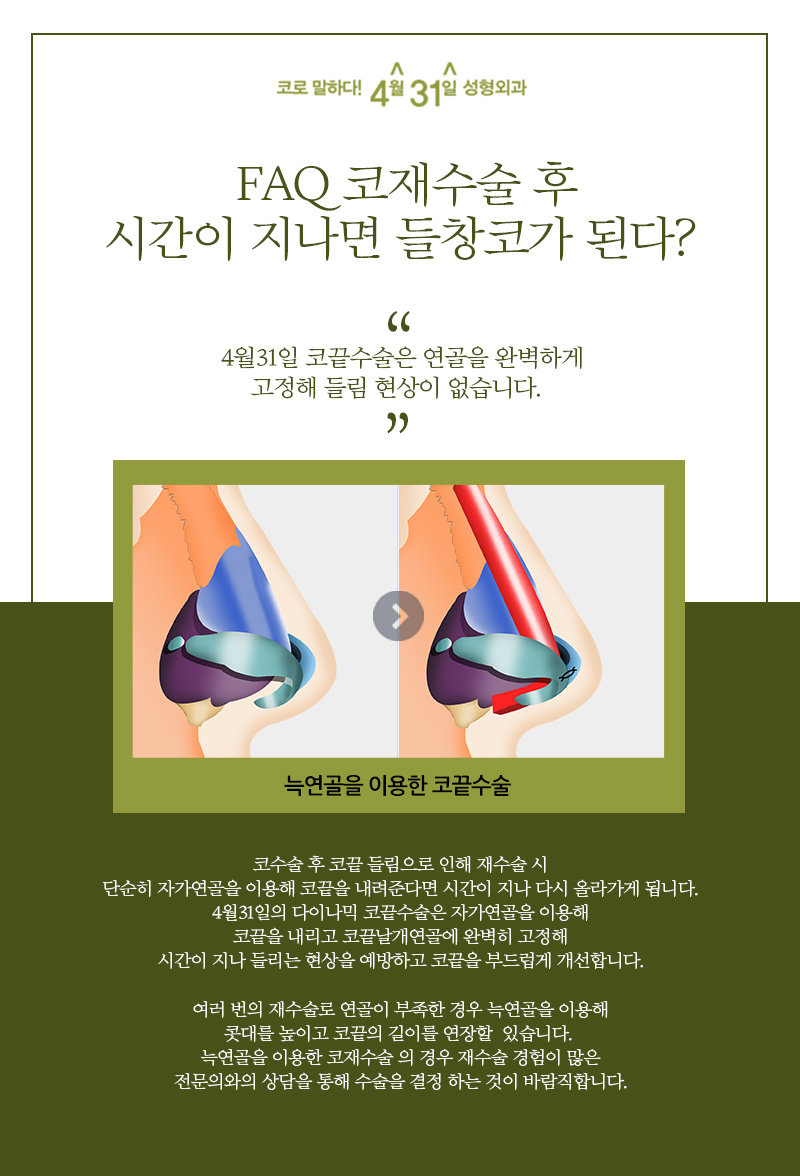
One of the most common issues when considering rhinoplasty revision is contracture, which can cause an upturned nose.
If you simply lower the nasal tip using autologous cartilage during revision surgery for an upturned tip,
there is a risk that it may rise again over time.
The Dynamic Nasal Tip Surgery performed at our clinic uses autologous cartilage to lower the nasal tip and securely fix it to the alar cartilage,
helping prevent re-upturning over time while softly improving the tip.
You may also be concerned about cases where there is a lack of cartilage due to multiple revision surgeries.
In such cases, rib cartilage can be used to raise the nasal bridge and lengthen the nasal tip.
As mentioned earlier, rhinoplasty revision has many different causes.
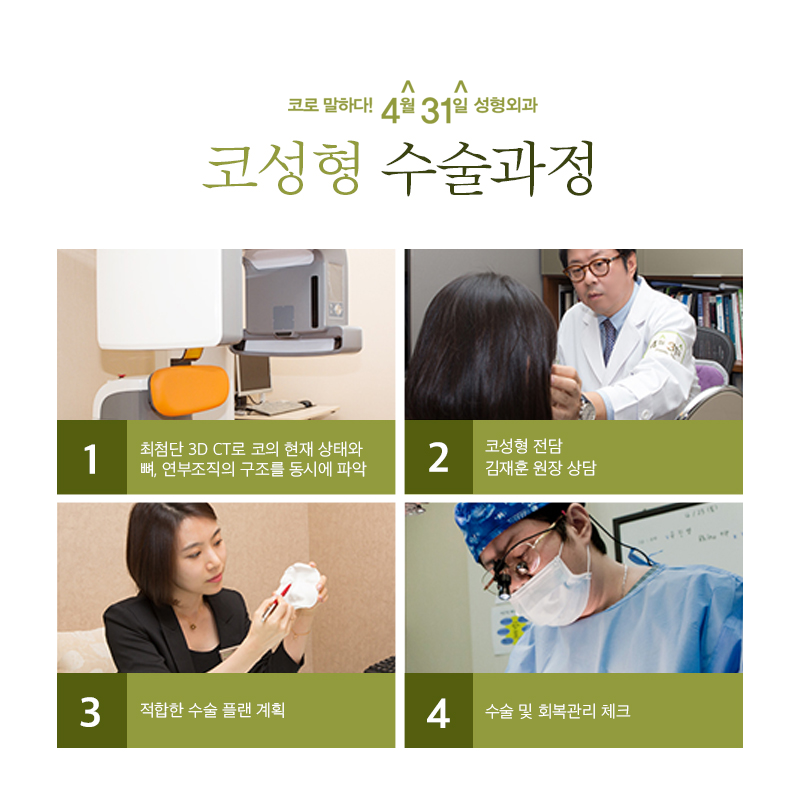
At our clinic, we use advanced 3D-CT to understand the current condition of the nose and the structure of the bone and soft tissue,
and through consultation, we select and carry out the method most appropriate for each cause.
Because rhinoplasty revision is a delicate and difficult surgery,
the medical team’s clinical experience, knowledge, and know-how are extremely important.
To prevent further revision surgeries and avoid complications,
it is advisable to find a plastic surgery specialist with extensive experience in rhinoplasty revision.
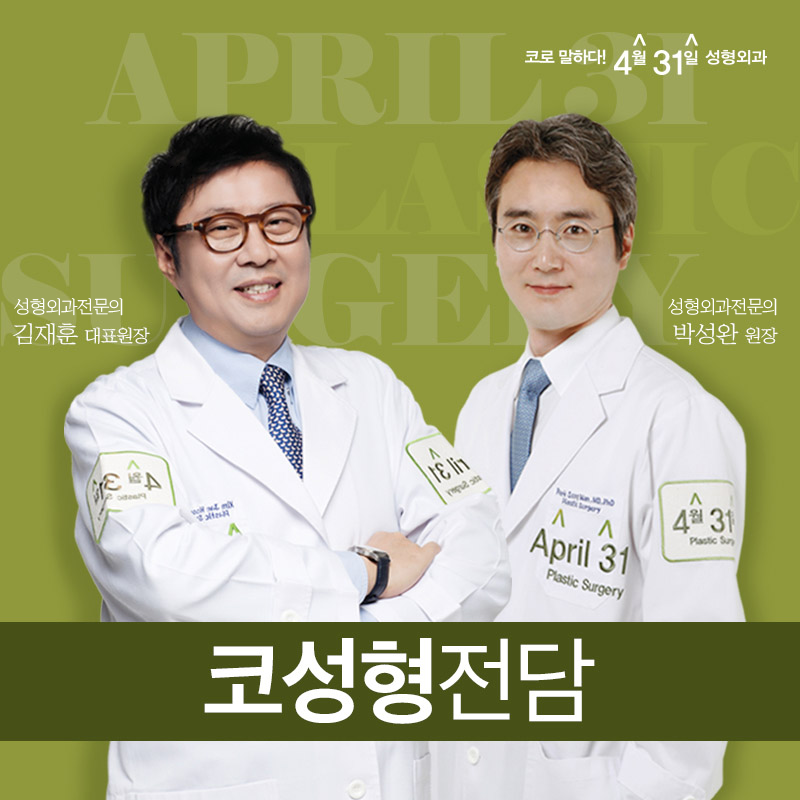
At April 31 Plastic Surgery, Chief Director Kim Jae-hoon, a plastic surgery specialist dedicated to rhinoplasty,
and plastic surgery specialist Director Park Sung-wan
personally oversee everything from consultation to recovery care.
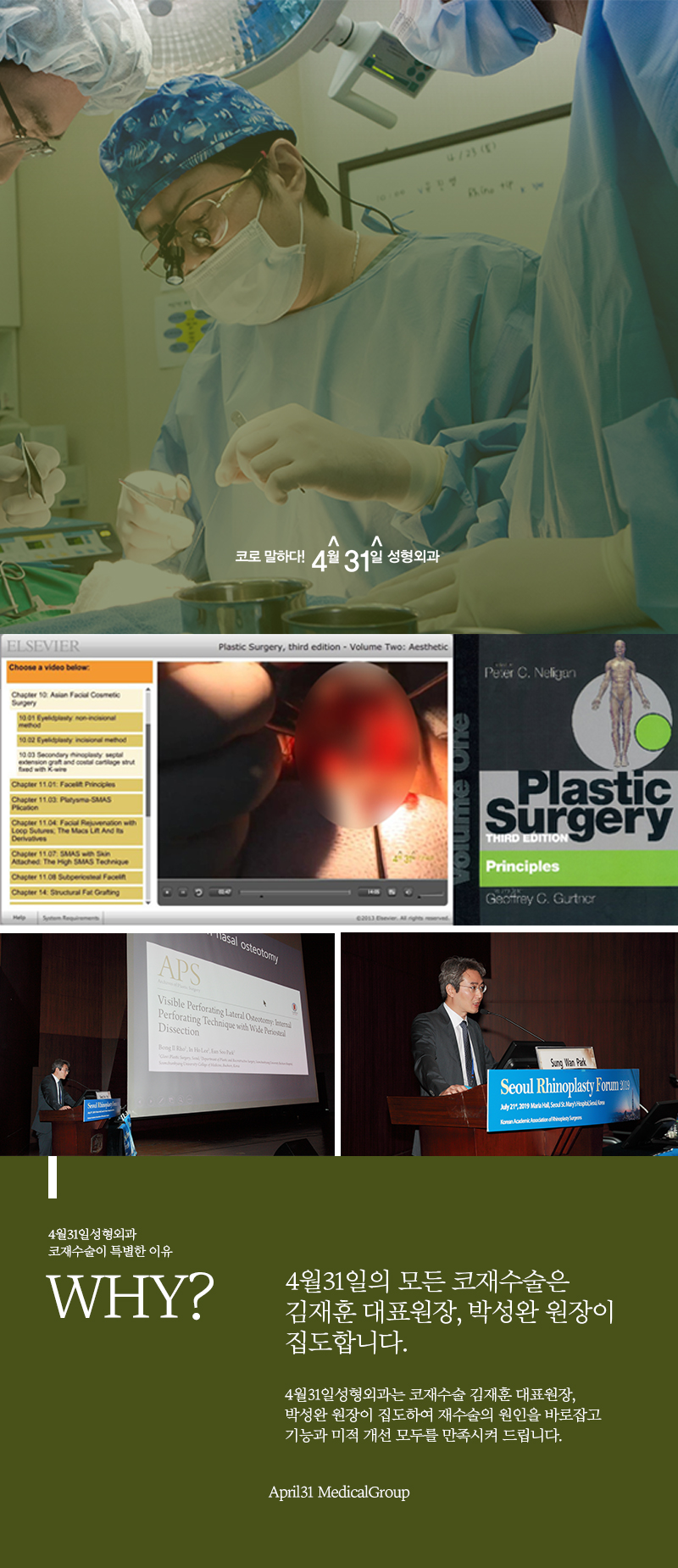
Because of their deep knowledge gained through paper publications in world-renowned SCI international journals and the globally prestigious PRS journal,
and because Director Kim’s rhinoplasty revision technique surgical video was included in the official world-standard plastic surgery textbook, Peter Neligan’s Plastic Surgery,
I believe there is a reason they are known as a leading clinic for rhinoplasty revision in Gangnam.
If you want satisfaction not only in aesthetics but also in functional improvement,
consider getting a consultation at April 31 Plastic Surgery now.