Compared with the past, people’s perceptions of plastic surgery have changed a lot these days.
Recently, as appearance has become part of one’s competitiveness, the idea that taking care of one’s looks is a form of self-management has become more common.
Because of that, negative perceptions of plastic surgery have greatly diminished,
and positive views have become more common instead.
There are many different types of plastic surgery, but the most commonly sought are eye and nose surgery.
Among them, rhinoplasty can greatly improve one’s image with even a slight change,
because the nose is the most three-dimensional feature of the face.
As a result, the proportion of people undergoing rhinoplasty is increasing,
and nose surgery is among the procedures with a relatively high revision rate in plastic surgery.
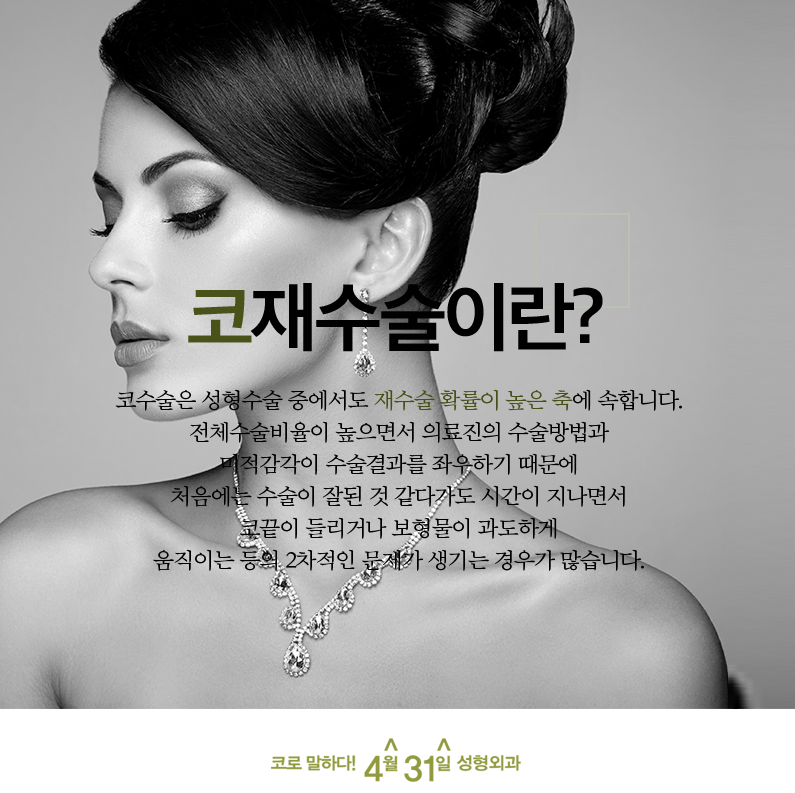
The reasons why complications requiring revision after an existing nose surgery are extremely varied.
In addition to aesthetic issues such as the bridge being too high after surgery, or the bridge and tip not blending smoothly and making the nose look larger,
there are various other reasons, including inflammation, allergic reactions, skin changes, and implant movement caused by the implant.
Among them, the contracture-nose phenomenon that causes the tip to turn upward after surgery is a complication that requires revision.
Inside the nose, a capsule forms as part of the body’s defense process to separate foreign substances such as implants inserted into the body from the body itself.
When this capsule becomes excessive, it thickens and creates elasticity,
and due to that elastic pulling force, the tip of the nose is pulled upward; this is called capsular contracture.
There are also several other forms of contracture nose.
When contracture nose occurs, scarring forms inside the nose, and the nose hardens and contracts.
Because it is a complication that occurs when a foreign material has been inserted,
the tip may turn upward or the nose itself may become shorter,
and in severe cases, the implant may become distorted and the shape of the nose may also become distorted.

So what causes contracture nose to develop?
Simply put, contracture nose appears when problems that should not occur after a surgery to raise the nose, such as inflammation,
have occurred but were not properly treated and were left unattended.
It can also occur if the nose is touched or altered too many times.
Because of these issues, people look for a plastic surgery clinic that specializes in contracture nose revision surgery in hopes of correcting the failed result.
Today, we would like to introduce April 31 Plastic Surgery as a clinic that specializes in contracture nose revision surgery.
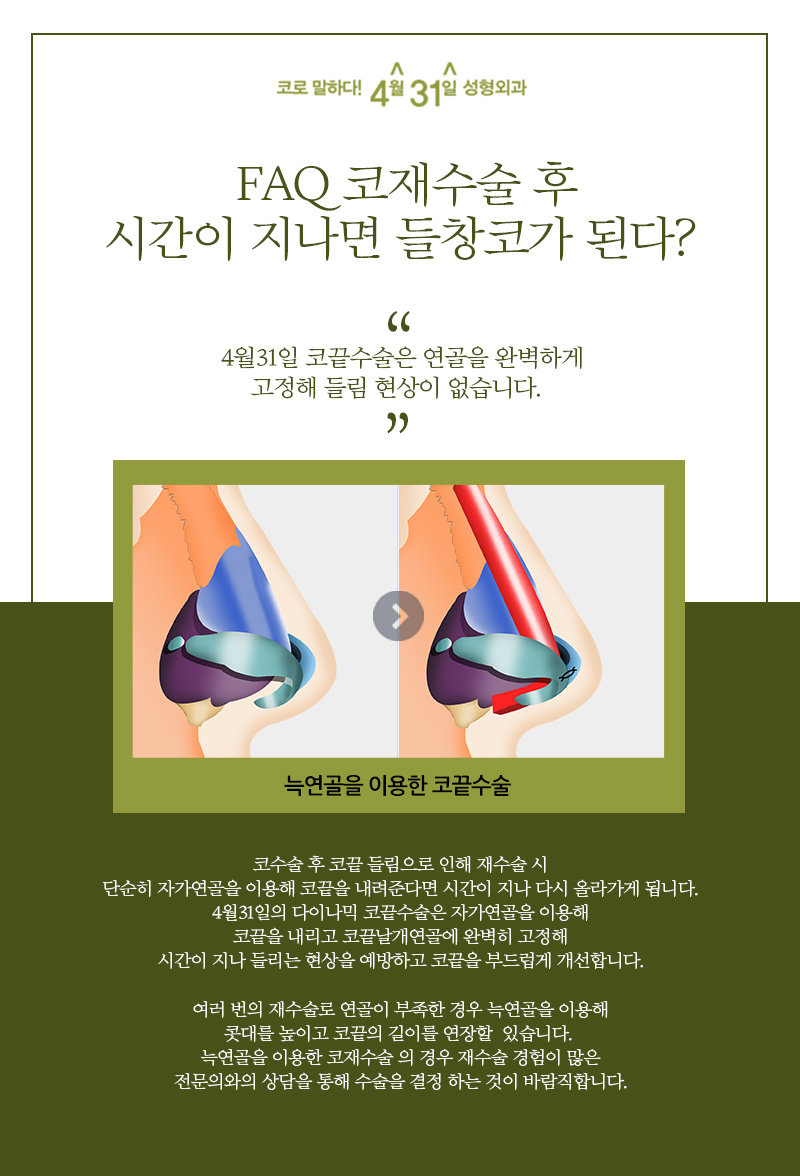
When having revision surgery because the tip has turned upward after nose surgery,
simply lowering the tip with autologous cartilage may cause it to rise again.
To prevent this, our clinic’s dynamic tip surgery lowers the tip using autologous cartilage,
and securely fixes it to the lower lateral cartilage of the tip to prevent it from turning upward again over time
and to achieve a smoother improvement in the tip.
For patients who lack sufficient cartilage due to multiple failed surgeries,
costal cartilage can be used to raise the bridge and lengthen the tip of the nose.
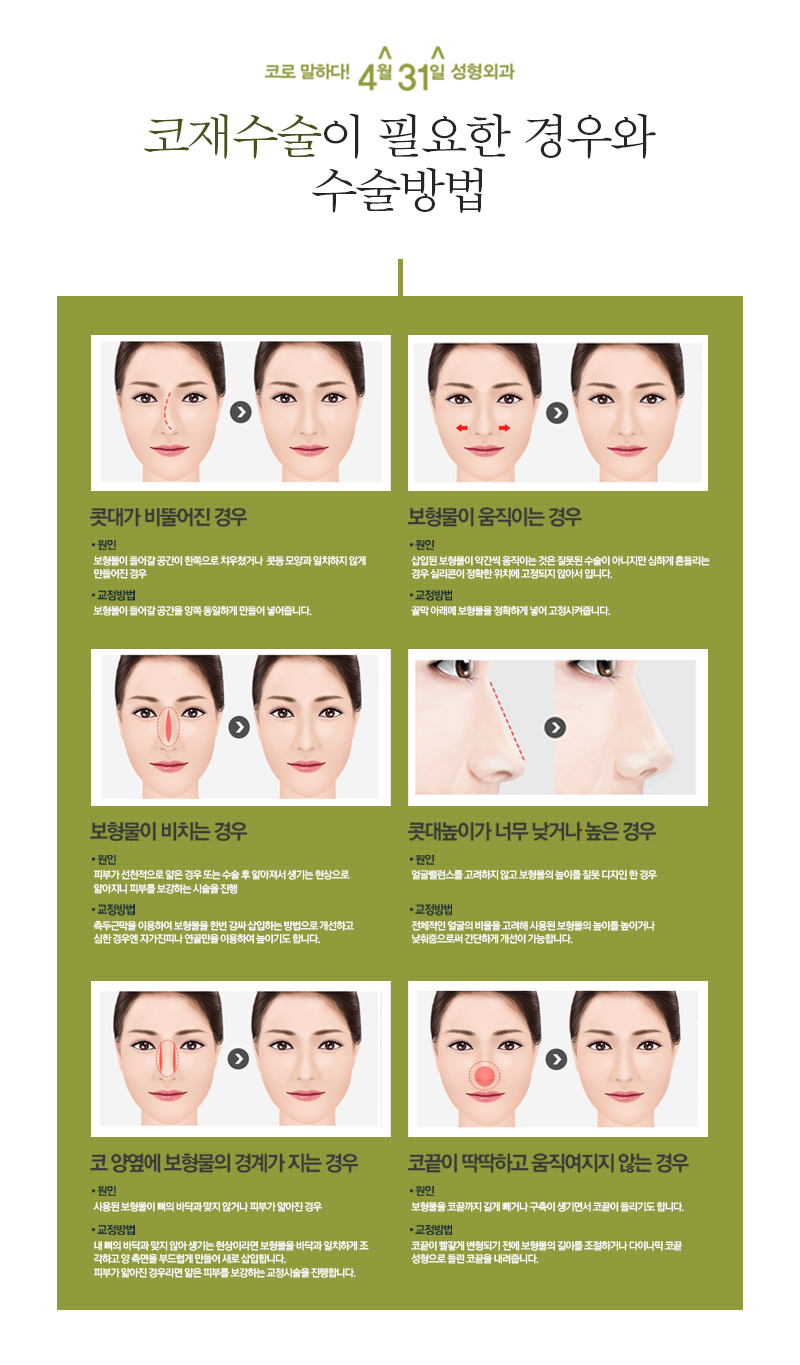
Although we introduced this as a clinic that specializes in contracture nose revision surgery, as mentioned earlier,
the reasons for needing nose revision surgery are very diverse.
Cases that require nose revision surgery include a crooked bridge, an implant that moves,
an implant that shows through the skin, a bridge that is too low or too high, visible implant edges on both sides of the nose,
and a nose tip that is hard and does not move.
Our clinic carries out appropriate surgical methods according to the various causes.
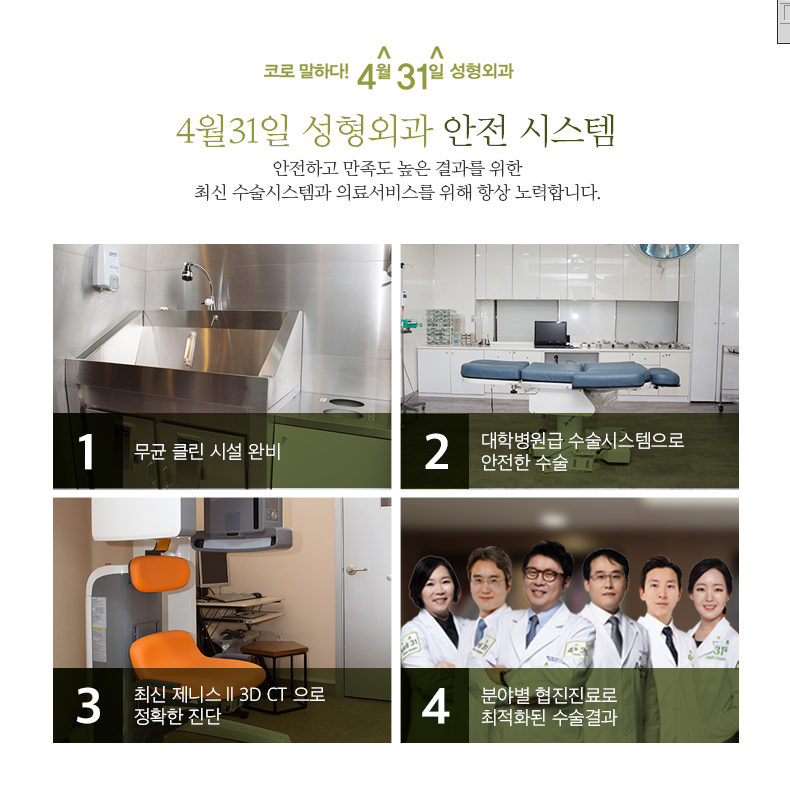
A clinic that specializes in contracture nose revision surgery should accurately identify the cause of the previous failure
and be a place where even the functional aspects of the nose can be improved.
In addition, sufficient consultation with the medical team performing the revision surgery is essential regarding the desired nose shape and past surgeries.
At our clinic, Chief Director Kim Jae-hoon, a board-certified plastic surgeon dedicated to rhinoplasty, and Dr. Park Seong-wan, a board-certified plastic surgeon,
use state-of-the-art 3D-CT to accurately assess the current condition of the nose and the structure of the bone and soft tissue,
and provide direct one-on-one consultations.
Not only that, but they also perform the surgery and recovery care themselves,
correcting the cause of the revision and satisfying both functional and aesthetic improvement.
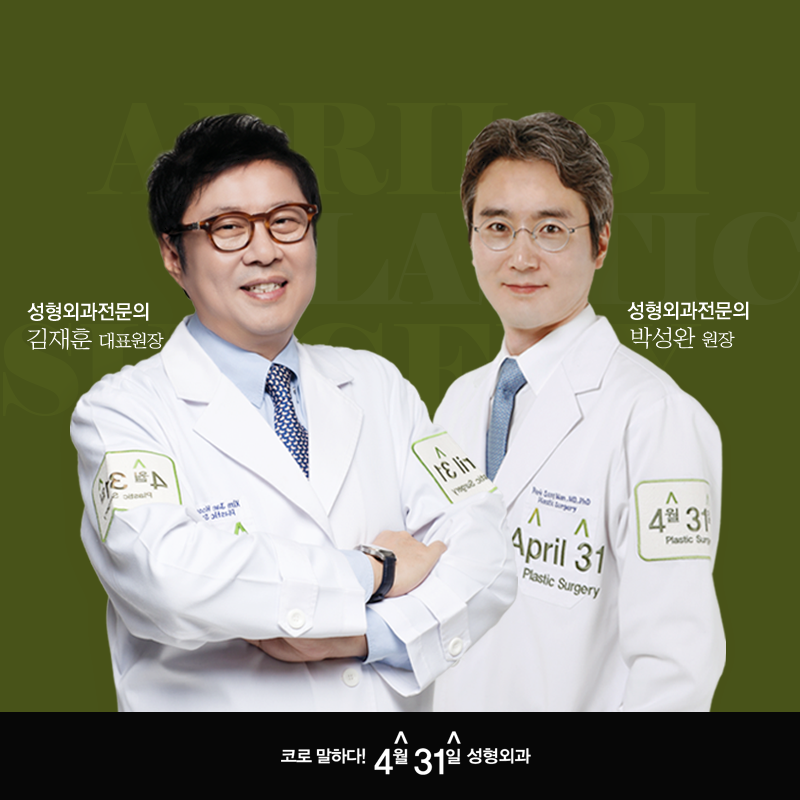
Because this is a second attempt after gathering courage again, and because no one wants to be hurt again,
I believe the medical team is truly important.
Director Kim Jae-hoon’s nose revision surgery technique video has been included in the internationally recognized plastic surgery official textbook, Plastic Surgery,
and he has also published papers related to nose surgery in several academic journals, so you can feel reassured.
Don’t get hurt again.
Join April 31 Plastic Surgery for a beautiful and healthy nose