
As interest in appearance has recently begun to grow,
more and more people are looking into ways to improve concerns about their facial features.
Among the facial features, the ones with the highest rate of cosmetic procedures are the eyes and nose.
Among them, the nose has a high cosmetic surgery rate, but the revision surgery rate is also very high.
Unlike the eyes, this is because the nose is changed in a way that involves adding implants and other materials, making it different from its original form.
Therefore, if you want to improve the nose, it is necessary to make a decision after considering various factors.
There are ways to improve not only the bridge of the nose but also the tip and the overall shape of the nose.
Among them, even if the bridge is high and straight, it is difficult to create a beautiful nose line if the tip is blunt.
In addition, because it is the highest and most protruding part of the face,
the shape of the nose tip is such an important area that it determines the overall image of the nose.
In conventional rhinoplasty,
to achieve aesthetic completeness, implants were used all the way to the nasal tip,
or methods were used that forcibly fixed cartilage or artificial bone called Medpor.
This could make the nose look unnatural and stiff, or lead to secondary recurrence or side effects.

Of course, there are people considering nose tip surgery who want to create a more beautiful nose tip line, but
many also look into treatment to improve a case where contracture occurred as a side effect of rhinoplasty and the nose tip turned into a pig nose.
For these people, today we would like to introduce Dynamic Nose Tip Surgery.

A pretty nose is not completed by shape alone;
not only nose tip design but also the subtle movement of the nose tip, as if it were my original nose, is important.
Dynamic Nose Tip Surgery is a method that improves the nose tip in a free and dynamic way by using only your own cartilage tissues, such as the alar cartilage and septum.

Because Dynamic Nose Tip Surgery uses only soft autologous cartilage,
it is not only natural like your original nose tip, but also allows a pig nose.
In addition, we provide individualized custom design by considering the golden ratio from the nose tip to the lips.
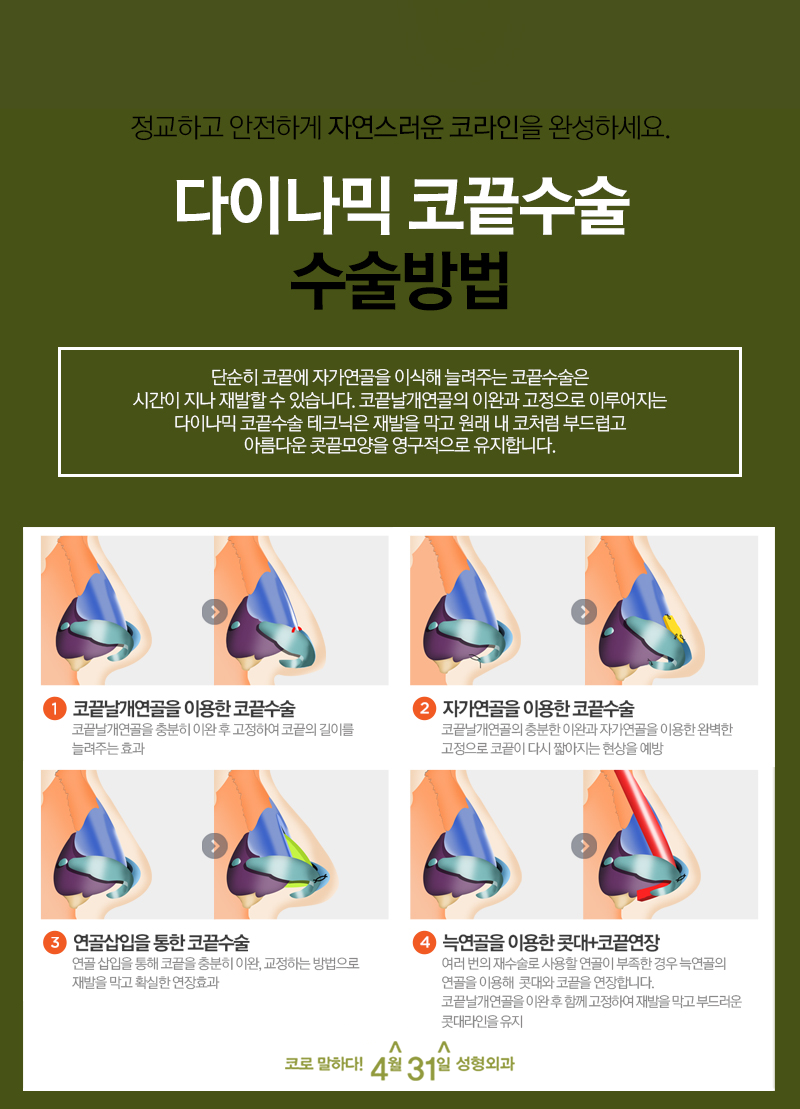
Simply grafting autologous cartilage onto the nose tip to lengthen it may recur over time.
Dynamic Nose Tip Surgery minimizes recurrence by relaxing and fixing the alar cartilage of the nose tip,
and can provide a nose tip that is natural and beautiful like your own.
In addition, we provide treatment tailored to each case using a variety of surgical methods.
First, in the case of nose tip surgery using the alar cartilage,
we sufficiently relax the alar cartilage and then fix it to lengthen the nose tip.
In the case of nose tip surgery using autologous cartilage,
we prevent the nose tip from becoming short again by sufficiently relaxing the alar cartilage and performing perfect fixation using autologous cartilage.
In the case of nose tip surgery through cartilage insertion,
we sufficiently relax and correct the nose tip through cartilage insertion,
thereby preventing recurrence and providing a clear lengthening effect.
Finally, in the case of bridge and nose tip lengthening using rib cartilage,
this is a method recommended for people who lack cartilage due to multiple revision surgeries.
We lengthen the bridge and nose tip using rib cartilage,
and after relaxing the alar cartilage, we fix them together to prevent recurrence and maintain a smooth bridge line.

To carry out a customized procedure according to each case,
it is necessary to understand the current condition.
At our clinic, we use 3D-CT to simultaneously assess the current state of the nose and the structure of the bone and soft tissue.

Based on this, Chief Director Kim Jae-hoon, a board-certified plastic surgeon in charge of rhinoplasty, and Dr. Park Seong-wan, a board-certified plastic surgeon,
personally handle the consultation, customized surgery, and recovery management.
If you are curious about Dynamic Nose Tip Surgery that considers the golden ratio,
click the banner below.