If You're Curious About Autologous Tissue Rhinoplasty Methods?
We have entered an era in which natural beauty is receiving more attention than excessive beauty.
Even when it comes to plastic surgery, rather than forcing results to follow trends,
many people now prefer procedures that are balanced and suited to their own features.
As a result, more people are pursuing natural-looking cosmetic surgery.
Because the nose is three-dimensional and can have a big impact on first impressions, many people are interested in rhinoplasty.
There are many rhinoplasty methods.
From nose fillers, which can raise the bridge of the nose with a simple procedure,
to rhinoplasty that can lift the nose dramatically by inserting implants into the nose,
there are various methods. However, because these methods involve placing something other than your own tissue into the nose, such as implants, fillers, or threads,
many people worry about side effects or drawbacks over time.

For people with thin skin, implants may become visible through the skin.
If foreign material or non-absorbable filler remains in the nose, it can be difficult to place an implant.
If there is an active inflammatory condition, immediate rhinoplasty is difficult.
For people who have had repeated foreign-body reactions in the nose but still want rhinoplasty,
for people who do not want to use implants,
and for cases where scar tissue and skin irregularity inside the nose have become severe after multiple surgeries,
people often look into autologous tissue rhinoplasty methods.
For those people, today we will explain autologous tissue rhinoplasty methods.
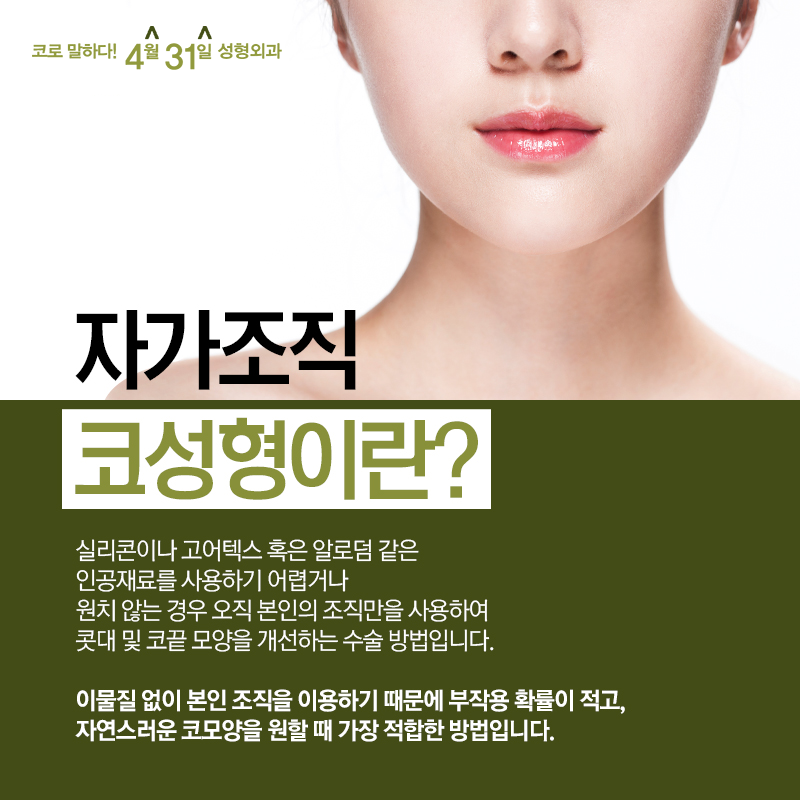
Autologous tissue rhinoplasty refers to a method that improves the bridge and tip of the nose using only the patient’s own tissue when synthetic materials such as silicone, Gore-Tex, or AlloDerm are difficult to use or are not wanted.
Because autologous tissue rhinoplasty uses the patient’s own tissue without foreign substances,
the risk of side effects is lower, and it is the most suitable method when a natural-looking nose shape is desired.
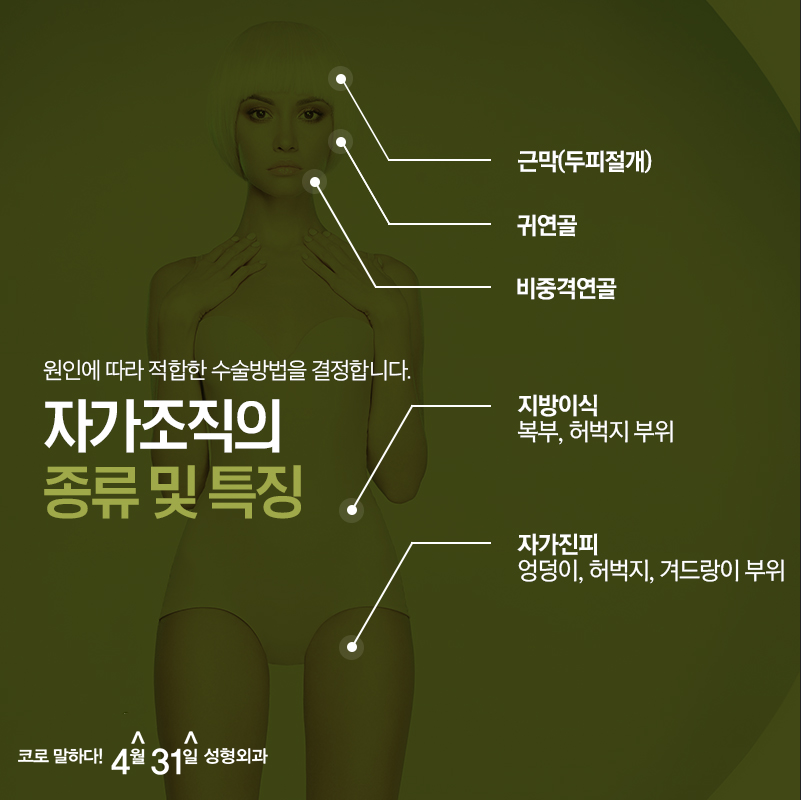
There are many different autologous tissue rhinoplasty methods,
because the appropriate method must be chosen according to the cause,
and the type of autologous tissue to use also differs.
First, in the case of ear cartilage, it can be harvested from behind the ear
and is often used for the nasal tip in simple augmentation procedures.
Ear cartilage is less rigid than septal cartilage and can create a natural-looking nasal tip.
Septal cartilage is harvested from inside the nose during nasal surgery,
so it does not cause scarring, functional issues, or structural problems,
and it is firmer than ear cartilage, so it plays a role in strongly supporting the tissue.
Dermofat grafting is a method that uses both a portion of the skin and the fat layer.
It involves taking tissue from the armpit area, thigh, or below the buttocks and grafting it onto the bridge or tip of the nose.
Fascia is a thin membrane that surrounds muscle.
The fascia commonly used in nasal surgery is the temporal fascia, which is harvested through an incision in the scalp,
making the surgery simpler and leaving no visible scar.
Fascia is used to raise the glabellar area or to prevent implants from showing through in patients with thin skin.
Bone is usually harvested from the skull, ribs, or pelvic bone.
However, because this is a relatively large procedure, it is not often used in general cosmetic surgery
and is mainly used in nasal reconstruction surgery, such as for nasal deformities caused by trauma.
Micro-fat grafting is usually harvested from the abdomen or thighs.
A special solution is injected into the harvest site, and the collected fat is precisely separated with a centrifuge,
then micro-injected into the area being treated.
Lastly, there is costal cartilage from the chest.
Costal cartilage is used when septal cartilage is difficult to use after multiple revision rhinoplasties.
It is mostly used for reconstruction or supporting structure,
and when costal cartilage is used, an incision line of 3 to 4 cm may remain from harvesting the 6th or 7th rib cartilage.
However, at our clinic, we use the 10th rib cartilage, which is easier to harvest,
so the incision is only 1 to 1.5 cm, and the scar line later becomes almost faded and is not easily noticeable.
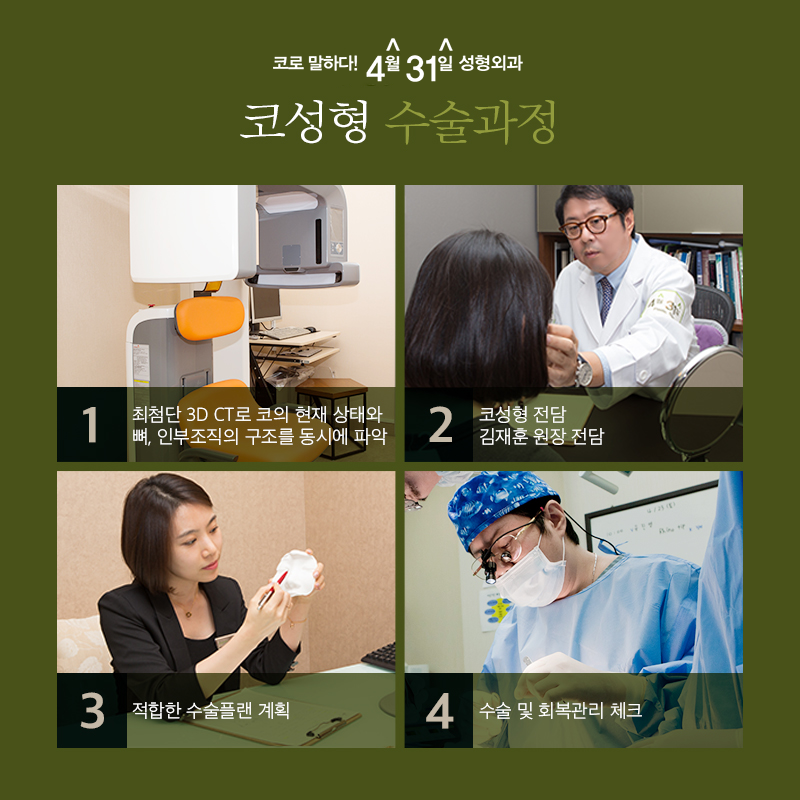
There are many different autologous tissue rhinoplasty methods like these,
and it is necessary to determine which method is appropriate.
To do this, our clinic uses 3D-CT to understand the current condition of the nose and the structure of the bone and soft tissue at the same time.
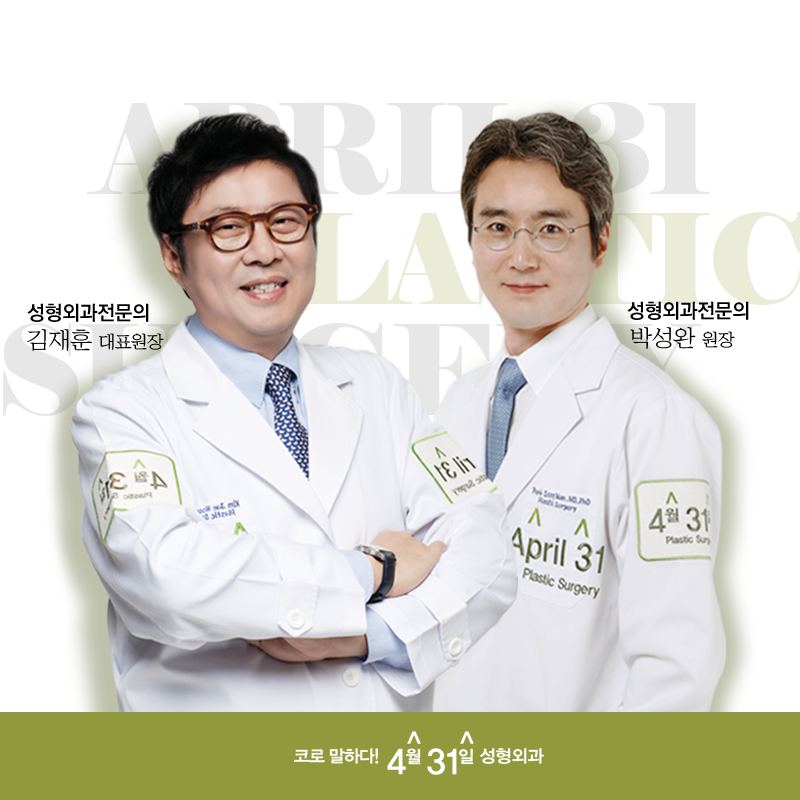
In addition, since Chief Director Kim Jae-hoon, a board-certified plastic surgeon specializing in rhinoplasty, and Dr. Park Seong-wan, a board-certified plastic surgeon,
personally handle everything from consultation to surgery and recovery management checks,
you can look forward to the results you want.
For detailed inquiries and consultation requests, please click the banner below.