Standards of beauty have continued to change over time.
In the past, plump and traditionally Korean beauties were preferred,
but at some point, Western beauty standards came to dominate.
As a result, many East Asians who had small and low noses began to undergo rhinoplasty
in order to create a more Western-looking nose.
The nose must be treated with different methods depending on each person’s condition and goals.
In addition, many people previously wanted changes to the bridge of the nose,
so various types of implants were used in nose surgery, which is why careful surgery planning is also necessary.

A careless surgical plan, excessive desire, or the surgical method and aesthetic sense of the medical staff can
not only leave you dissatisfied with the shape of your nose,
but can also cause secondary complications such as the tip being lifted or the implant moving excessively.
Among the various problems, the most common yet serious one is contracture.
Nasal contracture generally occurs due to an inflammatory reaction caused by a foreign implant such as silicone.
If inflammation continues for a long time, normal tissue changes, causing the skin to contract,
and eventually not only distorting or lifting the shape of the nose, but also hardening the skin or tissue.
Those searching for a renowned place for revision surgery for contracted nose often visit not only because of obvious inflammation,
but also because the nose frequently swells and subsides, the nose becomes shorter, the tip lifts, and it becomes hard.

For those who have been looking for a renowned place for revision surgery for contracted nose for these reasons,
today we would like to explain our clinic’s revision rhinoplasty.
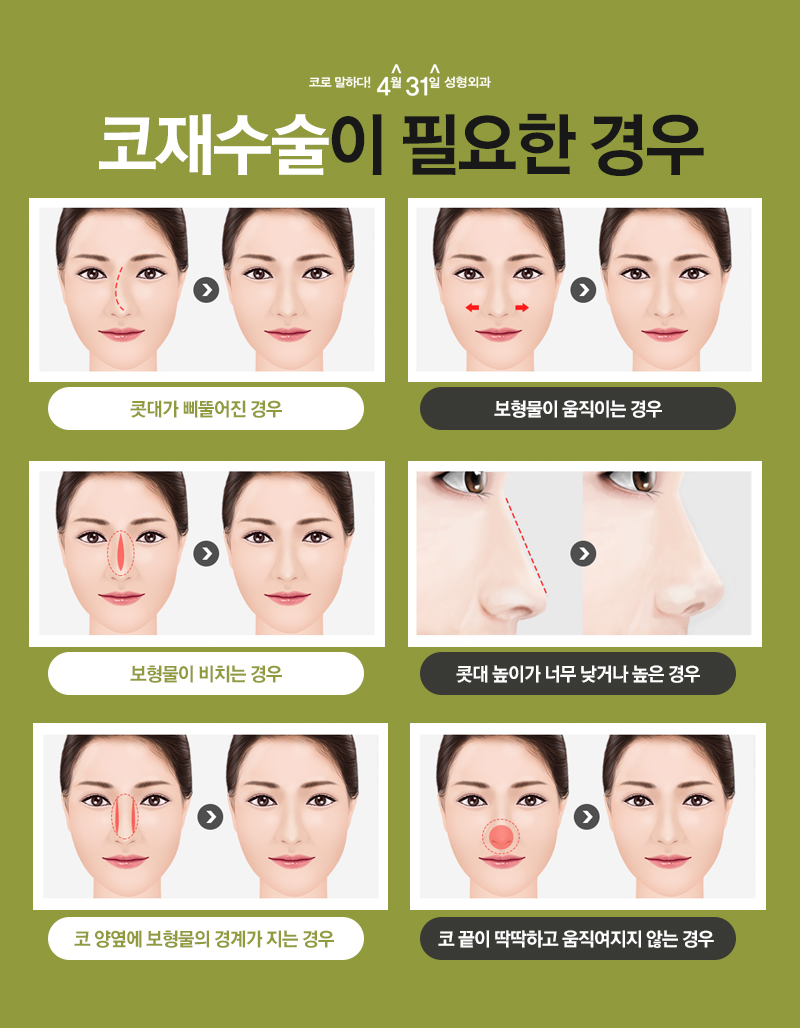
Revision rhinoplasty requires an appropriate surgical method depending not only on contracted nose, but also on various other causes.
At our clinic, we provide customized surgery using different methods depending on each case.
First, in cases where the space for the implant is shifted to one side or the bridge shape has been made uneven,
that is, when the bridge is crooked,
we make the space for the implant the same on both sides.
A slight movement of an inserted implant is not a wrong surgery,
but if the inserted implant shakes significantly,
it is because the silicone was not fixed in the correct position.
In such cases, we place the implant precisely beneath the periosteum and secure it.
If the skin is congenitally thin or has become thin after surgery, causing the implant to show through,
we improve it by wrapping the implant once with the temporal fascia before insertion,
and in severe cases, we raise the bridge using only autologous dermis or cartilage.
If the implant height was designed incorrectly without considering facial balance,
for cases where the bridge is too low or too high,
we simply improve it by increasing or reducing the height of the implant used while considering the overall facial proportions.
If the implant used does not match the base of the bone, or if the skin has become thinner and the outline of the implant appears on both sides of the nose,
we apply different correction methods depending on the cause.
If it is a phenomenon caused by not matching the base of my bone,
we sculpt the implant to fit the base and smooth both sides before reinserting it,
and if the skin has become thin, we perform a corrective procedure to reinforce the thin skin.
If a contracted shape occurs, such as when the implant is extended all the way to the tip of the nose or the tip lifts due to contracture,
we adjust the length of the implant or lower the lifted tip with dynamic tip surgery before the tip turns red and deforms.
Among these, contracted nose is especially common and difficult to correct,
which is why many people look for a renowned place for revision surgery for contracted nose.
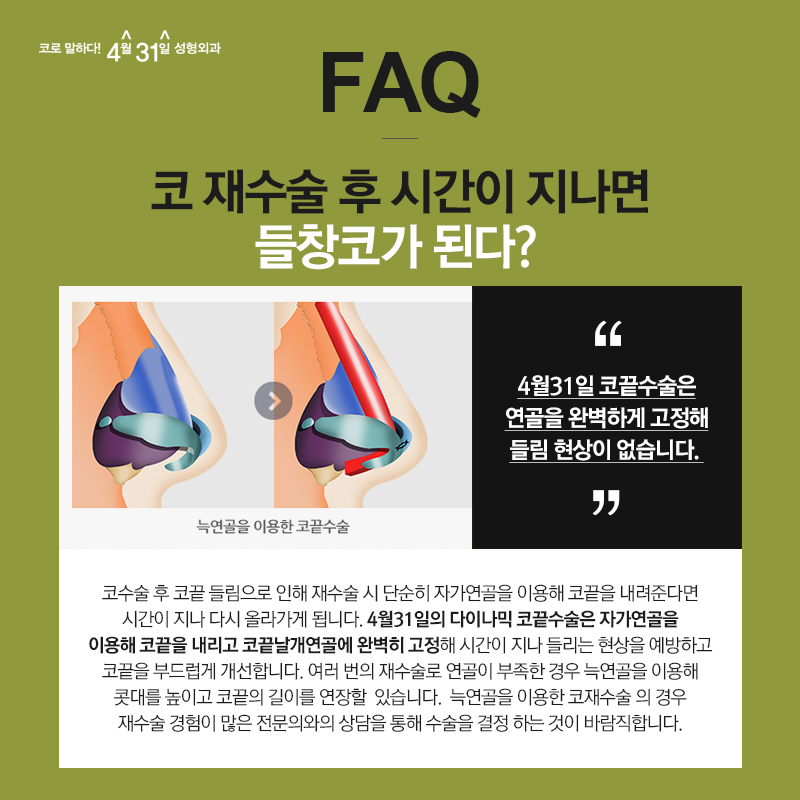
Even if revision surgery is performed, simply lowering the tip with autologous cartilage can cause it to rise again over time.
At our clinic, with dynamic tip surgery, we lower the tip using autologous cartilage,
secure it perfectly to the alar cartilage to prevent it from lifting again over time,
and improve the tip smoothly.
Even if you lack cartilage due to multiple surgeries, there is no need to worry;
we can use rib cartilage to raise the bridge and extend the length of the nose tip.
Usually, when rib cartilage is used, 6th and 7th rib cartilage are harvested,
which had the drawback of leaving a 3 to 4 cm incision.
At our clinic, we use the 10th rib cartilage, which is easier to harvest, and obtain it through a 1 to 1.5 cm incision,
and later it fades significantly, so the scar line is not easily noticeable.
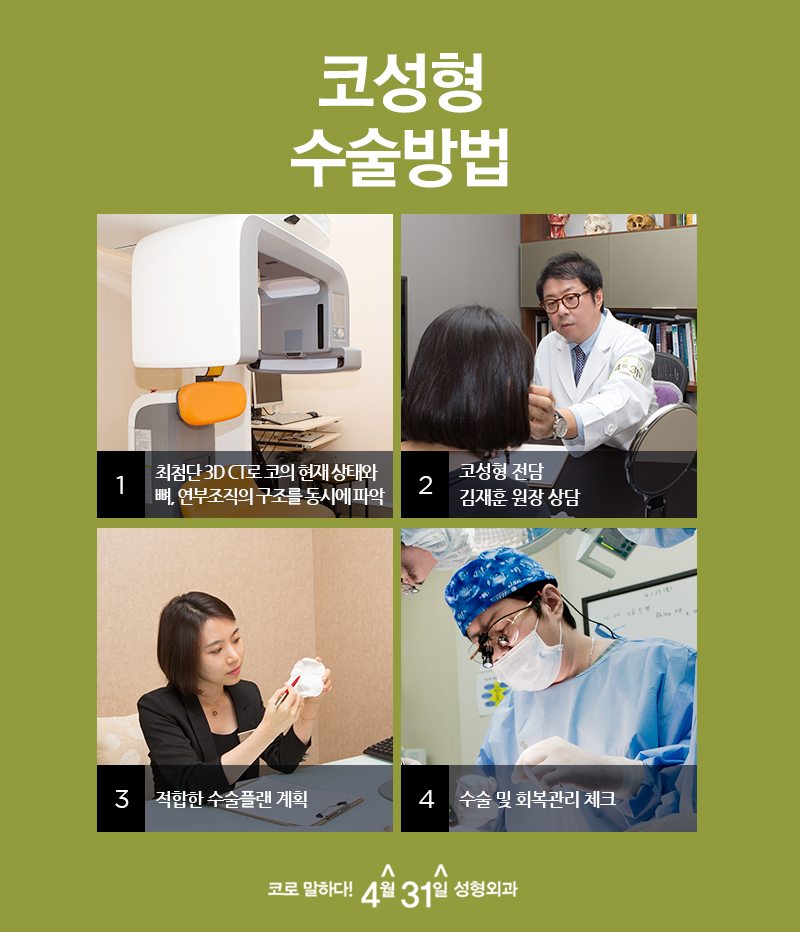
Important parts of revision surgery include consultation after proper examination, the skill of trustworthy medical staff, and customized surgery.
First, at our clinic, 3D-CT is used to identify the current condition of the nose and the structure of the bone and soft tissue at the same time.
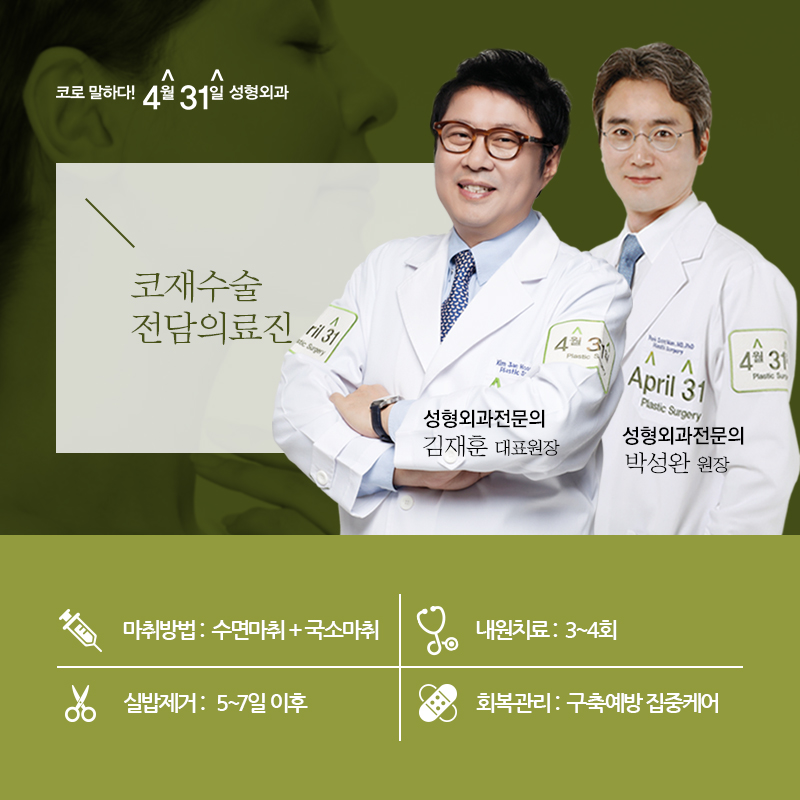
In addition, our head surgeon, plastic surgery specialist Kim Jae-hoon, who specializes in rhinoplasty, and plastic surgery specialist Park Seong-wan,
will do their best through one-on-one consultations, customized surgery based on an appropriate surgical plan, and recovery management.
If you have been looking for a reliable and trustworthy renowned place for revision surgery for contracted nose, please receive a consultation now.