
Have you ever heard people say that the weather suddenly turns cold whenever the college entrance exam comes around?
There is a saying that the weather becomes sharply colder after the CSAT because all the stress from the examinees lingers in the air.
For test-takers, tension and worry can make it hard to think about anything other than studying.
For most people, it becomes a source of concern because of the things they will have to face when the weather gets even colder.
There are many parts of our body that are affected when the weather gets cold, but
skin is something we can directly and immediately feel the effects of,
so many people worry about it.
As winter sets in, many people complain of itching and dryness,
and when the skin is dry, makeup tends to sit poorly.
When makeup does not apply well, skin imperfections become visible as they are.
As a result, it is only natural to worry about duller skin texture and enlarged pores.
In particular, pores are a concern for many people because they cause makeup to cling unevenly and make the skin look rough,
and they are not easy to shrink.
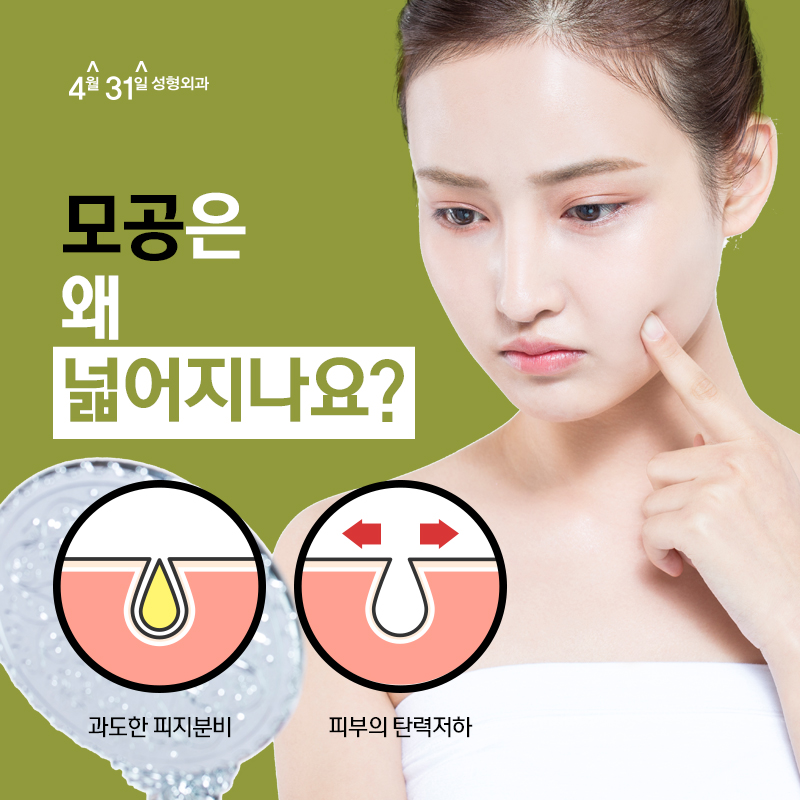
So, in order to reduce pores,
it is necessary to understand why they become a source of concern and trouble.
First, the reasons pores become larger can be broadly divided into two categories.
The first reason pores become larger is excessive sebum production.
Inside pores are sebaceous glands that secrete sebum.
Although the size, shape, and distribution of sebaceous glands vary depending on the body area,
they are generally known to be widely distributed on the face.
Sebum can have positive effects on the skin by suppressing moisture evaporation, providing antibacterial action, and regulating emulsification and absorption,
but
excessive sebum can instead have a negative effect.
When sebaceous glands are stimulated by stress, lack of sleep, hormonal imbalance, and similar factors,
they may secrete too much sebum.
When sebum is produced in excess like this, it is discharged from inside the pores to the outside,
which causes the pores to become larger.
The second reason pores become larger is reduced skin elasticity.
Skin is made up of several layers.
Simply put, skin can be divided into the epidermis, dermis, and subcutaneous tissue.
First, the epidermis is the outermost layer that covers and protects the dermis.
The epidermis contains proteins that provide impermeability to the skin and also play a role in blocking ultraviolet rays.
The dermis is the skin layer surrounding sensory receptors,
and it supplies nutrients to the epidermis and supports the skin.
Finally, the subcutaneous tissue contains many tissues in the veins and nerves beneath the dermis,
especially those that help absorb shock.
Among these, the part related to why pores become larger is the dermis.
The dermis is mostly made up of collagen and elastin.
Collagen and elastin are elastic proteins with rubber-like resilience,
and they play an important role in skin elasticity and wrinkle prevention.
However, when the amount of collagen and elastin decreases due to reasons such as dry skin or aging,
skin elasticity drops,
and as a result, not only the skin but also the pores lose elasticity.
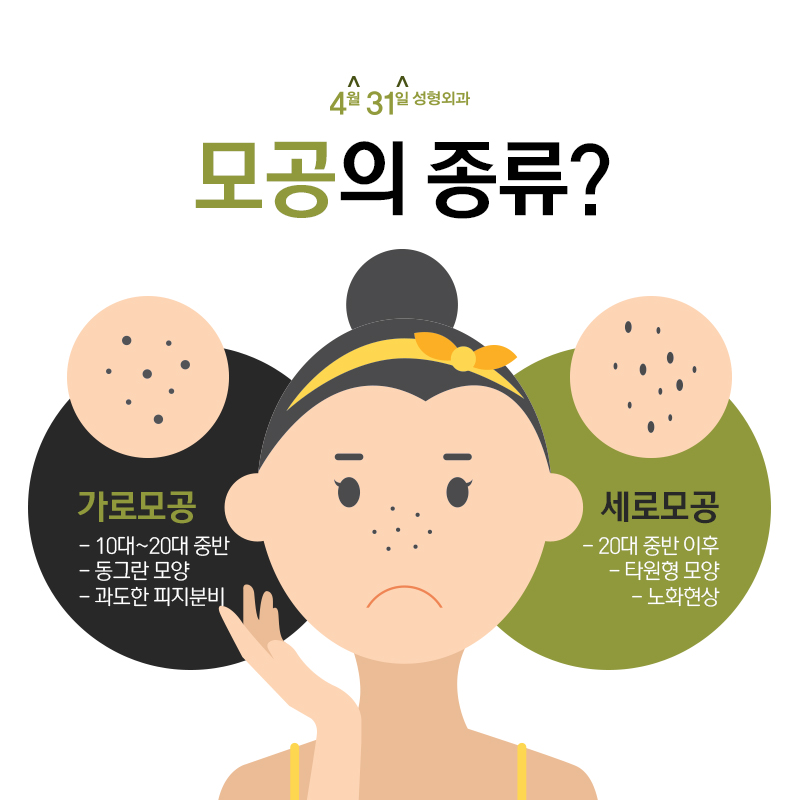
Then, are there only one type of pore? No.
Depending on their shape, pores can be thought of as falling into two types.
First, in people from their teens to their mid-20s,
excess sebum secretion due to hormones can be a likely reason pores become larger,
and in such cases the pores enlarge in a round shape,
which is called horizontal pores.
Although it varies by person when the skin begins to age,
aging usually starts after the mid-20s.
When skin aging is the reason pores become larger,
the pores enlarge into an oval shape,
which is called vertical pores.
The reasons pores become larger and the types of pores can differ from person to person in many ways,
so many people look for a pore-reducing laser that can conveniently solve these concerns all at once.
However, with so many different types, it can be hard to choose.
For those who are struggling to decide,
today I will introduce the Pico laser.
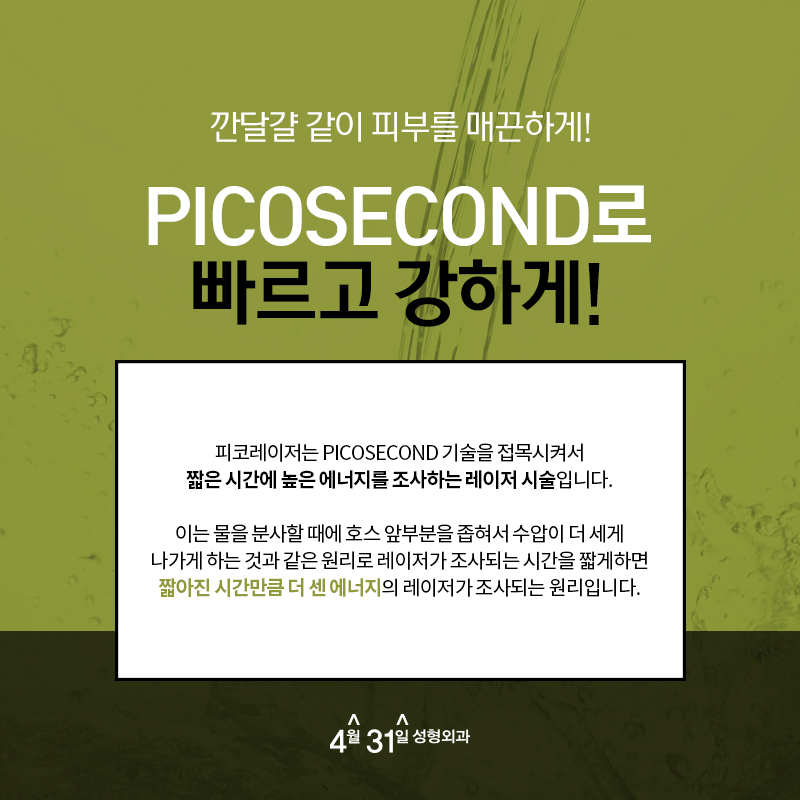
The Pico laser is a laser that delivers thermal energy in a short time,
causes less damage to surrounding tissue, and minimizes the number of treatment sessions,
making it effective for pore treatment.
So, let’s take a closer look at how short the time is, and what is good about causing less damage.
First, because the Pico laser uses picosecond technology, which means one trillionth of a second,
it is a method that achieves an ultra-short pulse 100 times faster than conventional pore-reducing lasers.
Therefore, it refers to a method in which stronger energy is delivered in a shorter time.
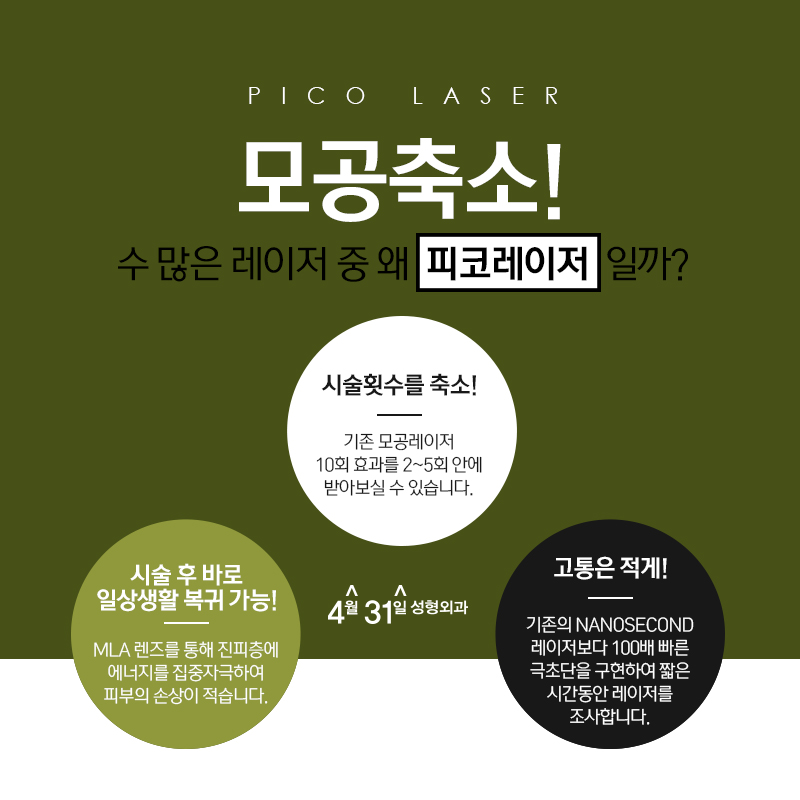
So, I understand that it is fast,
but you may wonder why the Pico laser is recommended instead of other pore-reducing lasers.
Because the Pico laser delivers strong energy,
you may be able to achieve the effect of receiving 10 sessions of a conventional pore-reducing laser in just 2 to 5 sessions.
In addition, since the laser is delivered in a short amount of time,
the procedure is less painful.
Also, because energy is intensively delivered to the dermis through an MLA lens,
there is less damage to the skin, so you can return to daily life immediately after the procedure.
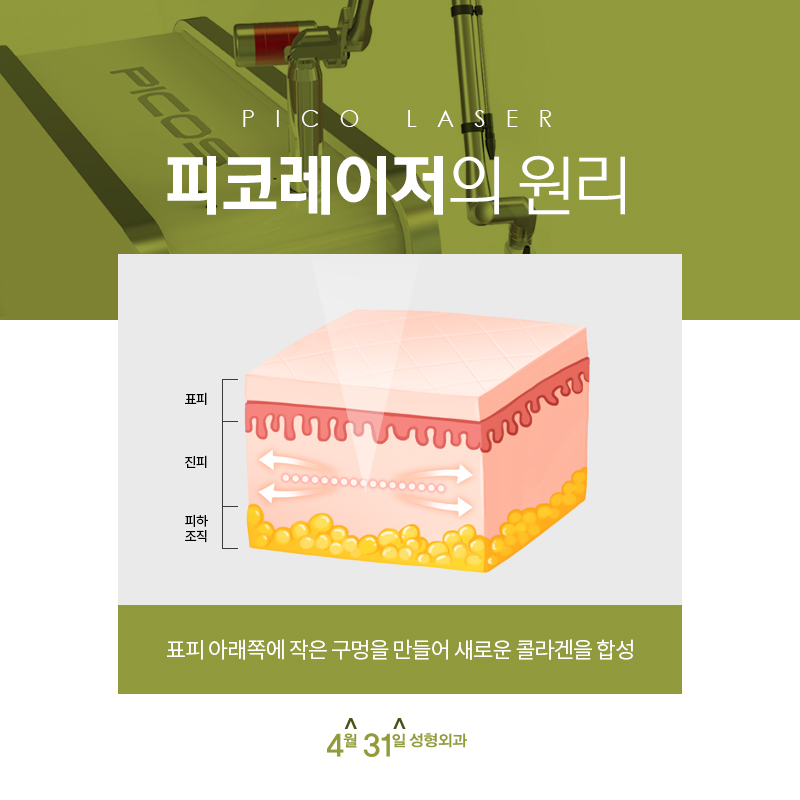
Then you may be wondering how the Pico laser treats pores.
Conventional pore-reducing lasers worked by exfoliating the skin to reduce pores,
but the Pico laser creates small holes below the epidermis to synthesize new collagen.
Through this, it reduces pores by filling them in.
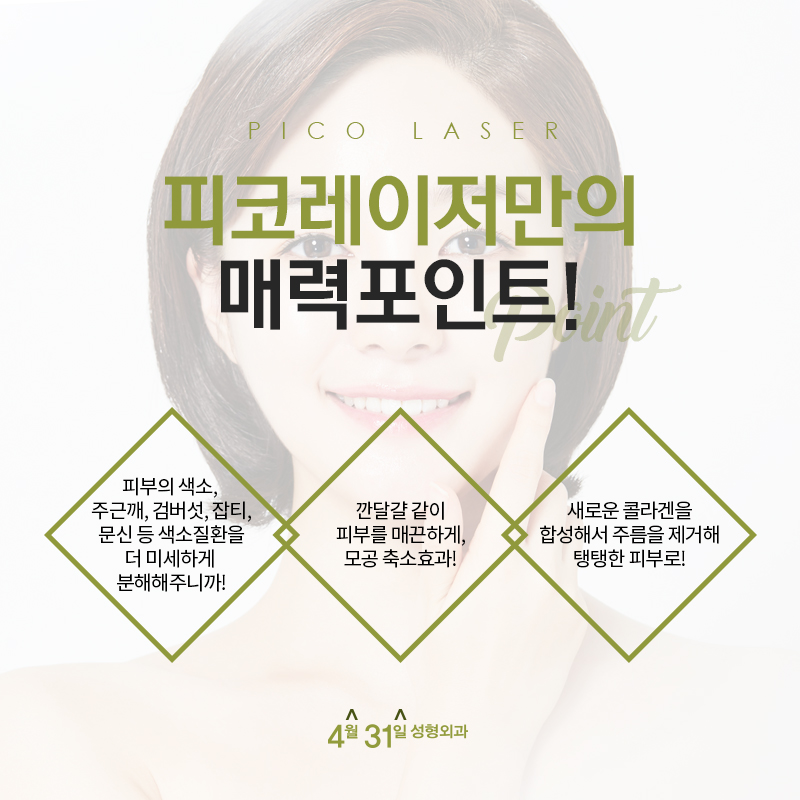
Through this principle, you can expect not only pore-reducing effects,
but also improvement of pigmentation conditions such as freckles, age spots, blemishes, and tattoos, as well as wrinkle-removal effects.

At our clinic, we run a weekly event every Tuesday and Thursday that offers discounts on all small aesthetic procedures, including the Pico laser.
Please keep this in mind when you visit,
as we expect you to be able to meet the Pico laser at a more reasonable price.
For detailed inquiries and consultation requests, please click the link below.