Recently, as more and more people of all ages and genders have come to view outward appearance as part of self-care,
many people have been seeking ways to improve their appearance-related concerns.
In particular, as people’s perceptions of plastic surgery have improved along with this trend,
interest in cosmetic surgery and procedures has increased regardless of age or gender.
Among these, the areas most commonly considered by many people are the eyes and the nose.
In the case of the nose in particular, because it is the most three-dimensional feature of the face, it has a major impact on facial lines,
and because even a small change can produce a significant improvement, it is the area that many people seek to improve after the eyes.

However, at the same time, it is also noted as one of the fields with the most side effects and dissatisfaction, so it is an area that causes concern.
The nose is especially an area where the surgeon’s technique and aesthetic sense determine the outcome, so even if it seems fine at first,
secondary problems can arise over time, such as the tip of the nose lifting or the implant moving excessively.
Recently, many people have tried to save money through various promotions and low-priced offers,
but preventing recurrence and side effects should be the top priority.
Likewise, for those considering revision surgery, when looking for a well-known revision rhinoplasty hospital,
it is important to focus more on safety-related factors than on cost.
For those who are considering another attempt,
there are various reasons for wanting improvement,
and it is important to proceed with the appropriate method according to each reason.
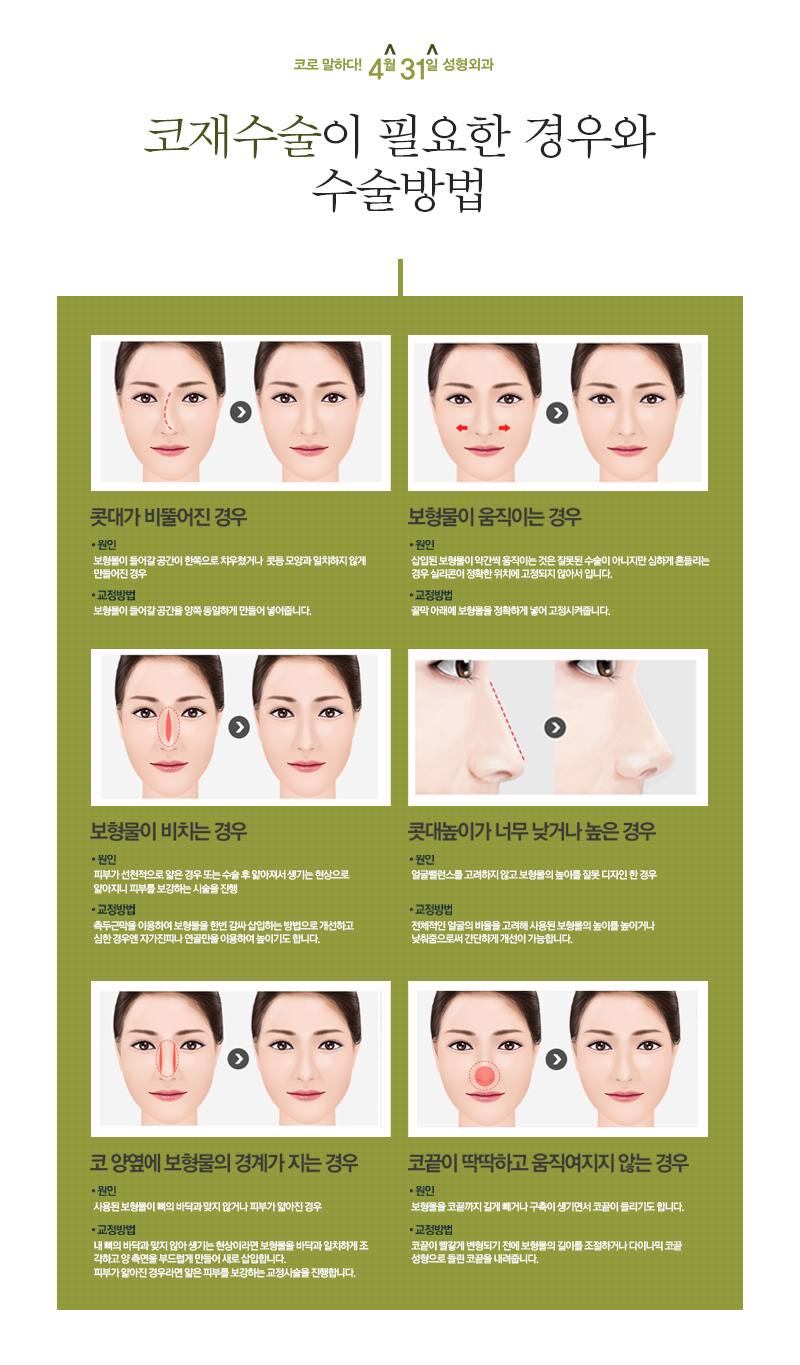
In cases where the implant space is偏 to one side or where the bridge is crooked because it does not match the shape of the nasal bridge,
the implant space must be made equal on both sides before insertion.
A slight degree of movement in an inserted implant is not necessarily incorrect, but
if silicone is not fixed in the correct position and the implant moves significantly,
the implant is placed accurately under the periosteum and fixed there.
If the skin is naturally thin or has become thin after surgery,
causing the implant to show through,
the implant is wrapped once with the temporalis fascia before insertion to improve the result,
and in severe cases, the height may be increased using only autologous dermis or cartilage.
Since the nose is a three-dimensional area, it should be designed with the overall proportions and balance in mind.
If the implant height was designed incorrectly without considering facial balance,
and the bridge is too low or too high,
it can be simply improved by adjusting the height of the implant used up or down while considering the overall facial proportions.
If the implant used does not match the bony base, or if the skin has become thin so that the boundary of the implant shows on both sides of the nose,
different correction methods are used depending on the cause.
If the problem is caused by a mismatch with the bony base,
the implant is carved to match the base and the sides are smoothed before reinsertion.
If the skin has become thin,
a correction is performed to reinforce the thin skin.
Finally, the situation experienced by the largest number of people is when the implant is extended too far to the tip of the nose or contracture occurs,
causing the tip to lift and the nasal tip to become stiff and immobile.
In such cases, before the tip turns red and deforms, the length of the implant is adjusted,
or the lifted tip is lowered with dynamic tip rhinoplasty.

If the tip of the nose is stiff and does not move, problems such as an upturned nose can occur.
This is a phenomenon that tends to recur, so many people may be concerned.
If the tip has lifted and it is simply lowered using autologous cartilage,
there is a risk that the tip will rise again over time.
To prevent this recurrence, our clinic uses a method called dynamic tip surgery.
This method lowers the nasal tip using autologous cartilage and secures it firmly to the alar cartilage,
preventing it from lifting again over time and improving the nasal tip smoothly.
In addition, when there is not enough cartilage due to multiple revision surgeries,
rib cartilage can be used to raise the bridge and extend the length of the nasal tip.
In the past, many people were concerned about scars when harvesting rib cartilage.
At our clinic, we use the 10th rib cartilage, which is easier to harvest,
so the procedure can be performed with a relatively short 1 to 1.5 cm incision,
and one advantage is that the scar usually fades over time and is hardly noticeable.

When performing revision rhinoplasty, detailed examinations are necessary
to identify the cause and to ensure a safe procedure.
At our clinic, we use 3D-CT to understand the current state of the nose, as well as the structure of the bone and soft tissue at the same time,
and we plan the appropriate surgical plan.
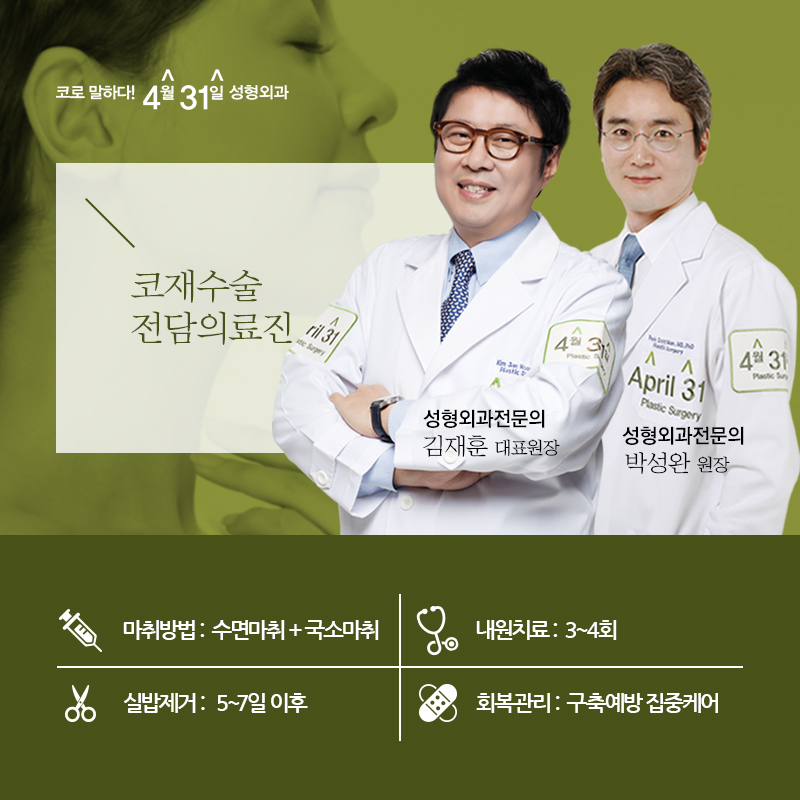
If you are curious about consultation, customized surgery, and recovery care with Dr. Kim Jae-hoon, the head director and plastic surgery specialist who specializes in rhinoplasty at a well-known hospital for safe revision rhinoplasty,
and Dr. Park Seong-wan, a plastic surgery specialist,
please receive a consultation now.
For detailed inquiries and consultation requests, please click the banner below.