
The word “first” is such an exciting and pleasant word.
There is a saying that if the beginning is good, the result will be good, and since the first start is truly an important part, doing your best from the beginning matters.
Recently, there are people who are getting ready for a new beginning.
I think they are students who have just finished the college entrance exam.
Including preparing to become adults, there seem to be many areas where people are getting ready for a fresh start.
After the college entrance exam, or for a new beginning, there are probably many things you are planning,
and one of them may be correcting something you have always thought of as a complex.
Of course, complexes you worry about may include internal matters as well,
but internal issues are not easy to fix.
That is why you are likely to think about external features that can be corrected more easily,
and among those, the eyes and nose are probably what many people consider most.
Today, I would like to talk about the nose, which is the center of the face.
It is said that nasal bone growth usually ends at age 16 for women
and at age 18 for men.
Before that, there is still the possibility of growth, so improvement is not recommended.
However, for those who have just finished this year’s college entrance exam, improvement is definitely possible.
That said, for minors, the guardian’s consent is absolutely required.
As more people are visiting plastic surgery clinics for their first nose surgery,
many places are advertising promotions and price discounts,
claiming that improvement is possible at competitively low costs.
However, because nose improvement is a surgical procedure,
it is important to go to a place with a board-certified plastic surgeon.

When you want to improve your nose, there can be many concerns.
For those considering their first nose surgery, there may be a lot to think about.
From a hump nose, where a protruding bridge gives a stubborn and aged impression,
to a long nose that makes the philtrum look short and usually seems older,
a bulbous nose that gives a dull impression,
a crooked nose that causes both aesthetic and functional problems,
and a turned-up nose that cannot create a refined image,
there can be many different complexes.
Among these, the feature most people look for is probably a low nose that makes the face look flat.
At April 31, all kinds of nose-related complexes can be improved,
but today we will talk about rhinoplasty for raising the nose,
which is what many people considering their first nose surgery are most often looking into.
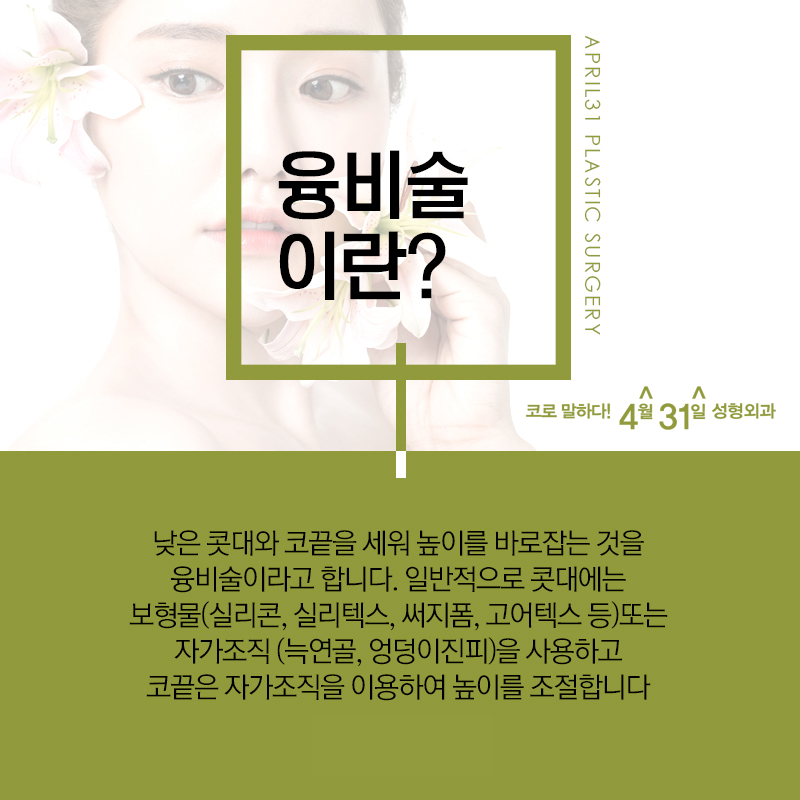
Many people may not be familiar with the term “rhinoplasty for raising the nose.”
Simply put, it means correcting the height by lifting a low bridge and tip of the nose.
In general, implants such as silicone, Silitex, Surgiform, and Gore-Tex,
or autologous tissues such as rib cartilage and hip dermis,
are used for the bridge of the nose,
and for the tip, autologous tissue is used to improve the height.
You may have heard the saying, “If you improve the nose with silicone, it needs to be replaced every 10 years.”
This is one of the 대표적인 rumors about implants.
Silicone is the material that has been used the longest among implants used for nose improvement.
That also means its safety has been recognized.
If no problems such as inflammation occur after the procedure, there is no need to replace it.
Just as different names are used depending on the shape of the nose,
not everyone has the same type of concern even if they share a similar worry.
This is also true for low noses.
Low noses can largely be divided into two types,
and at this clinic, customized procedures are performed according to each person’s concerns.
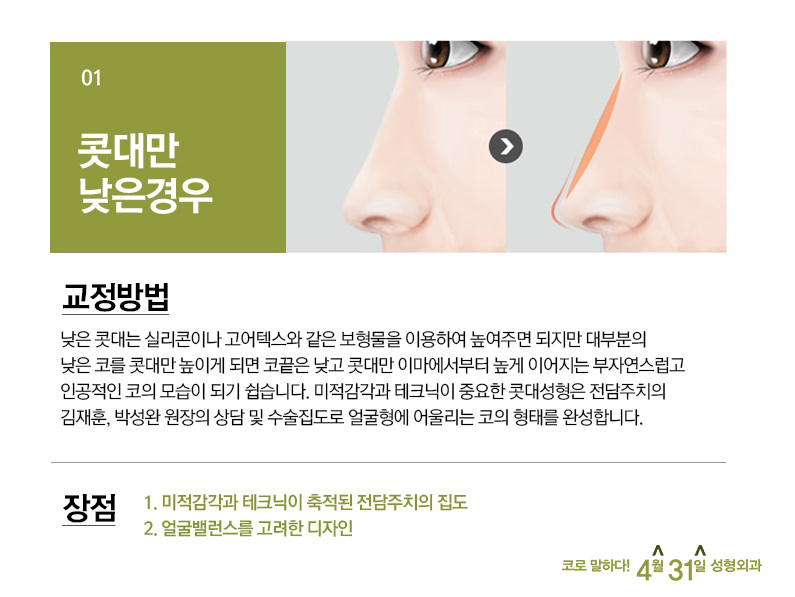
First, if only the bridge is low,
it can be raised using implants such as silicone or Gore-Tex.
However, in most low noses, if only the bridge is raised,
the tip may remain low, creating an unnatural or artificial line
that runs high from the forehead only through the bridge.
That is why, at this clinic, the dedicated doctors specializing in nose surgery
use accumulated aesthetic sense and technique to design the nose while considering facial balance.
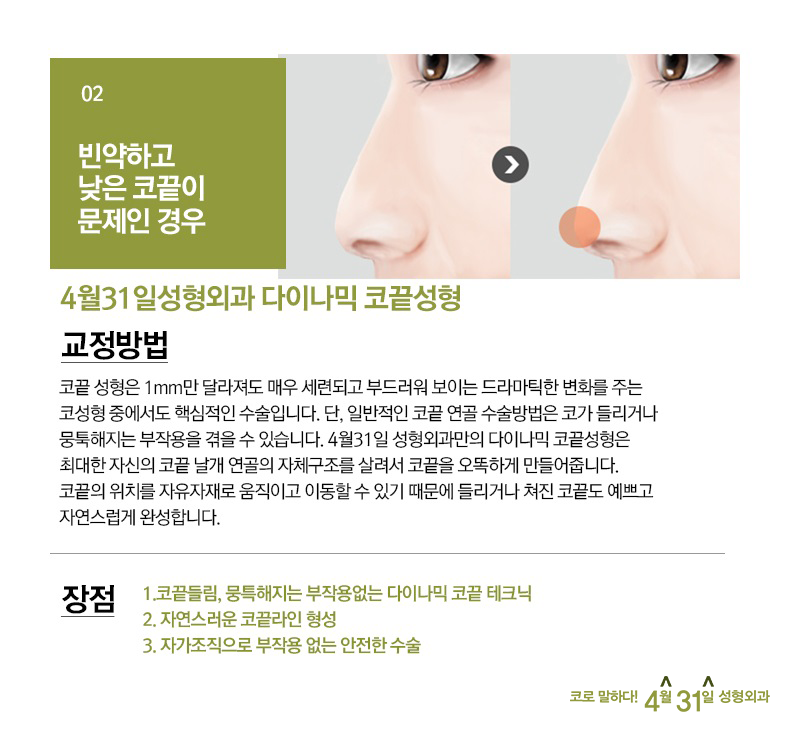
For the nasal tip, even a 1 mm difference can create a dramatic change,
making it look much more refined and soft.
However, the usual method of using nasal tip cartilage may cause side effects such as a raised or blunt tip,
so many people worry about that.
At this clinic, if you are concerned about a weak and low nasal tip,
we help improve it with dynamic nasal tip surgery.
This method makes the tip more defined by preserving as much of your own lower lateral cartilage structure as possible.
Because it allows the tip position to be moved and adjusted freely,
it can also improve a tip that is raised or drooping.
In particular, it minimizes side effects such as a lifted or blunt tip,
and because autologous tissue is used, the result looks natural and even allows a pig nose motion.

At this clinic, to improve each person’s nose into the shape that suits their face best,
we provide design based on harmony and balance.
To achieve effective improvement from both the side and the front,
we consider not only the bridge of the nose but also the line from the forehead to the chin tip,
as well as the forehead, eyes, nose, mouth, cheeks, and facial contours.
We also aim to proceed safely by understanding the range and limits of what can be improved.
To create the overall proportions of the upper, middle, and lower face,
it is important to consider the face as a whole when designing the bridge height, nasal tip shape, and nose line.
If the midface is prominent and the nose is made taller and more emphasized,
the midface may appear even more noticeable,
so we improve the nose so that it looks softer.
Conversely, if the midface is flat,
we raise the nasal tip that might otherwise look flat and avoid making the glabella too high,
creating a natural point at the tip of the nose and a more balanced overall face.
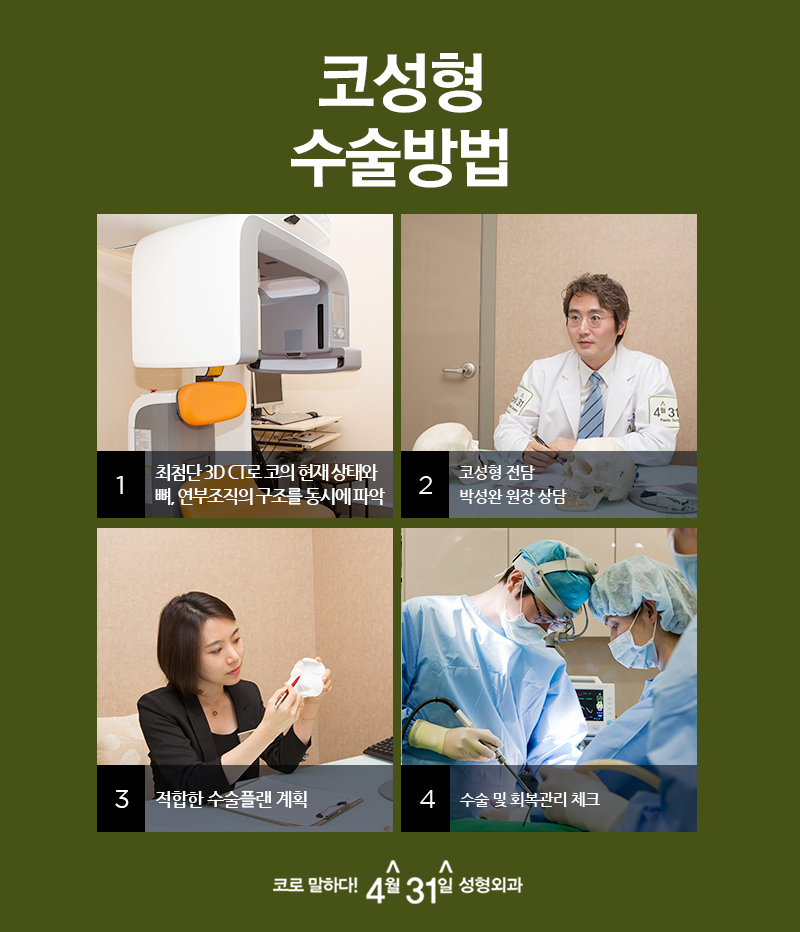
To carry out the procedure in a way that precisely fits each individual,
a detailed examination is necessary.
At this clinic, we use 3D-CT to identify the current condition of the nose
and the structure of the bone and soft tissue at the same time before proceeding.
We hope you can look forward to a successful first nose surgery
through one-on-one consultations, customized surgery, and recovery care
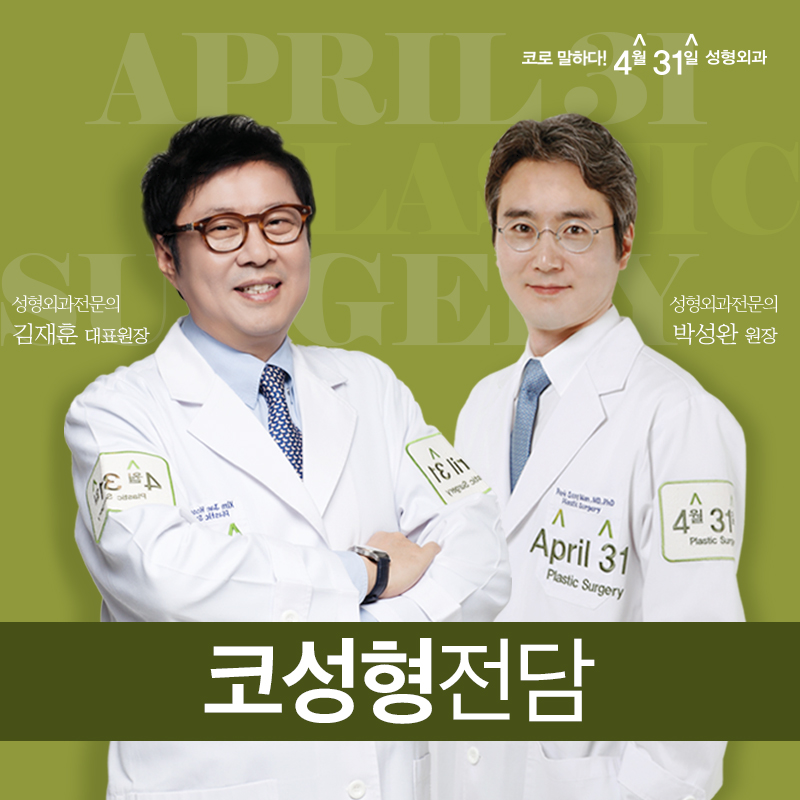
with Dr. Kim Jae-hoon, the CEO and board-certified plastic surgeon in charge of nose surgery at our clinic,
and Dr. Park Sung-wan, board-certified plastic surgeon.
For detailed inquiries and consultation requests, please click the banner below.