
When we meet someone for the first time, we cannot immediately know their personality or inner character,
so we tend to form our first impression based on their appearance.
Among facial features, the eyes not only determine a person’s image,
but are also the first part we look at when meeting someone.
Because of this, many people try to improve the eyes to create a positive and favorable impression.

The upper part of the eyes, the eyelids, may not seem very important,
but they play a major role in determining a person’s image.
That is why many people worry about sunken eyelids.
Some people may wonder why sunken eyelids happen.
First, the biggest cause of sunken eyelids is aging.
As we get older and lose body fat,
fat also decreases around the eyes, which are one of the thinnest areas on the face.
As a result, sunken eyelids can occur.
In addition, even among people who are not very old,
those who complain of sunken eyelids may develop the condition due to a lack of subcutaneous fat from excessive dieting,
genetic factors, or poor lifestyle habits.

When the eyelids become sunken, the eyes can look sleepy,
and the person may appear older.
Beyond these appearance-related concerns, there are also functional issues because the force used to open the eyes becomes weaker,
which can lead not only to eye fatigue, but also dry eye syndrome and ptosis,
so improvement is definitely needed.
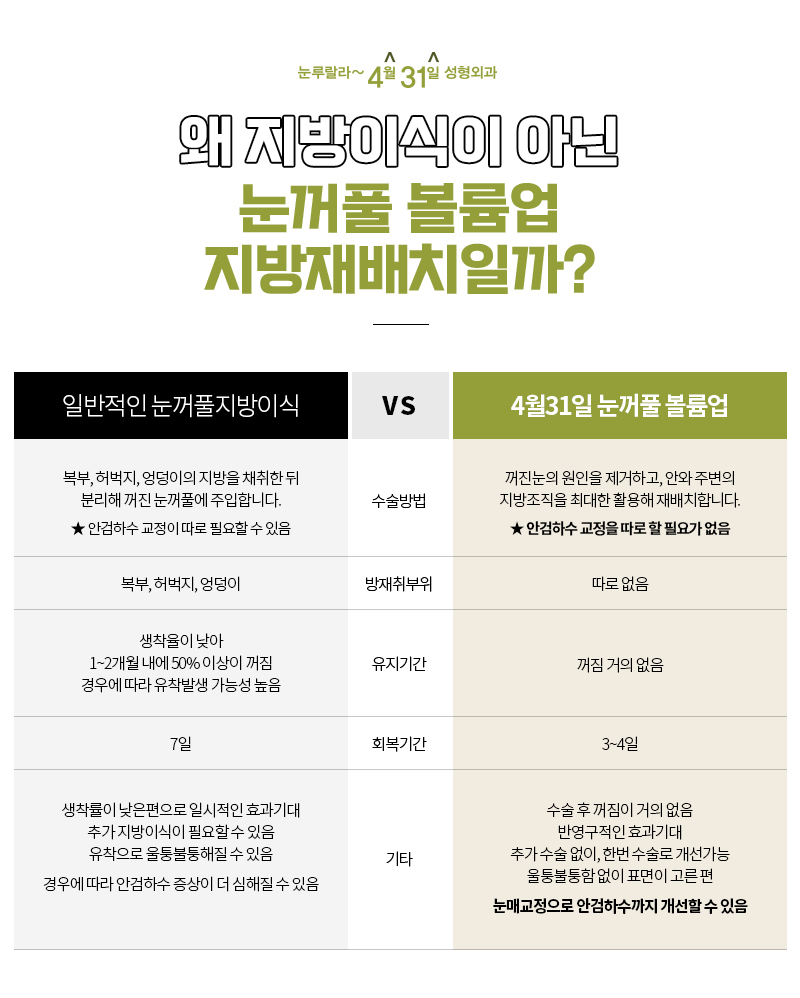
In many cases, people may have considered restoring volume through eyelid fat grafting.
With fat grafting, fat was harvested from areas with plenty of fat such as the abdomen, thighs, or buttocks,
then separated and injected into the sunken eyelids.
With this method, the survival rate is low,
so more than 50% may deflate within 1 to 2 months,
and in some cases there was a high possibility of adhesions that made the surface uneven.
Additional fat grafting may be needed,
and in some cases ptosis symptoms may worsen,
which meant ptosis correction could be required separately.

Because of these drawbacks,
you may have been wondering how to improve sunken eyelids.
Today, for people in this situation, we would like to introduce eyelid volume enhancement.
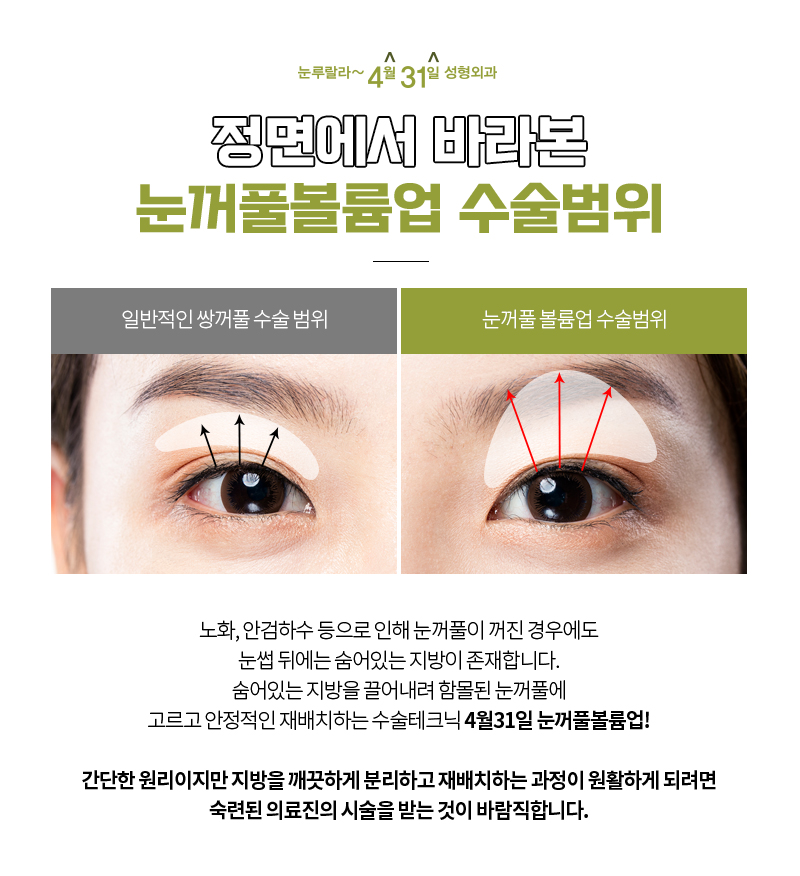
Eyelid volume enhancement is another name for orbital fat rearrangement surgery for the eyelids,
a method that redistributes the fat hidden behind the eyebrows to add volume to sunken eyelids.

Eyelid volume enhancement removes the cause of sunken eyes
and uses the surrounding orbital fat tissue as much as possible for redistribution,
so there is no need to worry about volume loss due to graft survival after surgery.
It can be improved with a single procedure without additional surgery,
and the surface tends to remain smooth without unevenness.
In addition, because ptosis can also be improved through eye correction,
there is no need for separate ptosis correction.
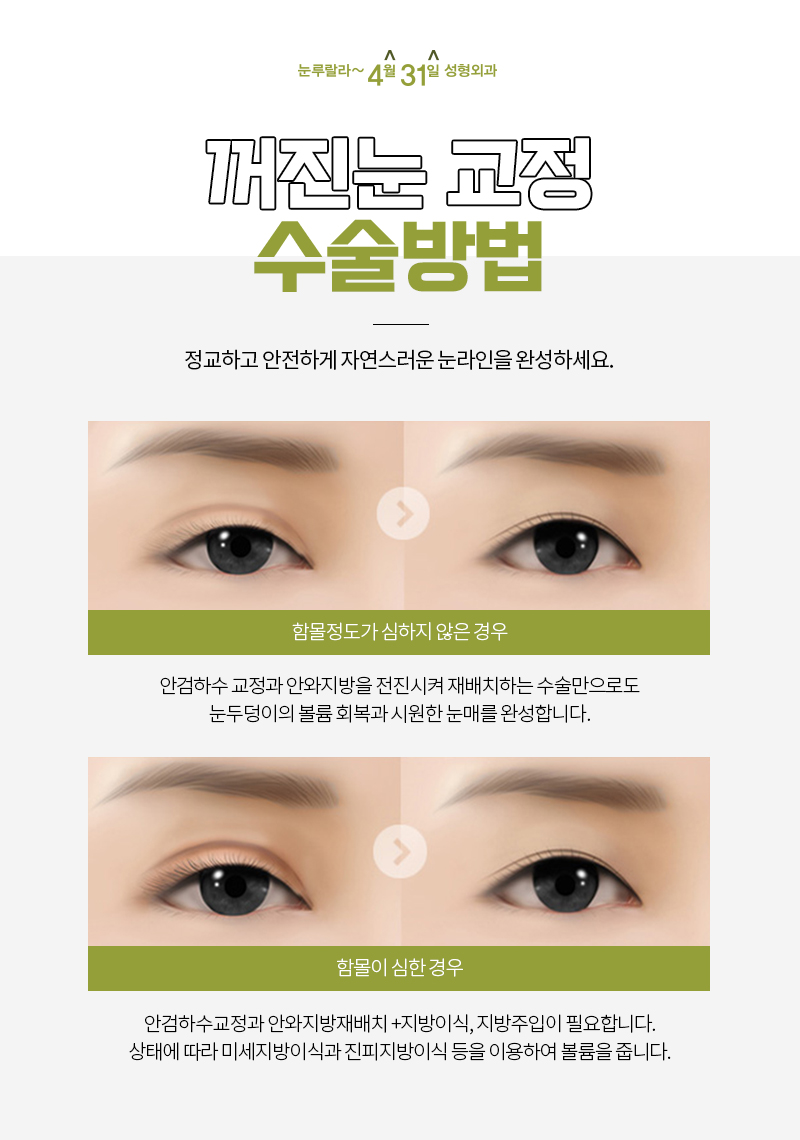
Because the degree of eyelid sunkenness differs from person to person,
it is best to proceed according to each individual case.
If the degree of hollowness is not severe,
a procedure that corrects ptosis and advances and repositions the orbital fat alone
may be enough to restore volume to the eyelids.
If the hollowing is severe,
ptosis correction, orbital fat repositioning, fat grafting, and fat injection may be needed.
Also, depending on the condition, volume can be added using microfat grafting and dermofat grafting.

The eyes are important because they play a very significant role both aesthetically and functionally,
which is why it is advisable to seek out a medical team you can trust.
At April 31 Plastic Surgery, board-certified plastic surgeon Oh Won-seok,
who is dedicated to eye surgery, performs the procedures personally,
so you can look forward to the results you want.
For detailed inquiries and consultation, please click the banner below.