Recently, more and more people have been paying attention to aesthetic concerns.
Because appearance can determine a first impression,
many people are paying even more attention to creating a favorable impression.
When it comes to beauty, one of the first things many people consider is the nose.
As the most three-dimensional part of the face, it can have an effect from both the front and the side,
which is why so many people focus on it.
It is always happy when a good result is achieved, but that is not always the case.
You may have made a big decision to create a more beautiful appearance,
but if the shape created is different from what you intended,
or if another problem arises, the resulting issues can take many forms.
Changing the nose line is one of the more difficult procedures among facial changes,
and because the likelihood of needing another procedure is high,
it is best to research carefully before proceeding.
However, if the result has already turned out poorly,
you need to analyze why such a problem occurred
and decide after looking into a method that is appropriate for the situation.

Nose surgery is one of the areas with a high rate of revision procedures among cosmetic surgery.
Because the overall proportion is high and the outcome is determined by the medical team’s methods
and aesthetic sense,
there are many cases where it seems to go well at first,
but secondary problems arise over time, such as the nasal tip lifting or the implant moving excessively.
For those looking into the criteria for choosing a rhinoplasty clinic for revision rhinoplasty
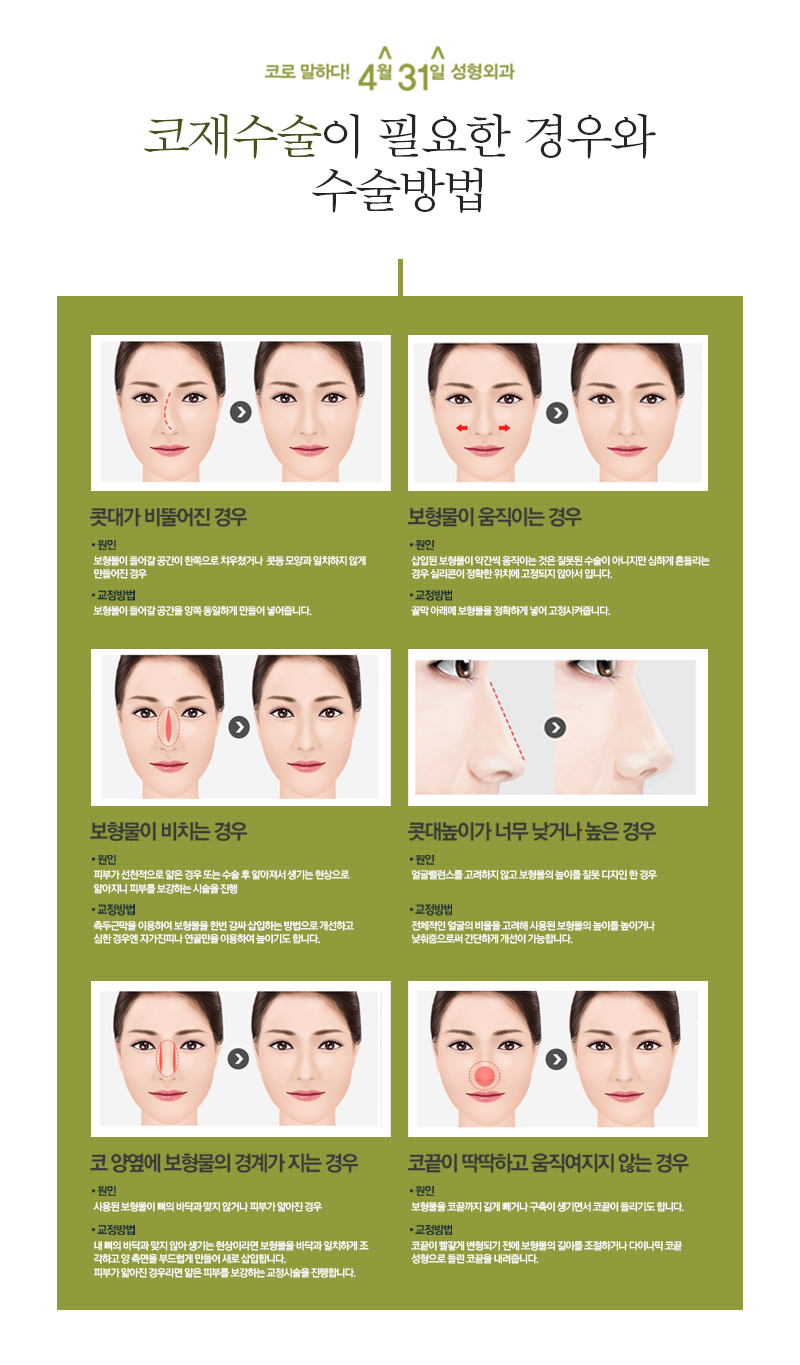
There are many reasons why these issues occur.
The bridge may become crooked, or the material may shift,
the material used may show through, or the bridge height may not match the facial proportions,
there may be visible implant edges on both sides of the nose,
or the tip may become hard and immobile, among many other reasons.
The approach varies depending on the situation,
so if you are looking into a revision rhinoplasty clinic,
it is best to receive a detailed consultation about how the procedure is carried out before deciding.
If the space for the implant is偏 toward one side or was made so that it does not match the shape of the nasal bridge,
resulting in a crooked bridge,
the improvement is made by creating equal space on both sides for the implant.
A slightly moving implant is not necessarily wrong, but
if silicone is not fixed in the exact position
and the implant moves excessively,
the implant is corrected by placing it precisely under the periosteum and securing it there.
If the skin is naturally thin or has become thin after surgery,
causing the implant to show through,
the improvement is made by wrapping the implant once with temporal fascia before insertion.
In severe cases, the height may also be increased using only autologous dermis or cartilage.
If the implant height was incorrectly designed without considering facial balance,
resulting in a bridge that is too low or too high,
the overall facial proportions are considered
and the height of the implant used is simply raised or lowered for improvement.
If the implant used does not match the base of the bone,
or if the skin has become thin and implant edges appear along both sides of the nose,
the improvement method varies depending on the cause.
If the issue is caused by a mismatch with the base of the bone,
the implant is carved to match the base and both sides are smoothed out,
then reinserted for correction.
If the skin has become thin, the condition is improved with a corrective procedure that reinforces the thin skin.
If the implant extends too far toward the nasal tip, or if contracture occurs,
and the tip becomes hard and immobile,
the length of the implant is adjusted before the tip turns red and deforms,
or a dynamic nasal tip procedure is used to lower an upturned tip.
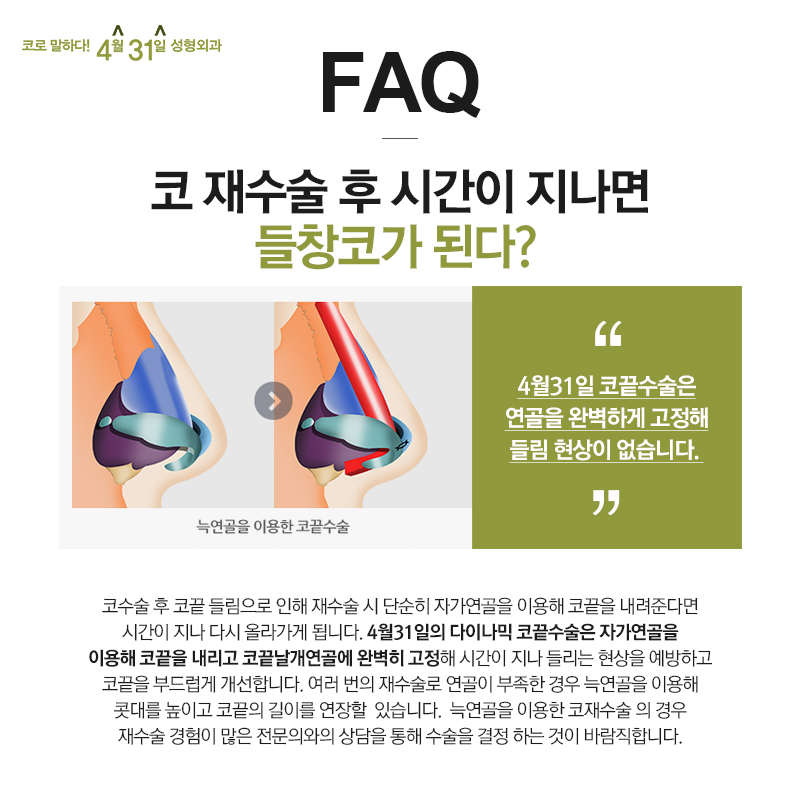
Among these, contracture symptoms such as a hard, immobile nasal tip and an upturned nose
will return over time if the tip is simply lowered using autologous cartilage.
At 4/31, through dynamic nasal tip surgery,
autologous cartilage is used to lower the nasal tip and it is firmly fixed to the alar cartilage,
preventing the tip from rising again over time
and improving the tip in a softer way.
If there is insufficient cartilage due to multiple revision surgeries,
rib cartilage can be used to raise the bridge and extend the length of the nasal tip.
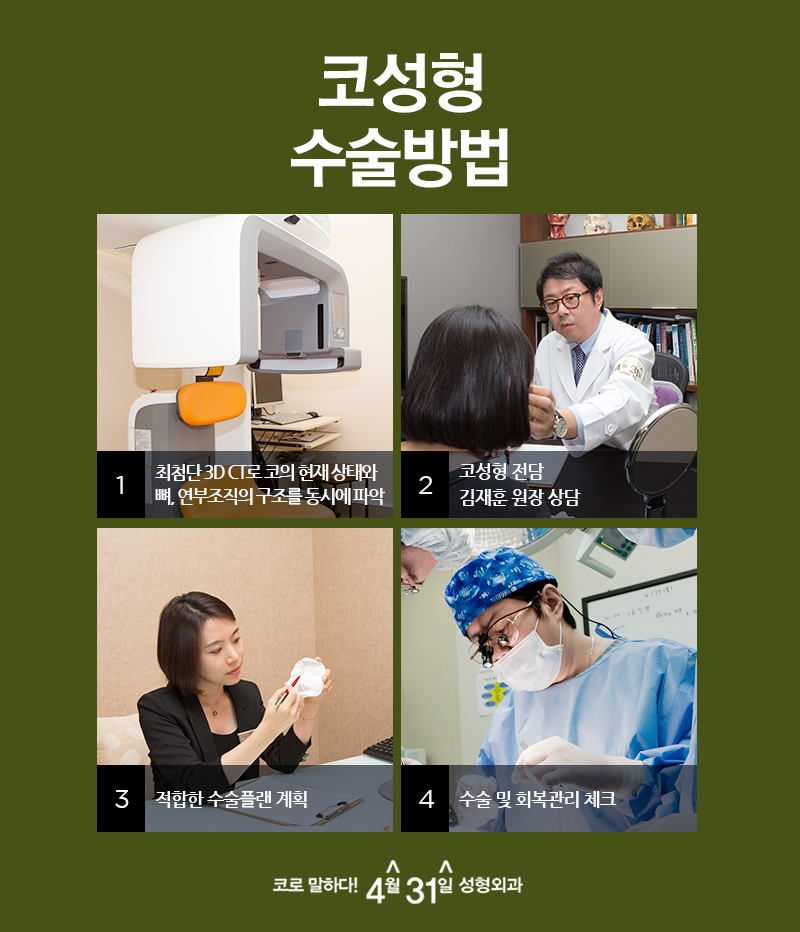
To proceed with the method that is truly right for you,
it is important to carry out the procedure with a detailed approach.
At our clinic, through 3D-CT,
we identify the current condition of the nose and the structure of the bone and soft tissue simultaneously in both 2D and 3D.
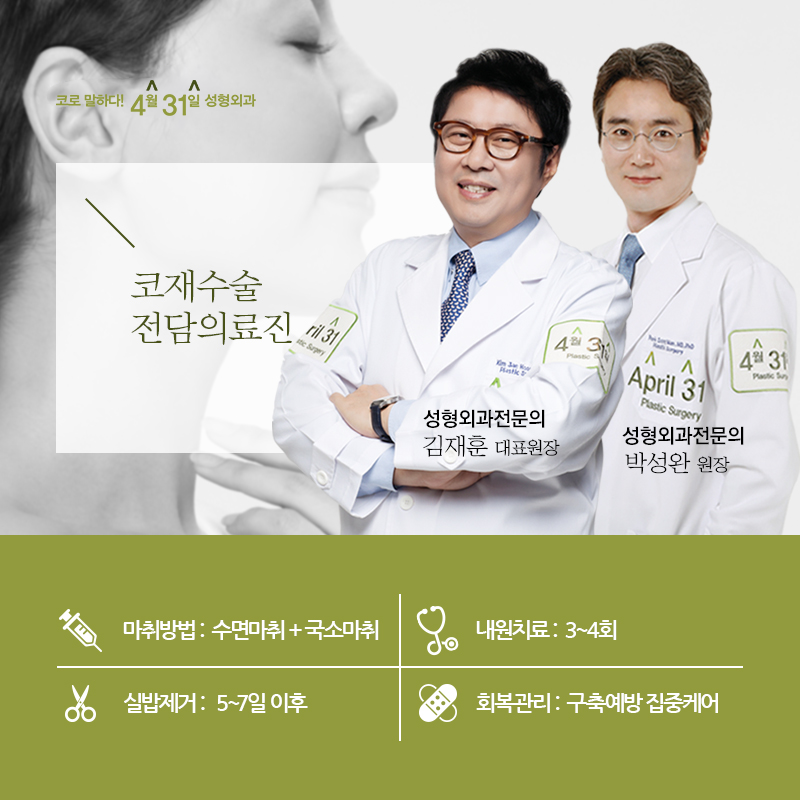
One of the desirable criteria for choosing a rhinoplasty clinic is
finding a board-certified specialist.
At our clinic, the rhinoplasty department is directly handled by
board-certified plastic surgeon Director Kim Jae-hoon and board-certified plastic surgeon Director Park Seong-wan,
so above all, you can expect results that remain natural over time
and do not develop other problems.
If you want to proceed in a direction that creates a line that looks naturally like your original nose line,
rather than a trendy line?
Please click the banner below for detailed inquiries and consultation requests.