How can you improve eyelids that look more aged than just using under-eye hollow fillers?

If we excluded electronic devices from everyday life, it would be impossible to get through daily living.
Electronic devices have become deeply integrated into our lives and provide convenience.
But as with everything, there are pros and cons.
Even electronic devices, which seem only beneficial, have drawbacks.
This is a health-related issue:
They cause eye fatigue.
In addition to electronic devices,
there are many environments that increase eye strain,
so recently, people of all ages have often been complaining of tired eyes.
In particular, middle-aged people who lack fat in the eyelids due to aging feel that discomfort more strongly.
Not only that, but the appearance also makes them look older and more tired,
so more and more people are looking for ways to improve sunken eyelids.

Then what exactly causes the eyelids to sink?
First, as mentioned earlier, it is due to aging.
As you get older, the skin sags and the fat layer decreases.
This happens because the subcutaneous fat around the eyes, where the skin on the face is thinnest, becomes reduced.
Other causes of sunken eyelids even at a relatively young age include
excessive dieting and bad habits such as rubbing the eyes.
As mentioned, sunken eyelids do not only make you look tired and older externally,
but also weaken the force used to open the eyes,
which can cause eye fatigue, dry eye syndrome, and ptosis, so improvement is necessary.
In the past, to improve sunken eyelids,
people chose under-eye hollow fillers or eyelid fat grafting as options.
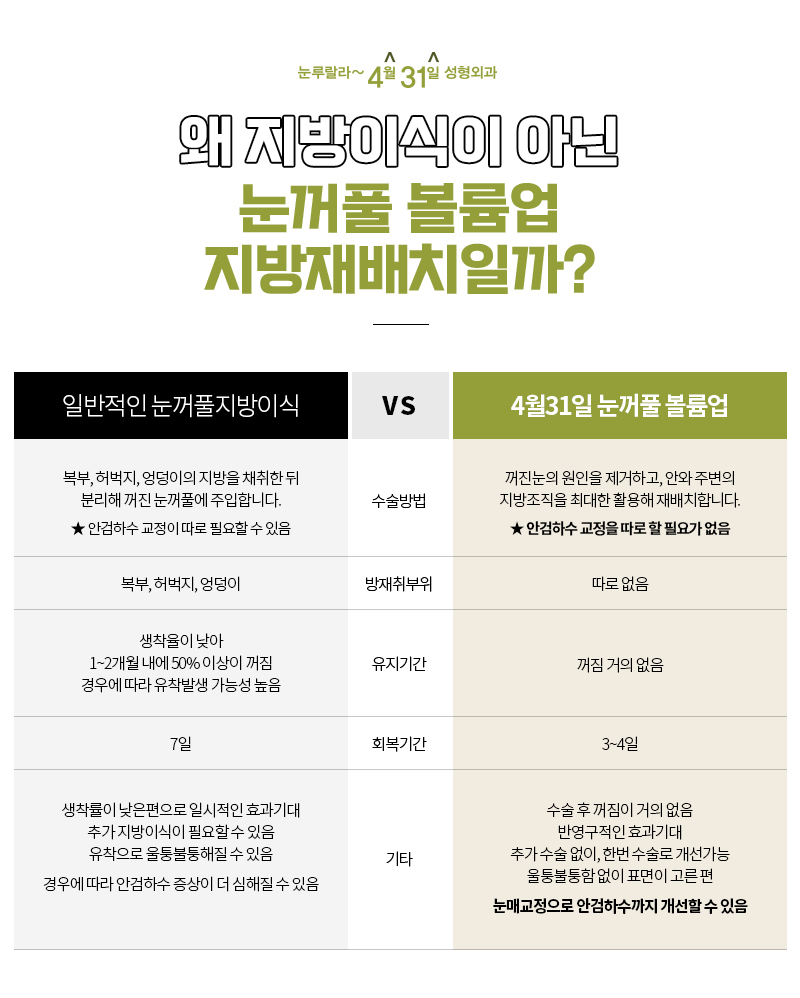
In the case of under-eye hollow fillers, the maintenance period is short,
there may be adhesions that make the surface uneven,
and if a repeat procedure or surgery is performed later,
there are disadvantages such as needing a removal surgery or an injection to dissolve the filler.
In the case of eyelid fat grafting, since fat is harvested and then injected,
the survival rate is low, and more than 50% may subside within 1 to 2 months.
Depending on the case, there is also a high possibility of adhesion,
and additional fat grafting may be needed.
Both under-eye hollow fillers and eyelid fat grafting are methods that separately require ptosis correction,
so it may have been difficult to decide which method would be best for improvement.

For people like this, today we will introduce eyelid volume-up.
Eyelid volume-up is a method that pulls down the fat hidden behind the eyebrows
and redistributes it to the sunken eyelid area.
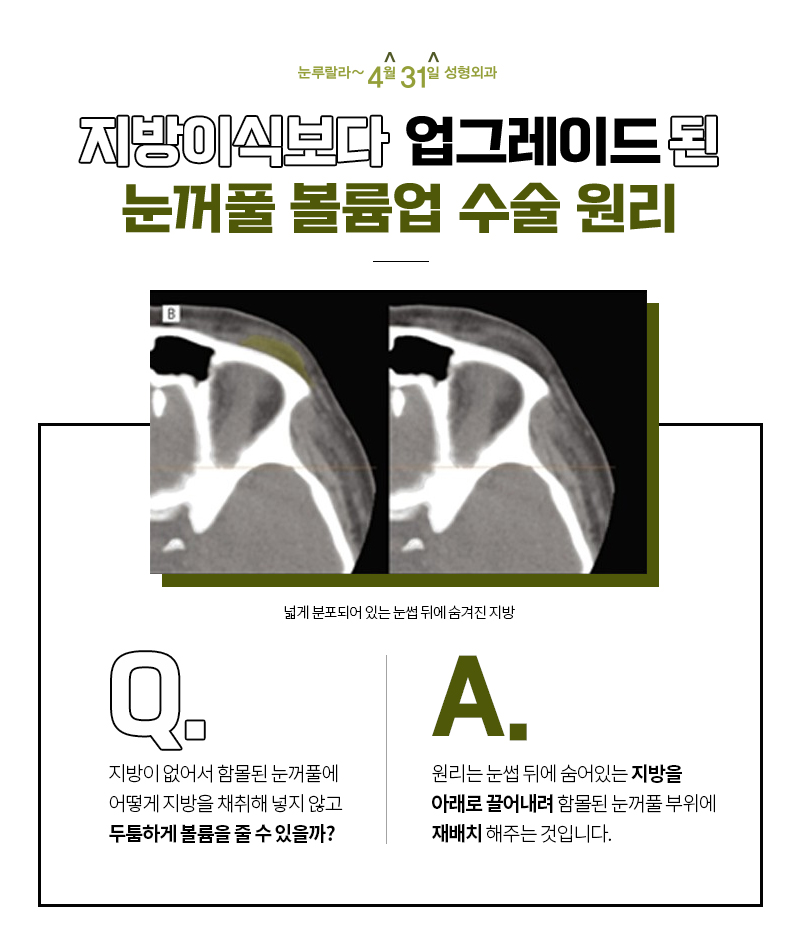
You may wonder how volume can be added to a sunken eyelid that lacks fat,
without harvesting fat and putting it in.
If you pinch above and below the eyebrows with both fingers,
you can notice the hidden fat being gathered.

Eyelid volume-up is a method that removes the cause of hollow eyes
and makes the most of the fat tissue around the orbit by redistributing it.
Because it is a redistribution method rather than a fat-harvesting method,
there is no need to worry about hollowing caused by survival rates,
and improvement is possible with a single procedure without additional surgery.
In addition, the surface tends to be even without bumpiness,
and it is a method that can also improve ptosis through eye shape correction.
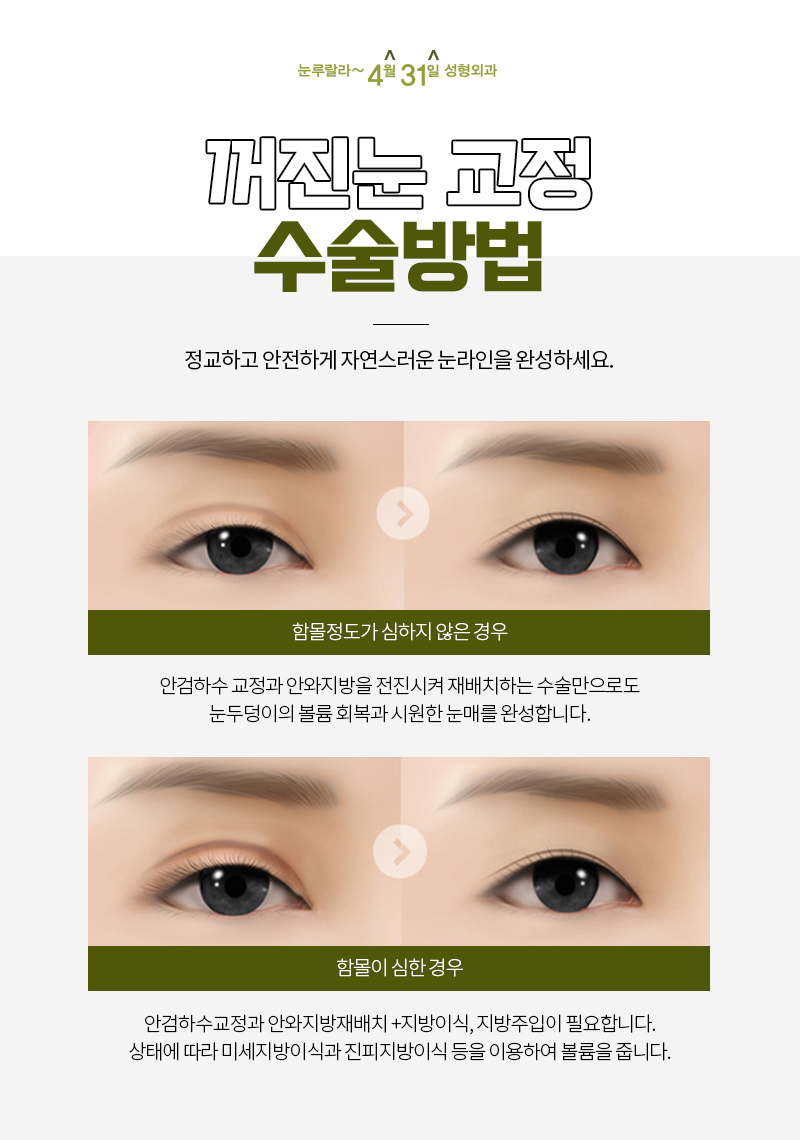
The method used to improve the eyelid area varies from person to person,
so it is important to proceed with the method that fits each case.
If the degree of hollowing is not severe,
volume recovery in the eyelid area and a refreshed eye shape can be achieved with only ptosis correction and anterior repositioning of orbital fat.
If the degree of hollowing is severe,
ptosis correction, orbital fat repositioning, fat grafting, and fat injection may be needed,
and depending on the condition, volume is provided using micro-fat grafting or dermofat grafting.
Although eyelid volume-up is a simple principle,
for the process of cleanly separating and repositioning the fat to proceed smoothly,
it is advisable to visit experienced medical staff based on a range of accumulated know-how.

At 4/31 Plastic Surgery,
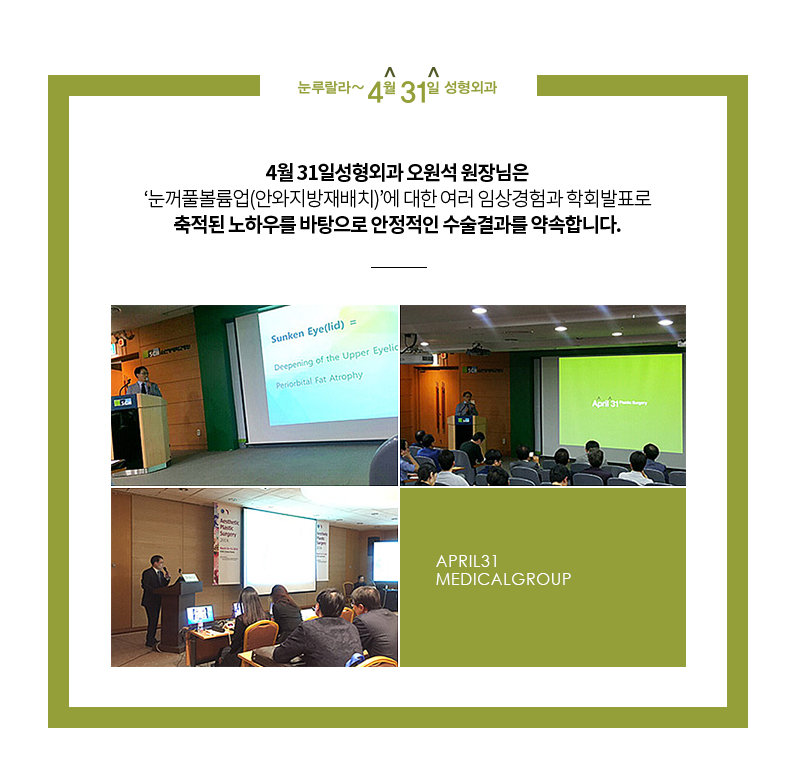
Dr. Oh Won-seok, a board-certified plastic surgeon dedicated to eye surgery,
can offer stable results based on extensive clinical experience and conference presentations.
For detailed inquiries and consultation requests, please click the banner below.