If You Want to Correct Sunken Upper Eyelids?

Looking youthful is something preferred by people of all ages and genders. That is why many people look into the factors that can help them appear younger.
There are many factors that can contribute to a youthful appearance.
While there are various things such as plump cheeks and large eyes,
today we would like to talk about voluminous upper eyelids.
Facial volume gives the face dimension, making it look smaller as well as younger.
For this reason, people with sunken upper eyelids often become concerned about it.

Sunken upper eyelids can make you look tired externally and
make you look older than you are,
and functionally, they can make it difficult to open your eyes,
so in addition to eye fatigue and dry eyes,
they can also cause ptosis,
which is why correction is necessary.
To solve the problem, it is first necessary to approach the fundamental cause.
So why does sunken upper eyelid occur?
Most people who are concerned about improving sunken upper eyelids
experience drooping eyelids due to the aging process.
This is because the skin around the eyes is the thinnest area on the face
and is one of the first places where signs of aging appear.
For younger people who complain of drooping eyelids, the reasons can include
excessive dieting, habits such as rubbing the eyes,
or genetic factors.
So you may be wondering how to solve this problem,
and today we will take a look at the upper eyelid volume-up procedure at April 31.

Upper eyelid volume-up is a method that gives volume to the eyelids
by rearranging the orbital fat around the eyes.
In other words, it refers to a method of pulling down the fat hidden behind the brows
and repositioning it in the sunken eyelid area.

You may be wondering how fat can exist in sunken eyes with reduced volume,
but even when the eyelids are sunken due to aging or ptosis, hidden fat remains behind the brows.
This can be confirmed when you pinch the brow with two fingers.
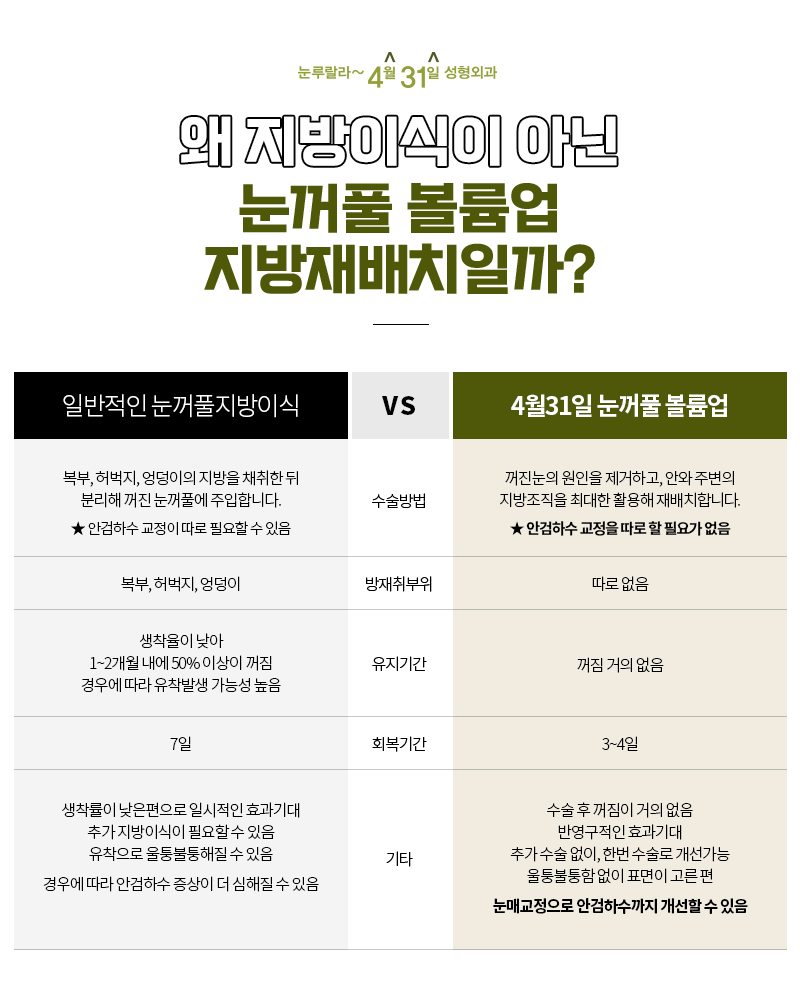
You may be wondering why we recommend upper eyelid volume-up instead of the upper eyelid fat grafting that many people have undergone.
In the case of upper eyelid fat grafting,
fat was harvested from areas with a lot of fat such as the abdomen, thighs, or buttocks, then separated
and injected into the sunken eyelids.
When fat was harvested from another area and injected,
the retention rate, which is the chance that the fat survives, was an important factor in determining how long the results lasted.
Because the retention rate of upper eyelid fat grafting was low, more than 50% of it would subside within 1 to 2 months,
and depending on the case, there was a high possibility of adhesions that made the surface uneven.
In addition, additional fat grafting may be needed, and in some cases, ptosis symptoms may worsen,
which meant that separate ptosis correction had to be performed.
In contrast, upper eyelid volume-up removes the cause of sunken eyes
and uses the fat tissue around the orbit for repositioning,
so there is no issue with the maintenance period related to the survival rate.
In addition, improvement is possible with a single surgery without additional procedures,
and the surface tends to be smooth without unevenness.
Moreover, upper eyelid volume-up can improve ptosis through eye shape correction
without the need for separate ptosis correction.
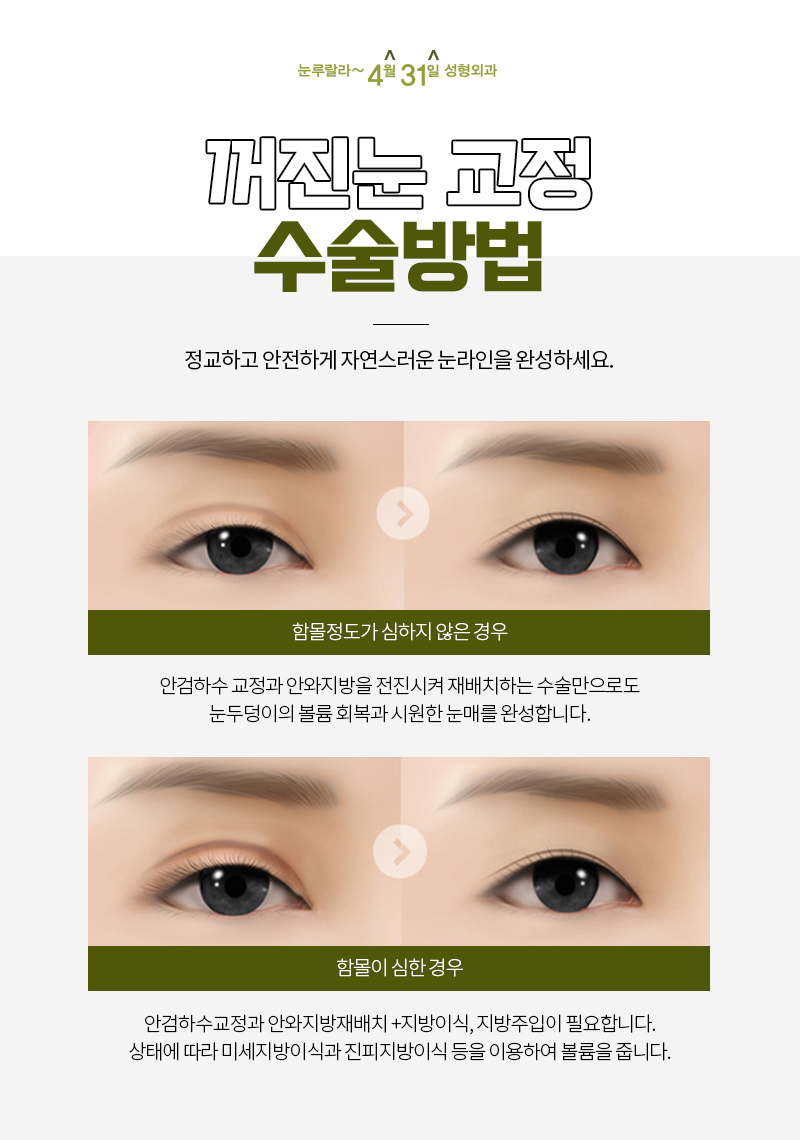
The degree of eyelid hollowness varies from person to person,
so it is important to improve it according to the degree of hollowness and the symptoms.
If the degree of hollowness is not severe,
volume recovery of the upper eyelids and a refreshed eye shape can be achieved with only ptosis correction and surgery to advance and reposition the orbital fat.
If the degree of hollowness is severe,
ptosis correction, orbital fat repositioning, fat grafting, and fat injection are needed.
Also, depending on the condition, volume is added using microfat grafting and dermal-fat grafting.
The eyes that determine appearance play an important role not only aesthetically
but also functionally, so it is very important to consider both aspects when proceeding.
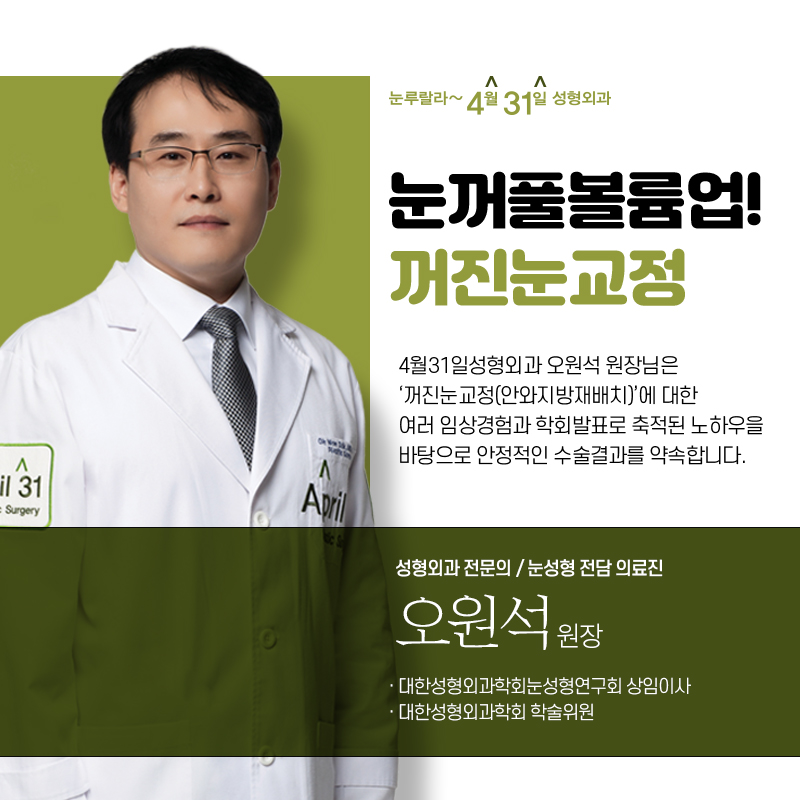
April 31 eye plastic surgery specialist and plastic surgeon Director Oh Won-seok
provides one-on-one consultations and checks customized surgery and recovery care based on photo analysis of the current condition and structure.
If you want to return to a youthful appearance,
please click the banner below for detailed inquiries and consultation requests.