If You Want to Correct Your Nose Completely, Down to the Tip, with Revision Rhinoplasty?

Although we say we are moving beyond an era that prioritizes appearance,
people still look for attractiveness in outward appearance, and when meeting someone for the first time,
we tend to look at their appearance and think about and evaluate their image.
If there is a complex about an external feature, we look into ways to remove or hide it,
and while it would be nice if our appearance could change exactly as we want,
unfortunately our image does not always turn out the way we want.
The nose is located at the center of the face.
Many people say they look at the nose when talking to someone,
and it is one of the first areas the eyes are drawn to.
If a problem arises in this area, it can create an imbalance in overall beauty,
so it is better to shape it in a way that harmonizes with the overall balance of the face.
However, even if it is created the way you want, various problems can occur,
such as secondary issues caused by not managing it properly.

In the case of the nose, it is among the areas that have a relatively high chance of needing correction again, even among procedures that improve appearance.
This is because the overall surgery rate is high, and the skill and aesthetic sense of the medical team
have a major impact on the result.
If you want to correct everything down to the tip through revision rhinoplasty, not for the first time but again,
you should receive a careful consultation and make your decision at a place that can identify the cause of the problem and proceed accordingly.
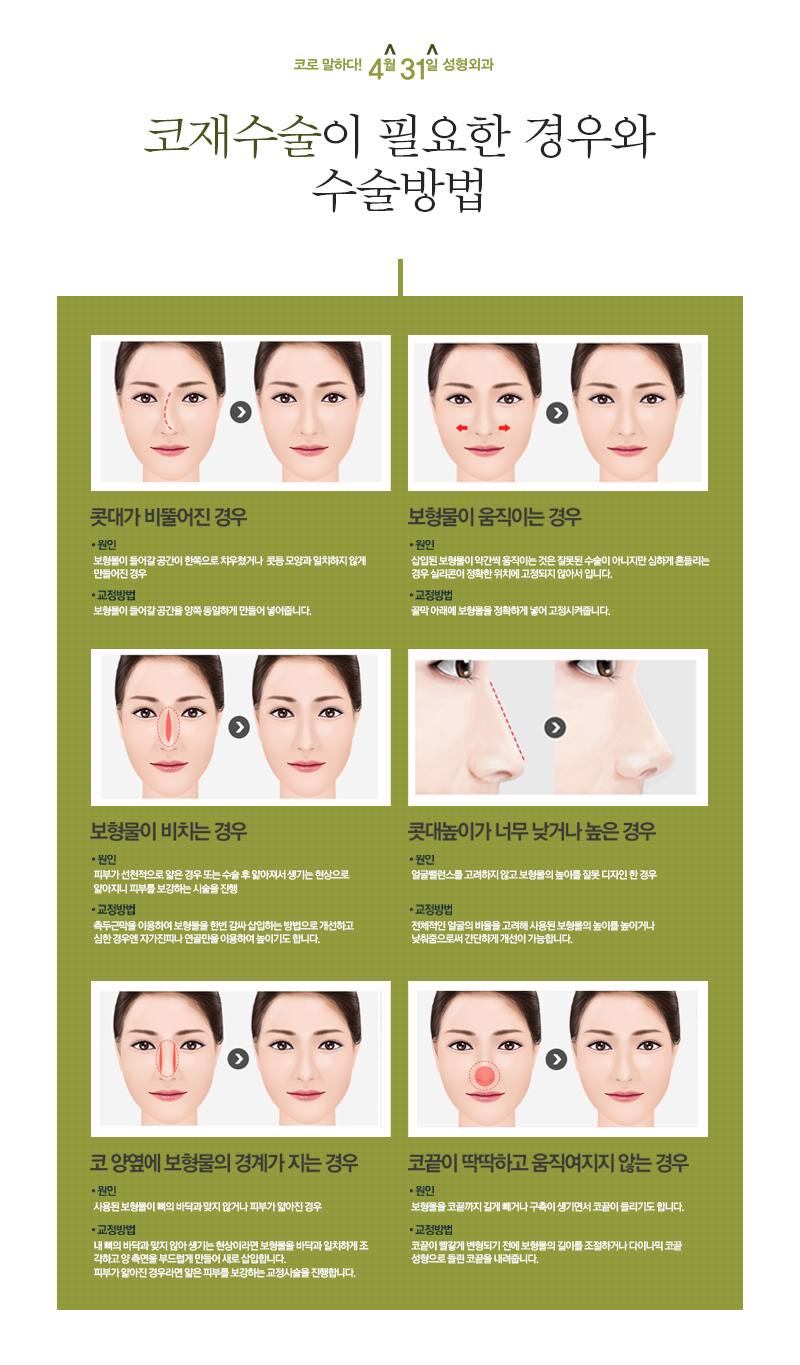
In revision rhinoplasty, there are many problems that can occur for anyone, including secondary issues.
Therefore, it is important to proceed with the appropriate method according to each cause.
There are various possible causes.
If the space for the implant is偏 to one side or if it was made so that it does not match the shape of the bridge,
and the bridge is crooked,
then improvement is made by creating the space for the implant equally on both sides before inserting it.
A slight movement of an inserted implant is not necessarily wrong, but
if the silicone is not fixed in the correct position and the implant moves significantly,
then improvement is made by placing the implant accurately under the periosteum and fixing it there.
If the skin is congenitally thin or has become thin after surgery,
and the implant shows through,
then improvement is made by wrapping the implant once with the temporal fascia before insertion,
and in severe cases, height may be increased using only autologous dermis or cartilage.
If the implant height was incorrectly designed without considering facial balance,
and the bridge height is too low or too high,
then it is simply improved by raising or lowering the height of the implant used while considering the overall proportions of the face.
If the implant used does not match the base of the bone or the skin has become thin,
and the border of the implant appears along both sides of the nose,
then improvement is provided according to the cause.
If it is a phenomenon caused by not matching the base of my bone,
the implant is carved to match the base and the sides are smoothed before reinsertion,
which improves the result.
If the skin has become thin, the condition is improved with a corrective procedure that reinforces the thin skin.
If the implant has been extended too far to the tip of the nose or contracture has developed,
and the tip is stiff and does not move,
then before the tip turns red and becomes deformed, the length of the implant is adjusted,
or a dynamic tip procedure is used to lower a lifted tip.

Among the various causes, contracture symptoms such as a stiff, immobile tip
and an upturned nose cannot be completely prevented simply by lowering the tip with autologous cartilage;
with time, it may rise again.
At April 31, through dynamic tip surgery,
the tip is lowered using autologous cartilage and firmly fixed to the alar cartilage,
helping prevent the tip from lifting again over time and improving the tip in a softer way.
If cartilage is insufficient due to multiple revision surgeries,
rib cartilage can be used to raise the bridge and extend the length of the tip.
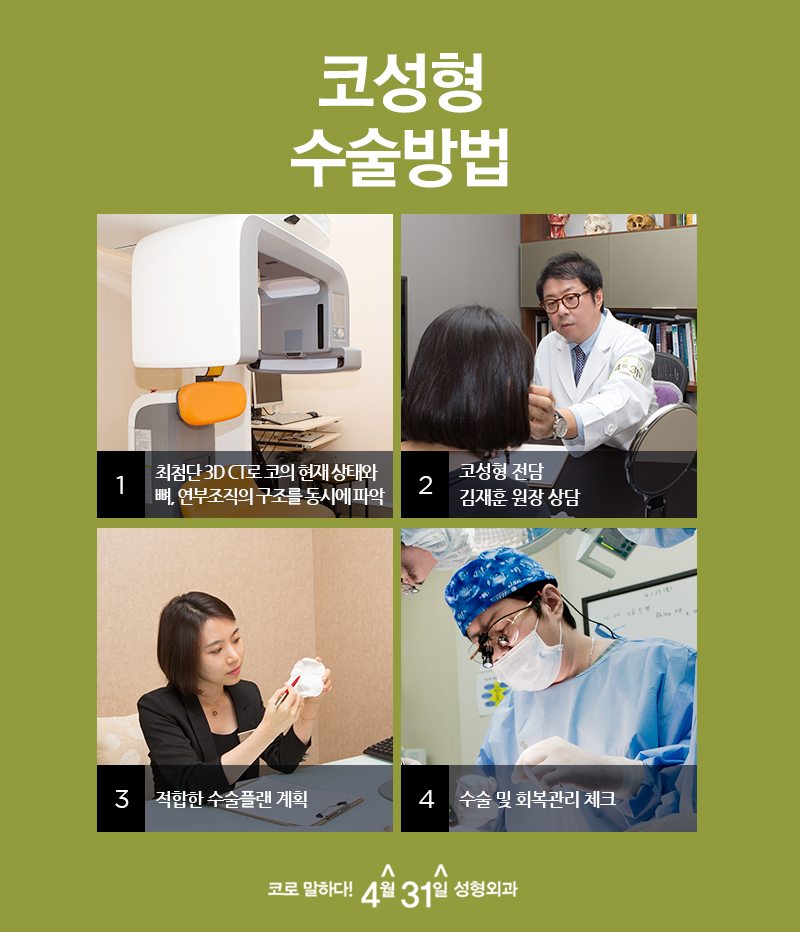
If you want to completely correct your nose, down to the tip, with revision rhinoplasty here,
more than anything else, it is important to identify the cause through a detailed examination.
At our clinic, we use 3D-CT to check carefully and proceed with the method appropriate to the cause.
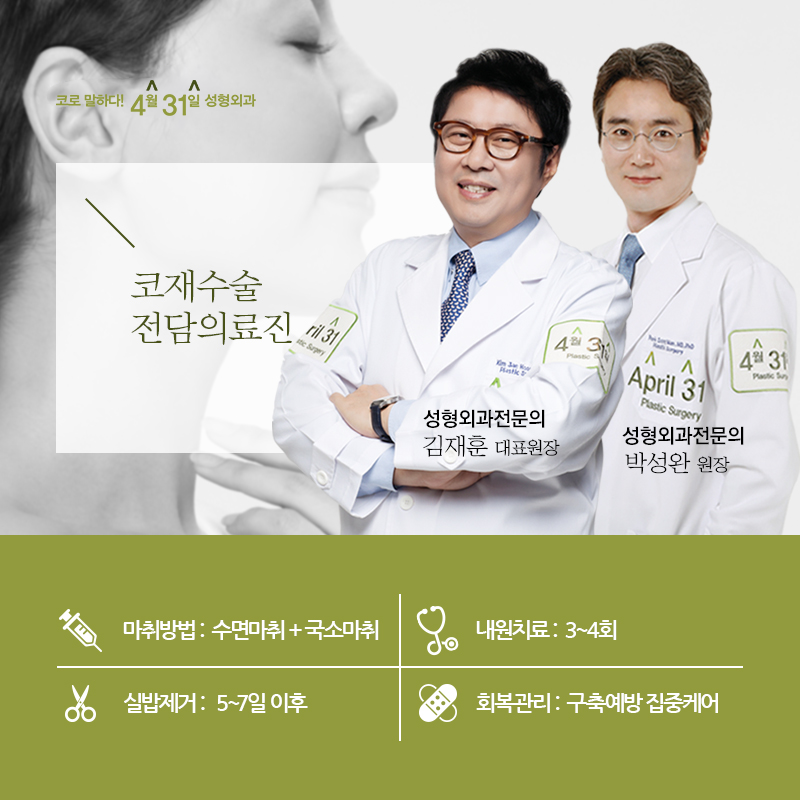
April 31’s dedicated rhinoplasty team
Together with Plastic Surgery Specialist and Chief Director Kim Jae-hoon, and Plastic Surgery Specialist Dr. Park Sung-wan,
create the nose line you want!
For detailed inquiries and consultation requests, please click the banner below.