Recently, many people have been making efforts for beauty.
When you first meet someone, you cannot know their inner qualities,
so it is likely that you pay more attention to outward appearance.
There are various aspects of appearance that need attention.
Among them, the most common area people think about improving is the facial features.
Among the facial features, the nose is the most three-dimensional part of the face,
and because it affects both the front and side views,
many people want to improve it.
However, for those who underwent a procedure to become more beautiful but still feel disappointed,
they often look into revision surgery for a contracted nose.

If this is not the first surgery but a revision rhinoplasty that also needs correction of the tip,
you should first identify why this problem occurred and choose a place that can proceed accordingly,
after receiving a thorough consultation before deciding.
If a problem has occurred, not only may confidence in appearance decline, but functional issues can also arise,
so many people look into revision surgery for a contracted nose and wonder whether they need correction again.
When performing revision surgery for a contracted nose, there are many problems that can occur for anyone, including secondary issues.
Because there are various causes, if such a case happens to you,
it is important to identify the cause and symptoms and find the method that suits you.
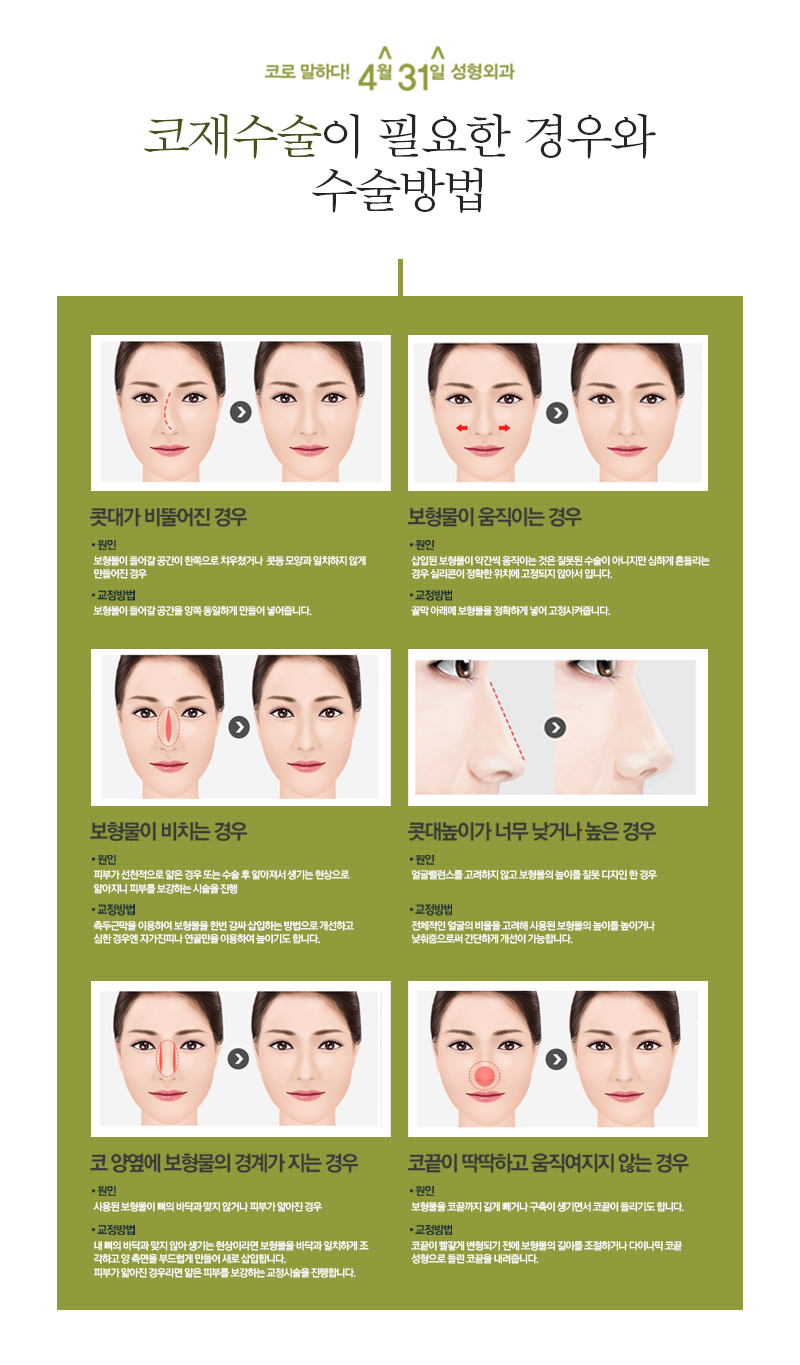
If the space for the implant is偏 to one side or is made in a way that does not match the shape of the nasal bridge,
resulting in a crooked bridge,
the implant space is made equally on both sides and the implant is placed to improve it.
Slight movement of an inserted implant is not necessarily wrong, but
if the silicone is not fixed in the correct position and the implant moves significantly,
the implant is placed accurately under the periosteum and fixed to improve it.
If the skin is congenitally thin or has become thinner after surgery,
causing the implant to show through,
the condition is improved by wrapping the implant once with temporal fascia before insertion,
and in severe cases, height may be increased using only autologous dermis or cartilage.
If the implant height was designed incorrectly without considering facial balance,
and the nasal bridge is too low or too high,
the overall facial proportions are considered,
and the implant height is simply raised or lowered to improve it.
If the implant used does not match the base of the bone, or if the skin has become thin,
causing the edges of the implant to show on both sides of the nose, the condition is improved according to the cause.
If it is a phenomenon caused by a mismatch with the bone base,
the implant is carved to match the base and the sides are smoothed out
and then reinserted to improve it.
If the skin has become thin, it is improved with corrective surgery that reinforces the thin skin.
If the implant is extended too far to the nasal tip, or if contraction occurs,
causing the tip to become stiff and immobile,
the length of the implant is adjusted before the tip turns red and deforms,
or a dynamic tip surgery is performed to lower an upturned tip.
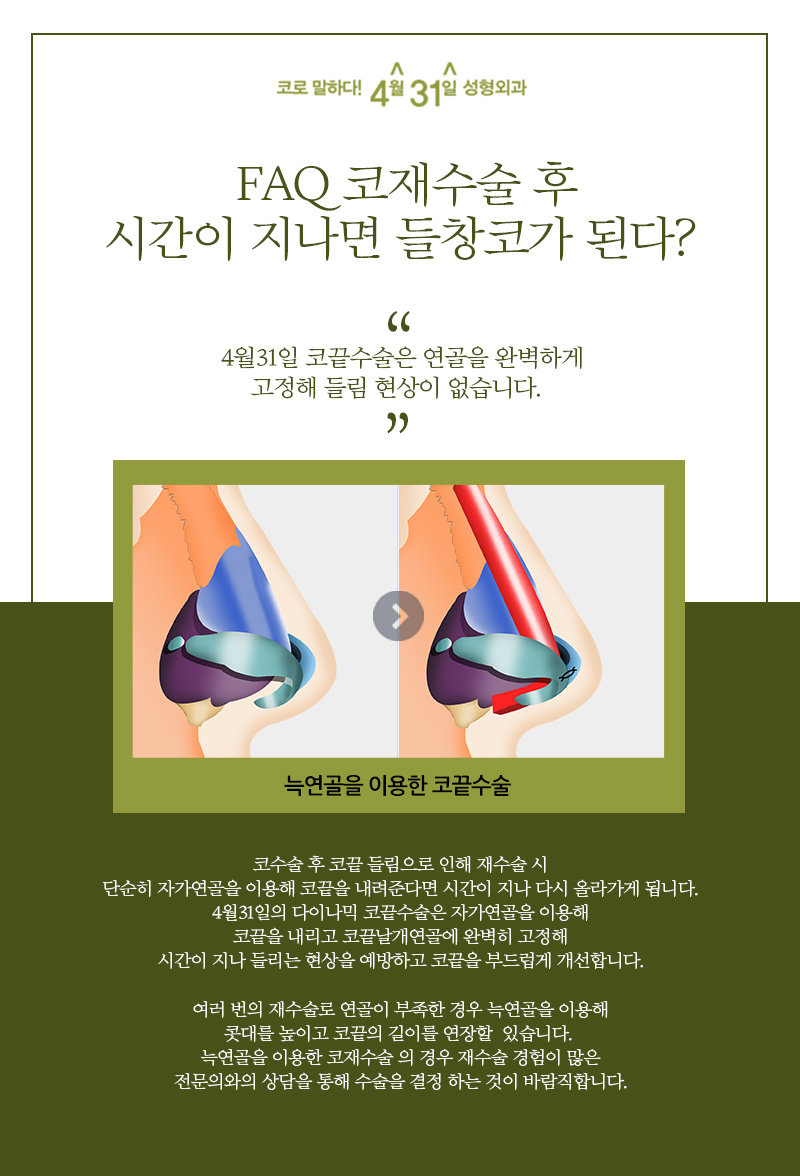
Among the various causes, contracture phenomena such as the nasal tip becoming stiff and immobile
and turning into a snub nose cannot be fully corrected simply by lowering the tip with autologous cartilage,
because it may rise again over time.
At April 31, through dynamic tip surgery,
autologous cartilage is used to lower the tip and it is firmly fixed to the alar cartilage,
preventing it from rising again over time and improving the tip more smoothly.
If there is a shortage of cartilage due to multiple revision surgeries,
rib cartilage can be used to raise the nasal bridge and extend the length of the tip.
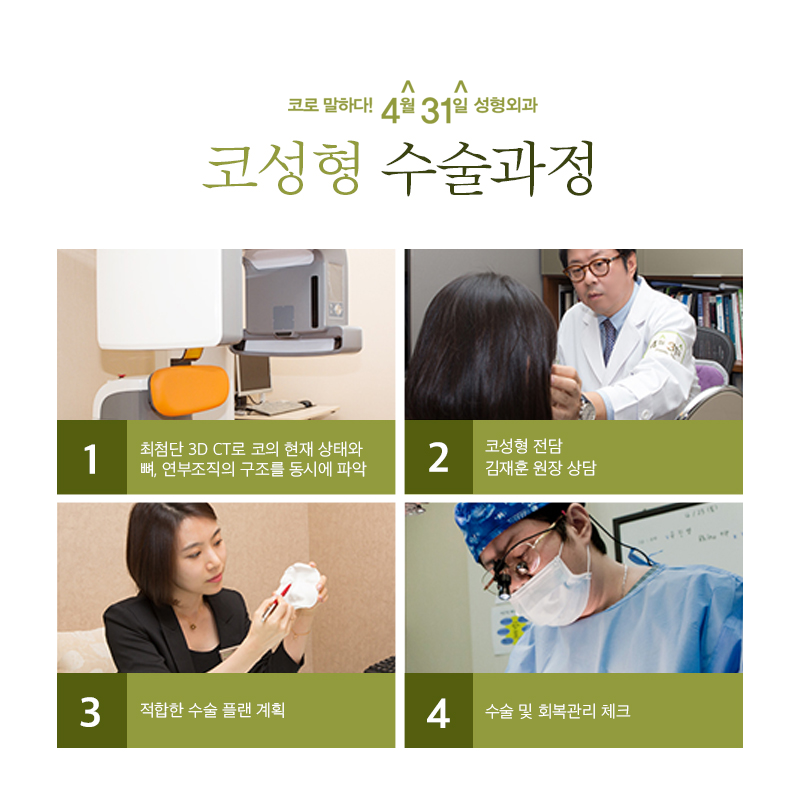
If you want to perfectly correct even the nasal tip through revision surgery for a contracted nose here,
what matters most above all else is identifying the cause through a detailed examination.
At our clinic, we carefully check using 3D-CT and proceed with a method tailored to the cause.
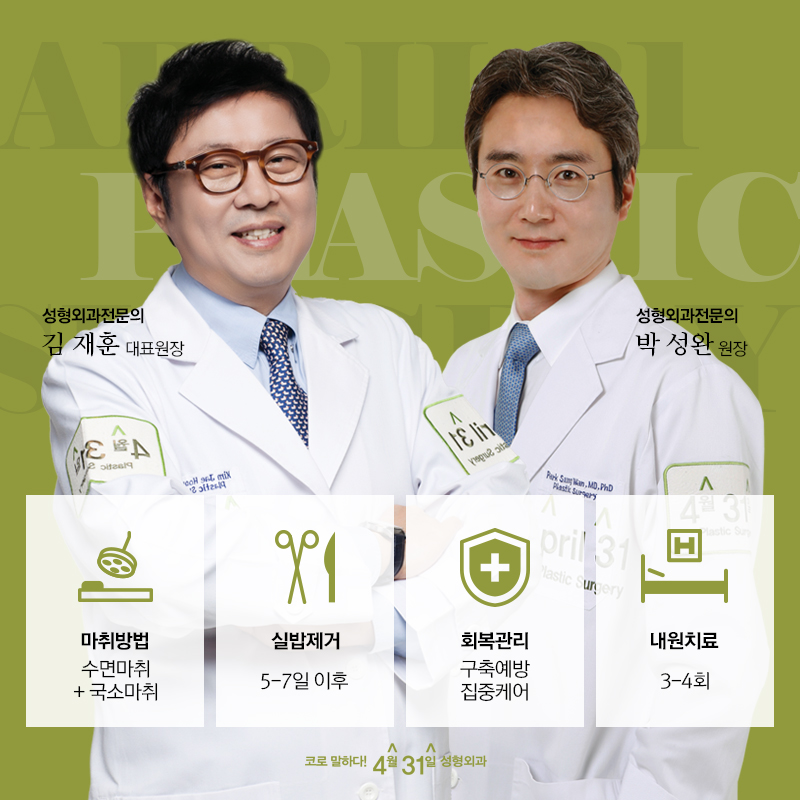
At April 31, with the rhinoplasty specialists
and together with Chief Director Kim Jae-hoon, a board-certified plastic surgeon, and Director Park Seong-wan, a board-certified plastic surgeon,
we hope you can expect the results you want through revision surgery for a contracted nose that accurately identifies the cause and symptoms.
For detailed inquiries and consultation requests, please click the banner below.