
The word “first” always feels exciting.
Recently, as medical technology has advanced and become more widely available,
more and more people are seeking to correct external complexes.
There are many different ways to improve appearance,
but among them, many people consider changing the nose because even a small change can greatly improve the overall image.

Because the nose is the center of the face and also the most three-dimensional feature,
it has a major impact on appearance and also plays an important functional role.
For that reason, when proceeding with nose improvement,
it is important to create a nose shape that achieves harmony and balance while considering the proportions of the face.
Thinking about these points, you may have wondered where you should go.
When you first consider improving the nose,
there are important points to keep in mind.
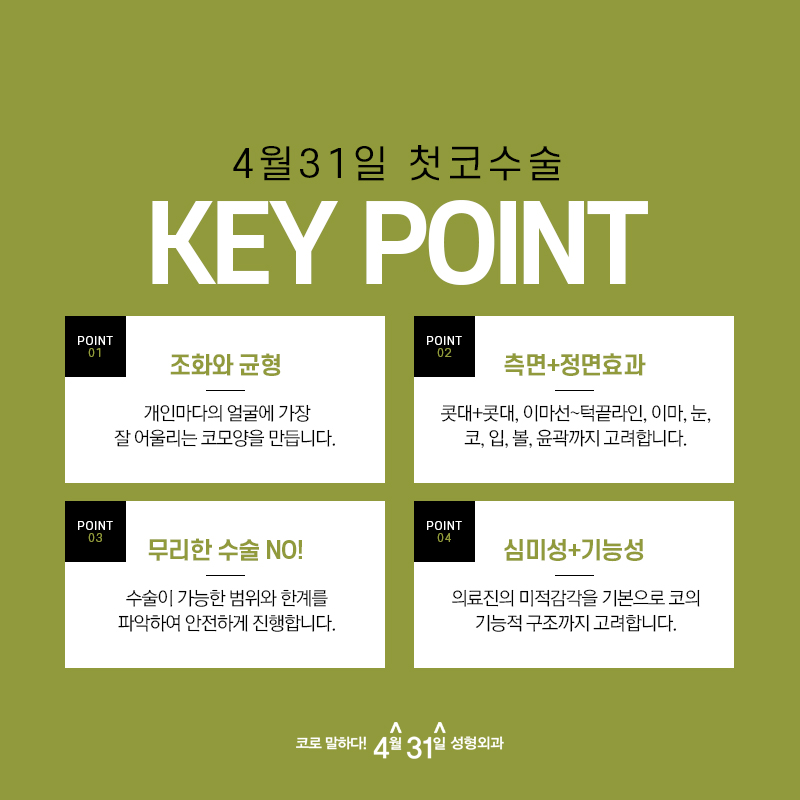
First, you should consider harmony and balance
so that you can create the nose shape that best suits each individual face.
Also, because it is the most three-dimensional area of the face,
it is necessary to consider the effects from the side and the front by taking into account everything from the bridge line and the forehead line to the chin tip line, forehead, eyes, nose, mouth, cheeks, and facial contour.
It is also important to understand the possible range and limitations
and not proceed in an excessive way.
Lastly, based on the medical team’s sense of aesthetics,
it is also an important point to consider both aesthetics and functionality
by taking into account the functional structure of the nose as well.
In order to proceed with a customized method according to each case,
April 31 Plastic Surgery focuses on a balance technique.
Considering the overall proportions of the upper, middle, and lower face,
creating the bridge height, tip shape, and nose line is the key point for an ideal procedure.
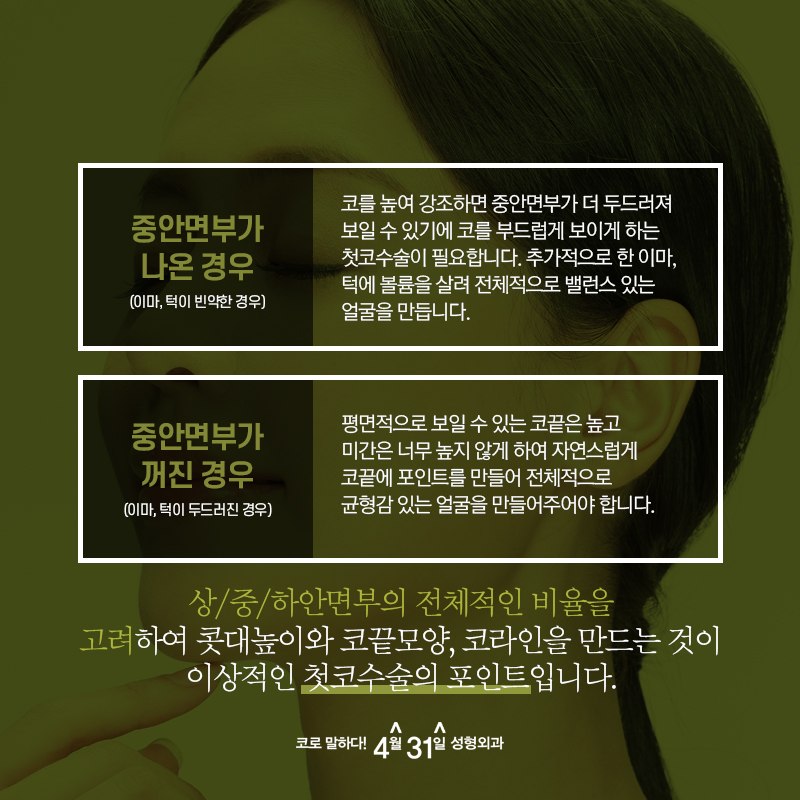
First, when the forehead and chin are underdeveloped and the midface appears prominent,
simply raising the nose may make the midface look even more pronounced,
so a method that makes the nose appear softer is needed.
In addition, volume is added to the forehead and chin to create an overall balanced face.
When the forehead and chin are prominent and the midface appears recessed,
the nose tip, which may otherwise look flat, should be made higher while the glabella is not made too high,
so that a natural point is created at the nose tip
and the face as a whole becomes more balanced.
Among the various nose shapes, many people look for bulbous nose surgery in particular
in order to create a line for the nose, the center of the face.
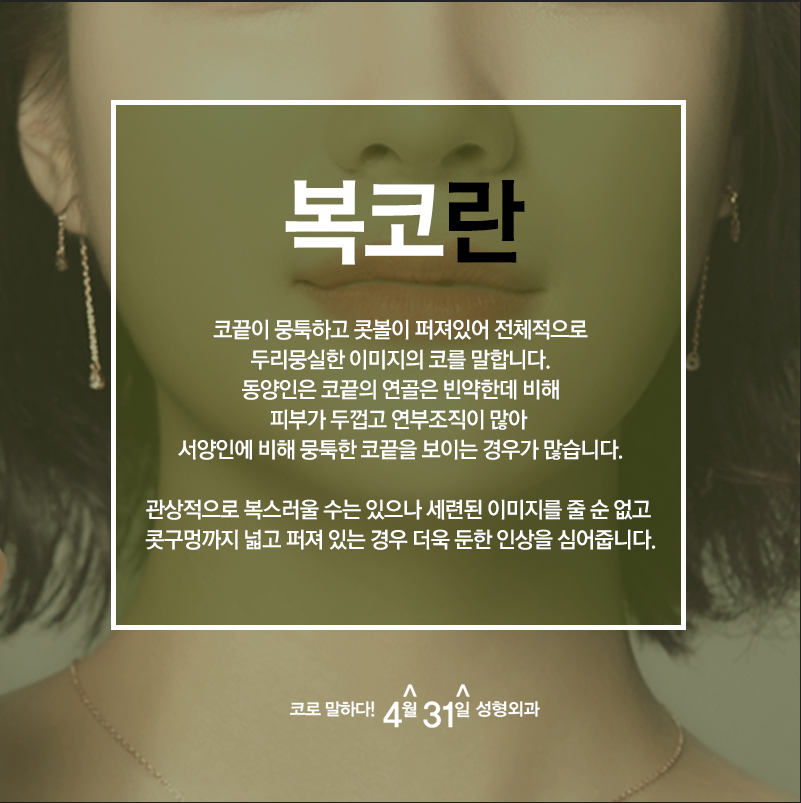
A bulbous nose refers to a nose with a blunt tip and wide nostrils, giving the overall impression of a rounded nose.
In particular, in the case of East Asians, the cartilage at the nose tip is often underdeveloped, while the skin is thick and there is a lot of soft tissue,
so a blunt nose tip is more common than in Westerners.
A bulbous nose may be considered fortunate in face reading,
but it does not create a refined image,
and when the nostrils are also wide and spread out, it gives an even duller impression.
For this reason, many people seek bulbous nose surgery
in order to improve the line of the nose, the center of the face.
A bulbous nose can develop for various reasons.
When trying to improve the nose, the center of the face, through bulbous nose surgery,
it is important not only to proceed with an appropriate design according to the cause
but also to use the appropriate method according to the cause.
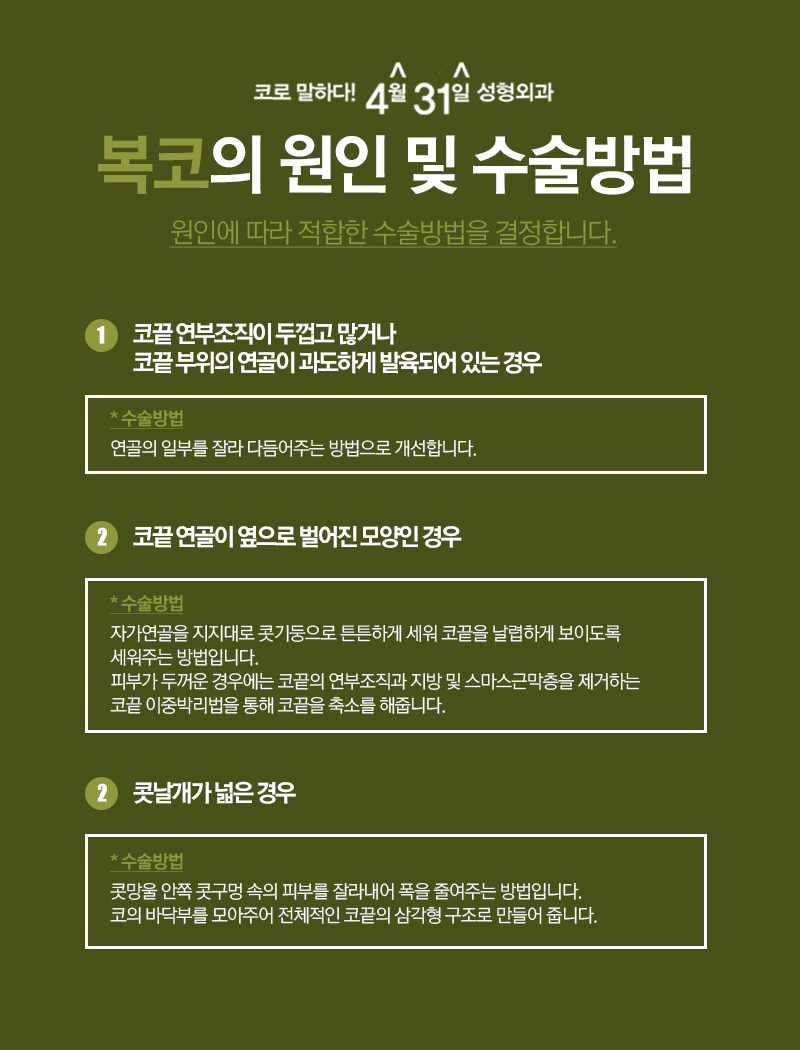
If the soft tissue at the nose tip is thick and excessive, or if the cartilage in the nose tip area has overdeveloped,
we improve it by trimming part of the cartilage.
If the cartilage at the nose tip is spread outward,
we firmly support it with autologous cartilage as a columellar strut
and proceed with a method that sharpens the nose tip so it appears more defined.
If the skin is thick,
the nose tip is reduced through a double-dissection method that removes soft tissue, fat, and the SMAS fascial layer from the nose tip.
If the alar base is wide,
the width is reduced by removing skin from the inside of the nostril.
In addition, the base of the nose is brought together to create an overall triangular structure for the nose tip.
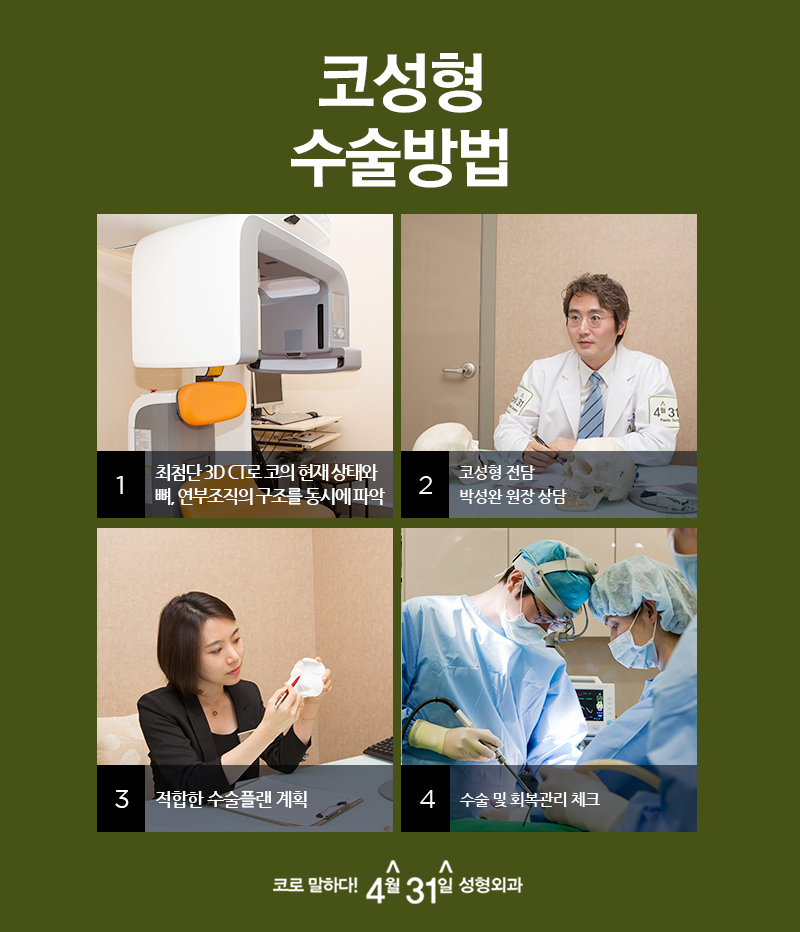
To determine the cause in each case,
it is necessary to understand the current condition of the nose and the structure of the bone and soft tissues.
For this, our clinic uses 3D-CT.
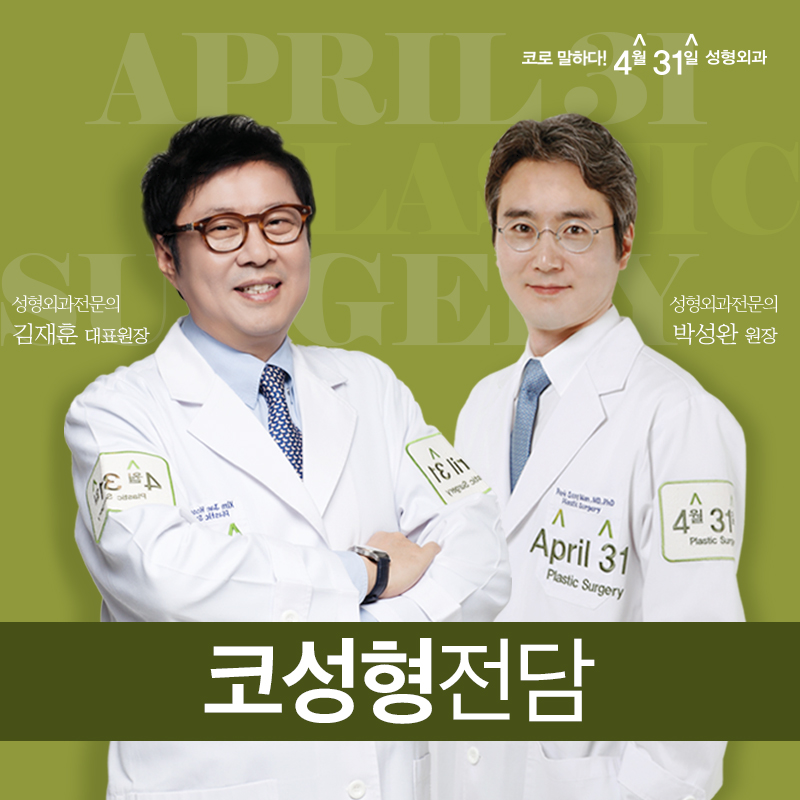
Also, in order to improve to the desired line,
Chief Director Kim Jae-hoon, a plastic surgery specialist dedicated to nose surgery, and Dr. Park Sung-wan, a plastic surgery specialist,
personally take care of everything from one-on-one consultations to customized surgery and recovery management.
For detailed inquiries and consultation requests, please click the banner below.