Although people say we are moving past an era that prioritizes appearance,
we still look at appearance when finding charm in outward features and meeting someone for the first time.
We see a person’s face, think about their image, and make judgments based on it.
If there is a complex about an outward feature, we look into ways to remove or hide it,
and while it would be nice if our appearance could change exactly as we want,
unfortunately our image does not always turn out the way we want it to.
The nose is located at the center of the face.
Many people look at the nose when talking, and it is said to be one of the areas that first draws the eye.
If there is an aesthetic issue in this area, it can create imbalance in the overall beauty,
so it is best to shape it so that it harmonizes with the overall facial balance.
Even if it is made the way you wanted, various problems can arise, such as secondary issues caused by improper care.
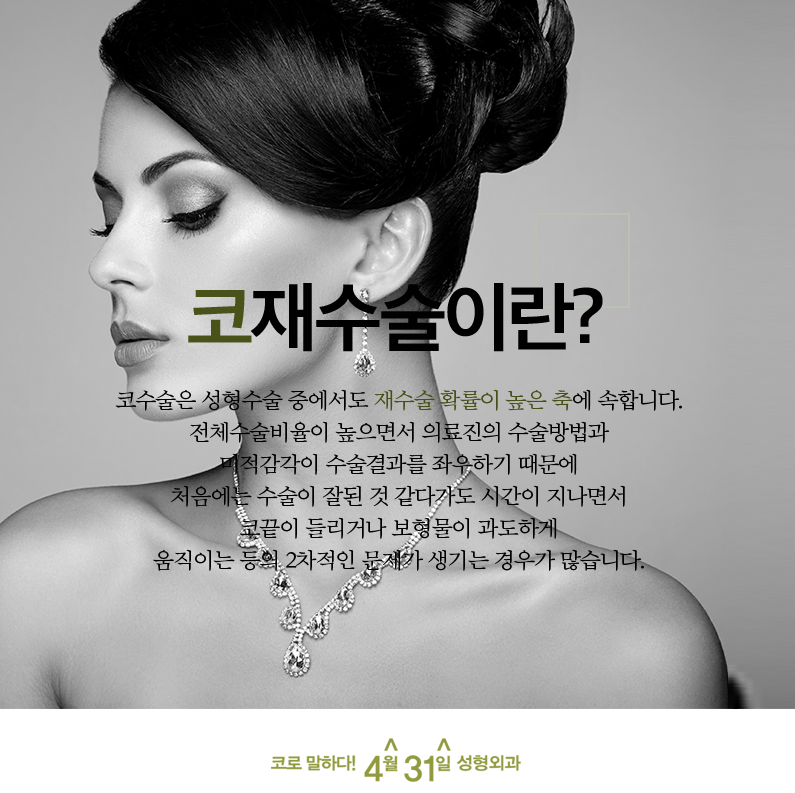
If you want to determine the cause of nose revision surgery, since it is not the first procedure but something that must be done again,
you should make your decision after receiving careful consultation at a place that can identify why the problem occurred and proceed accordingly.
Problems can also occur when an implant that does not suit you is used.
You may have wondered what you should do if this happens to you.
In particular, if such a problem occurs in a method that changes the nose line more than other areas,
it can reduce confidence in appearance and even cause functional problems,
so many people consider whether they should move forward only after understanding the cause of nose revision surgery.
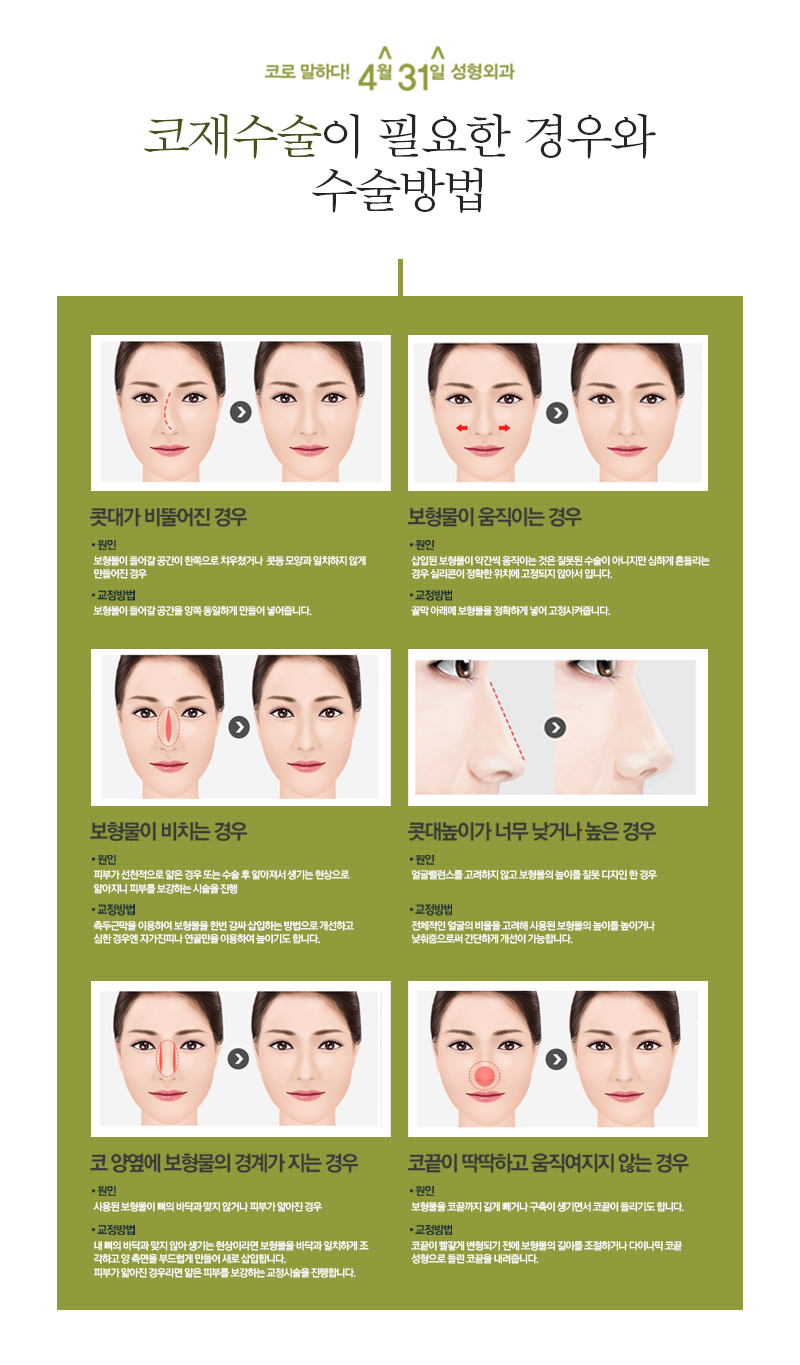
During nose revision surgery, the types of problems that can occur for anyone, including secondary issues, are varied.
That is why it is important to proceed with the appropriate method according to each cause.
There are many different causes.
If the space for the implant is偏 to one side or is made not to match the shape of the nasal bridge,
when the bridge is crooked,
we improve it by creating equal space on both sides and inserting the implant.
Minor movement of the inserted implant is not necessarily a problem, but if the silicone is not fixed in the correct position
and the implant moves significantly,
we improve it by placing the implant precisely under the periosteum and securing it.
If the skin is naturally thin or becomes thinner after surgery,
causing the implant to show through,
we improve it by wrapping the implant once with the temporal fascia before inserting it,
and in severe cases, we may raise it using only autologous dermis or cartilage.
If the implant height was incorrectly designed without considering facial balance,
and the nasal bridge is too low or too high,
we can simply improve it by increasing or decreasing the height of the implant used while considering the overall facial proportions.
If the implant used does not fit the bony base or the skin has become thin,
causing the boundary of the implant to show along both sides of the nose,
we improve it according to the specific cause.
If it is a phenomenon caused by not matching the bony base, we sculpt the implant to fit the base
and make both sides smooth before inserting a new one.
If the skin has become thin, we improve it with a corrective procedure that reinforces the thin skin.
If the implant is extended too far to the nasal tip or contracture occurs,
causing the nasal tip to become hard and immobile,
we adjust the length of the implant before the nasal tip becomes red and deformed,
or lower the upturned tip through dynamic tip surgery.
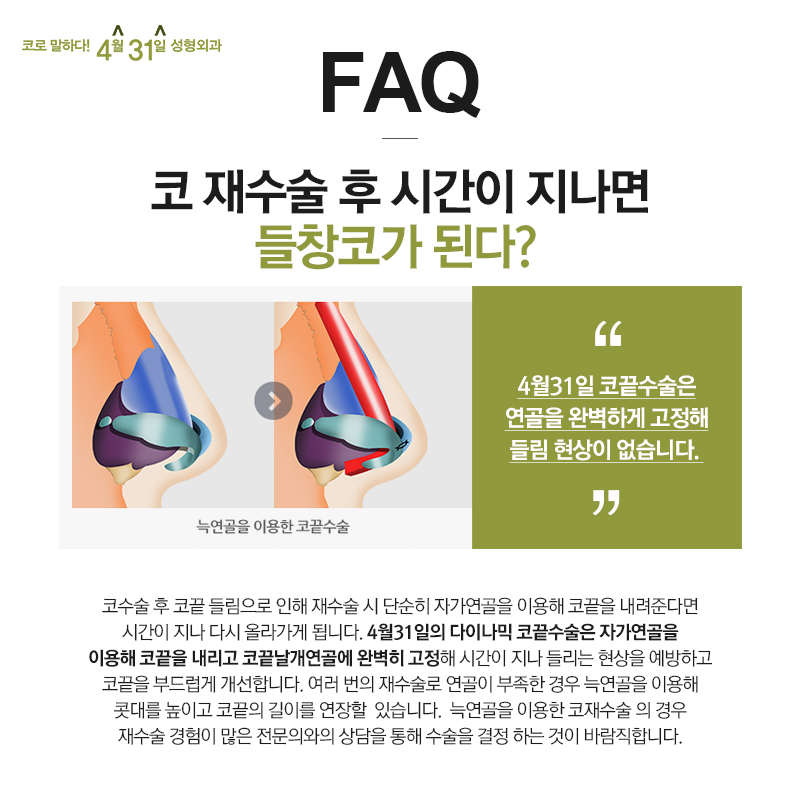
Among the various causes, contracture symptoms such as the nasal tip becoming hard, immobile, and upturned
can come back over time if the tip is simply lowered using autologous cartilage.
At April 31, through dynamic tip surgery, we use autologous cartilage to
lower the nasal tip and securely fix it to the alar cartilage, preventing the tip from rising again over time
and improving the nasal tip more naturally.
If cartilage is insufficient due to multiple revision surgeries,
we can use rib cartilage to raise the bridge and lengthen the nasal tip.

If you wanted to determine the cause of nose revision surgery at this clinic and proceed as your final surgery,
what matters most above all else is identifying the cause through a detailed examination.
At our clinic, we carefully check using 3D-CT and proceed with methods tailored to the cause.
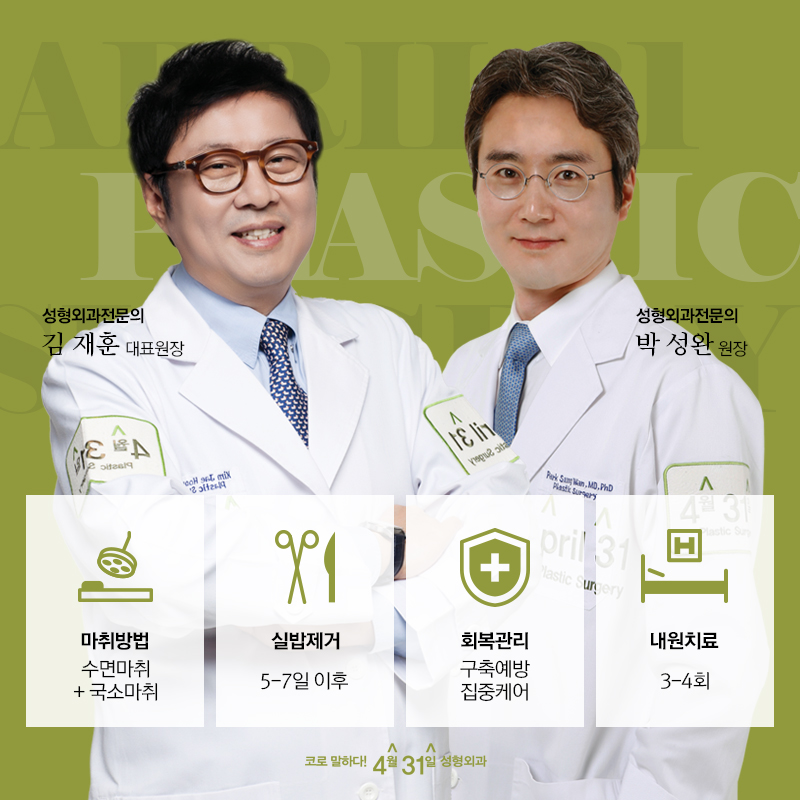
Dedicated nose surgery team at April 31
Together with board-certified plastic surgeons and the lead directors, Kim Jae-hun and Park Seong-wan,
create the nose line you want!
For detailed inquiries and consultation requests, please click the banner below.