
During the winter, when cold and dry weather continues,
more and more people are complaining of discomfort in the eyelids due to dryness.
As aging progresses and the eyelid loses volume,
middle-aged people may also experience dry eye syndrome, making the foreign-body sensation even worse.
If such discomfort continues, it may interfere with daily life,
so it is advisable to improve it through various methods, including fat grafting for sunken eyelids.

In the past, eyelid hollowing was considered a normal sign of aging,
but recently it can occur for various reasons, such as weight changes from excessive dieting,
genetic causes,
and bad habits like rubbing the eyes.
Sunken eyelids can make you look tired and
can also make you look older than you really are,
and functionally, they can make it difficult to open the eyes,
which may lead not only to eye strain and dry eye syndrome but also ptosis,
making correction necessary.

In the past, many people likely planned eyelid fat grafting as a way to address sunken eyelids,
but today we would like to introduce Eyelid Volume Up, a more advanced technique than eyelid fat grafting.
Eyelid Volume Up is also called eyelid orbital fat repositioning surgery.
As the name suggests, it is a method of repositioning orbital fat
to add volume to hollowed eyelids.
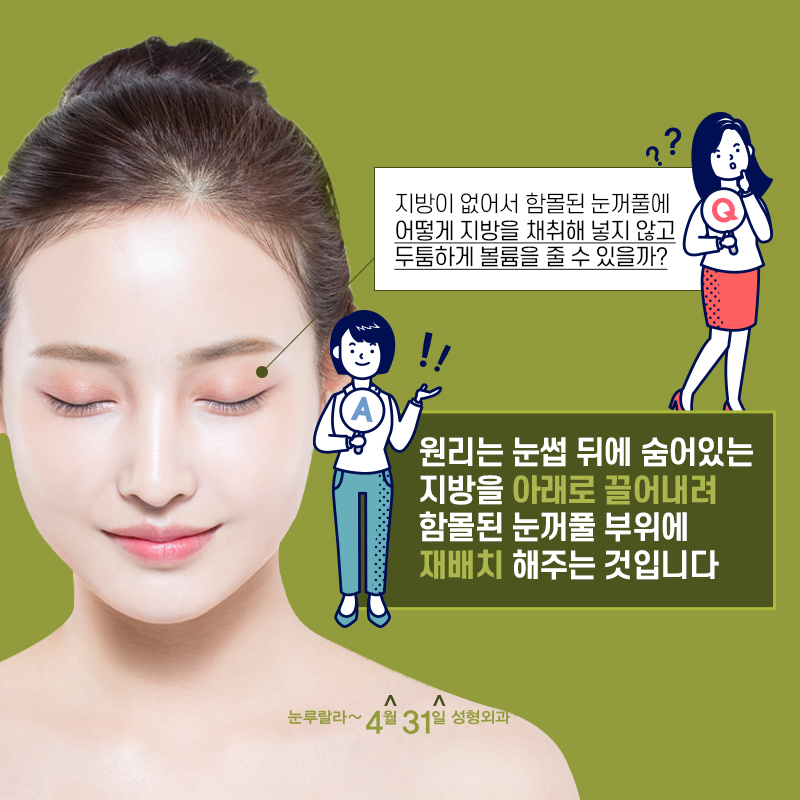
You may be wondering what orbital fat is.
Orbital fat refers to the fat around the eyes,
and Eyelid Volume Up is performed by pulling down the fat hidden behind the brow
and repositioning it to the sunken eyelid area.
You may be wondering why we are introducing Eyelid Volume Up
instead of the eyelid fat grafting method that many people have previously undergone
to improve sunken eyes and create a more lively impression.
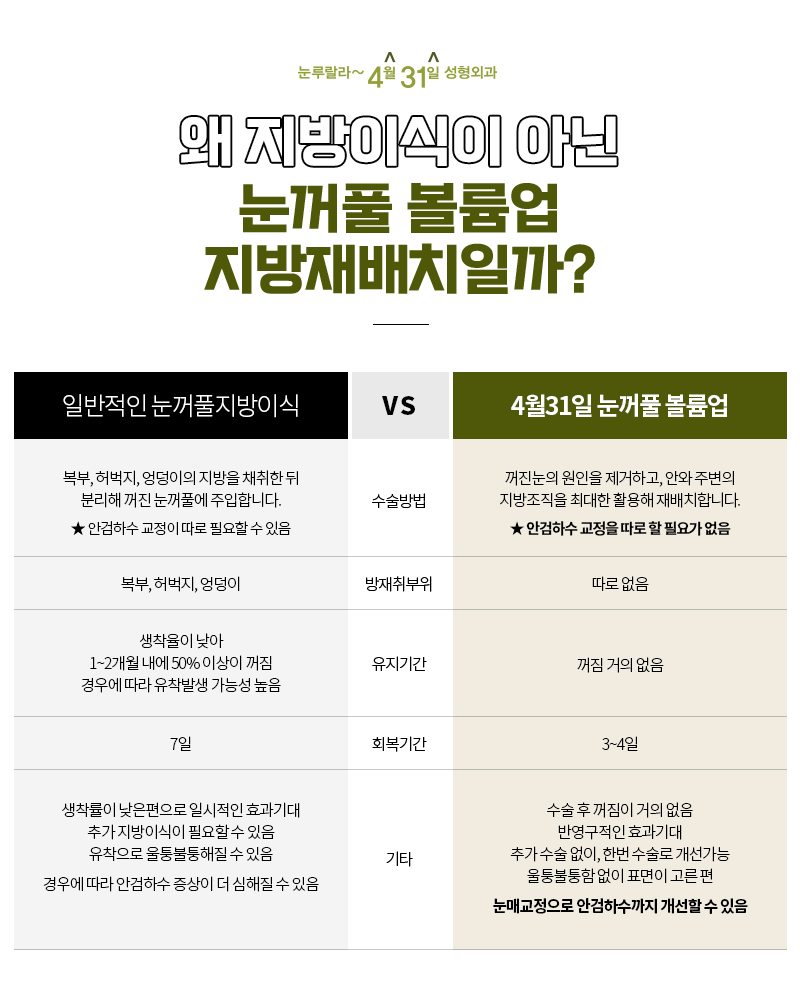
In the case of eyelid fat grafting, fat was harvested from areas other than the eyes,
such as the abdomen, thighs, or buttocks, where there is more fat, and then separated
and injected into the sunken eyelids.
However, because the fat is taken from another area,
the survival rate of the injected fat, known as the graft survival rate, is low,
and more than 50% may subside within 1 to 2 months,
with a high possibility in some cases of adhesions that make the surface uneven.
In addition, additional fat grafting may be necessary,
and in some cases it may worsen ptosis caused by sunken eyelids,
as well as create the burden of having to undergo ptosis correction separately.
In contrast, Eyelid Volume Up
maximally utilizes and repositions the fat tissue around the orbit,
so there is no need to worry about the graft survival rate.
It also tends to leave a smoother surface without bumps,
the recovery period is shorter than with eyelid fat grafting,
and improvement is possible with a single procedure without additional surgery.
In particular, for sunken eyelids, it is important to perform customized surgery for each case.
At our clinic, for a precise and natural eye line,
we apply different methods depending on the degree of hollowness.
To put it simply, it can be divided into two cases.
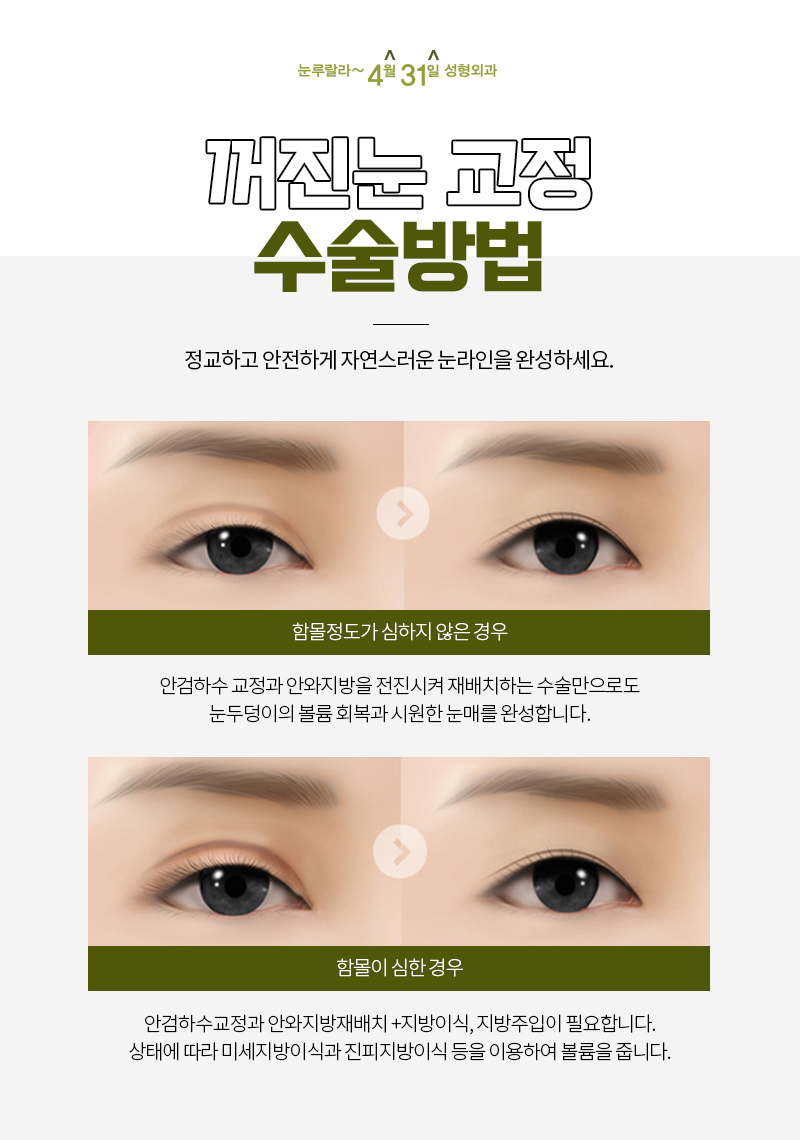
When the degree of hollowing is not severe,
ptosis correction and simply advancing and repositioning the orbital fat
can be enough to restore volume to the eyelid and create a refreshed eye shape.
When the degree of hollowing is severe,
ptosis correction, orbital fat repositioning, fat grafting, and fat injection are needed.
In addition, depending on the condition, it is important to add volume using micro fat grafting and dermal fat grafting.
Although it may sound very simple,
for the process of cleanly separating and repositioning fat to go smoothly,
it is important to receive the procedure from experienced medical staff.
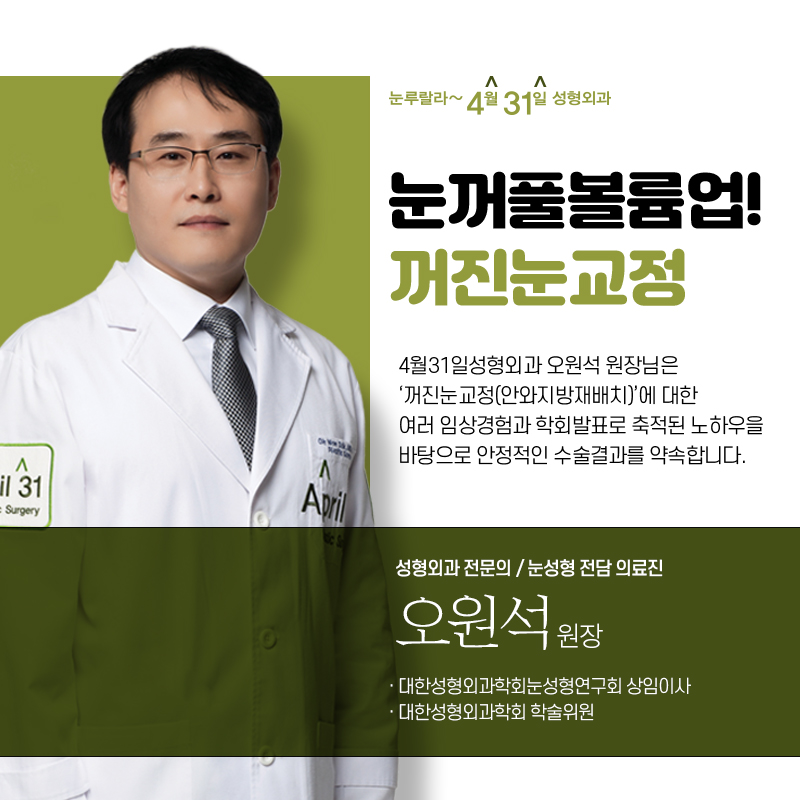
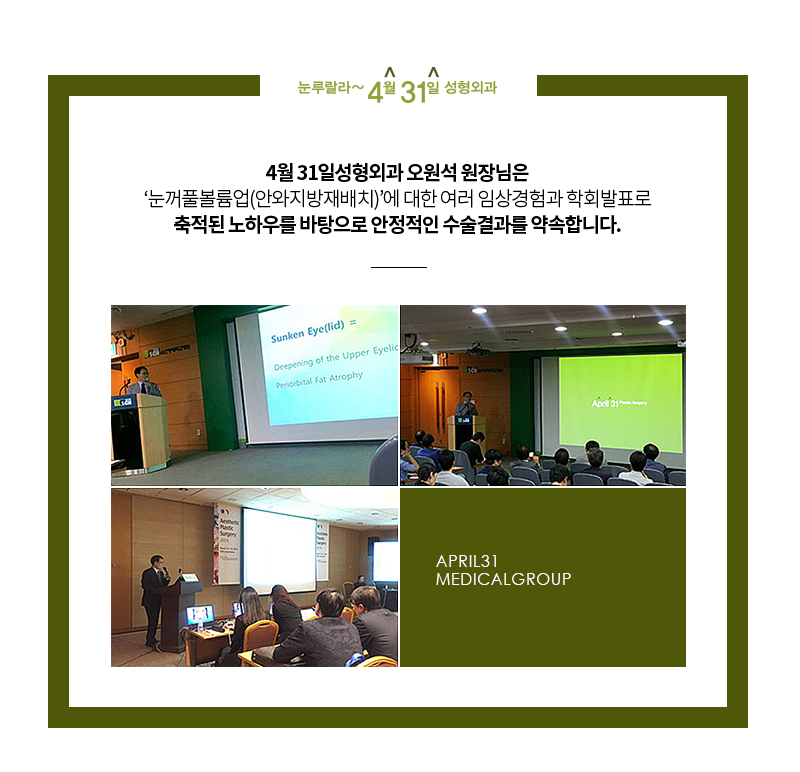
At our clinic, Director Oh Won-seok, a board-certified plastic surgeon specializing in eye surgery,
provides one-on-one consultations, customized surgery, and recovery management,
so you can expect stable surgical results.
For detailed inquiries and consultation requests, please click the link below.