When choosing the best place for revision rhinoplasty, choose a customized approach at April 31!

The nose, located at the center of the face, affects the overall impression of the face
and is one of the features that determines attractiveness.
Recently, the importance of appearance has grown even more,
and people who have insecurities about their appearance try to improve them.
For this reason, among those hoping to improve their appearance, there are many cases in which the nose is corrected.

However, in the case of the nose, procedures are usually performed by inserting an implant, and
because proportions are an important factor,
even if it seems the surgery went well at first, over time
problems such as the implant moving excessively or the bridge of the nose becoming crooked can occur.
In addition, even if patients are satisfied at first, later
a lower level of satisfaction with the surgery or the development of side effects leads
to more people looking for the best place for revision rhinoplasty.
Today, for those who want to finally choose the best place for revision rhinoplasty,
we would like to introduce April 31’s customized approach.
Before choosing the best place for revision rhinoplasty, those who are looking for it
need to think about the cause.
There are many different causes even within the broad category of why the nose needs to be improved again.
And it is important to proceed with a customized approach according to each patient’s cause.
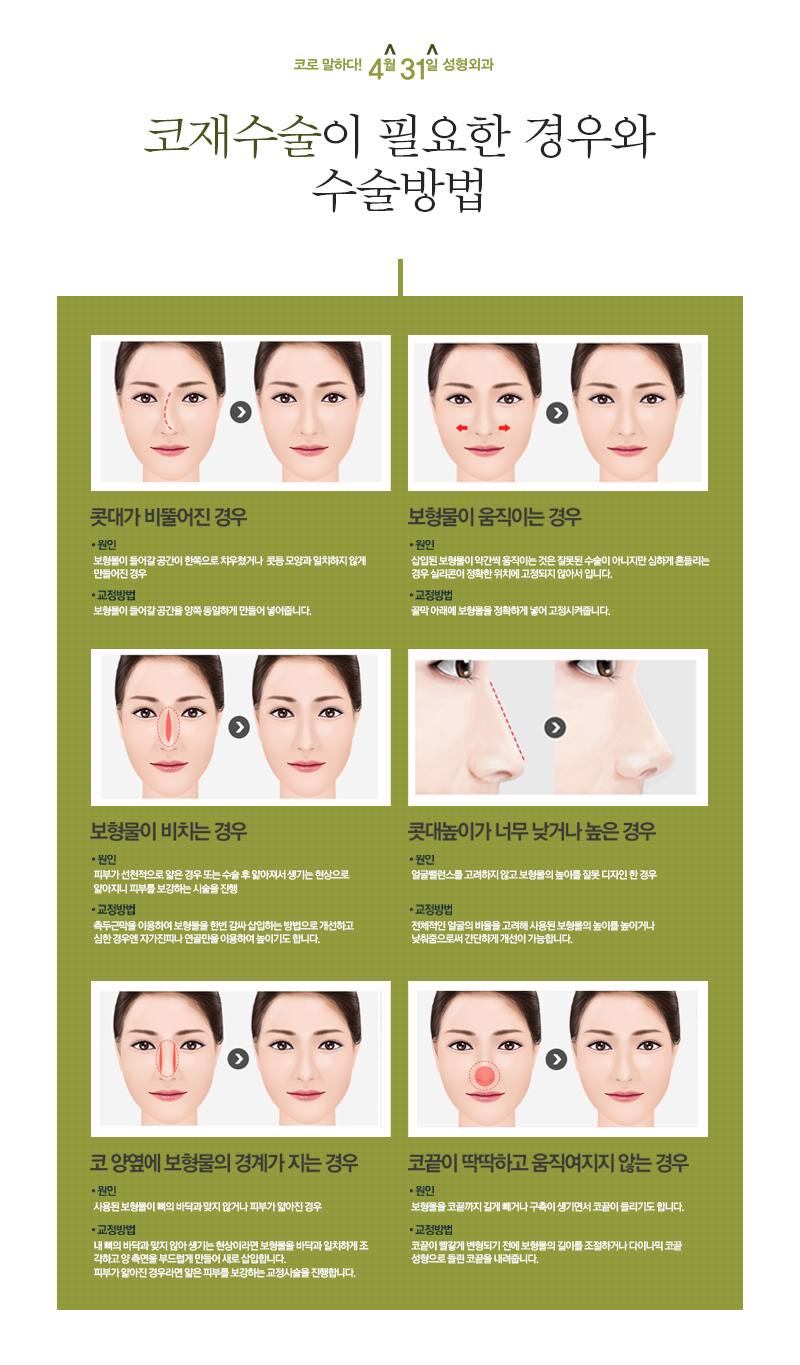
First, in cases where the space for the implant is偏向 one side or the bridge is crooked because it was made not to match the shape of the nasal bridge,
the space for the implant is made evenly on both sides and the implant is inserted.
In cases where the inserted implant is not fixed in the correct position and moves significantly, rather than just slightly,
the implant is placed precisely under the periosteum and fixed there.
In cases where the skin is congenitally thin or has become thin after surgery,
and the implant is visible,
the improvement is made by wrapping the implant once with the temporal fascia and inserting it,
and in severe cases, only autologous dermis or cartilage is used to build it up.
In cases where the implant height was designed incorrectly without considering facial balance,
so the bridge is too low or too high,
the implant height is raised or lowered while considering the overall facial proportions.
There can be two causes when the edges of the implant are visible on both sides of the nose.
First, if this happens because the implant used does not match the base of the bone,
the implant is carved to match the base and both sides are smoothed before being inserted again.
If the boundary appears because the skin has become thin,
we provide correction to reinforce the thin skin.
In cases where the implant is extended far to the tip of the nose or contracture occurs due to inflammation,
if an upturned nose develops,
the length of the implant is adjusted before the tip becomes red and deformed,
or dynamic tip surgery is used to lower the upturned tip.

Among these, when contracture causes an upturned nose,
even if it is improved again, simply lowering the tip with autologous cartilage is a case with a high possibility of recurrence.
April 31’s dynamic tip surgery lowers the tip using autologous cartilage and fixes it firmly to the alar cartilage,
preventing the tip from lifting over time and improving the tip smoothly.
In cases where cartilage is insufficient due to multiple failures,
rib cartilage is used to raise the bridge and extend the length of the tip.
To accurately diagnose the cause of the failure,
of course a thorough examination is necessary, and for patient satisfaction,
it is important to conduct a detailed consultation.
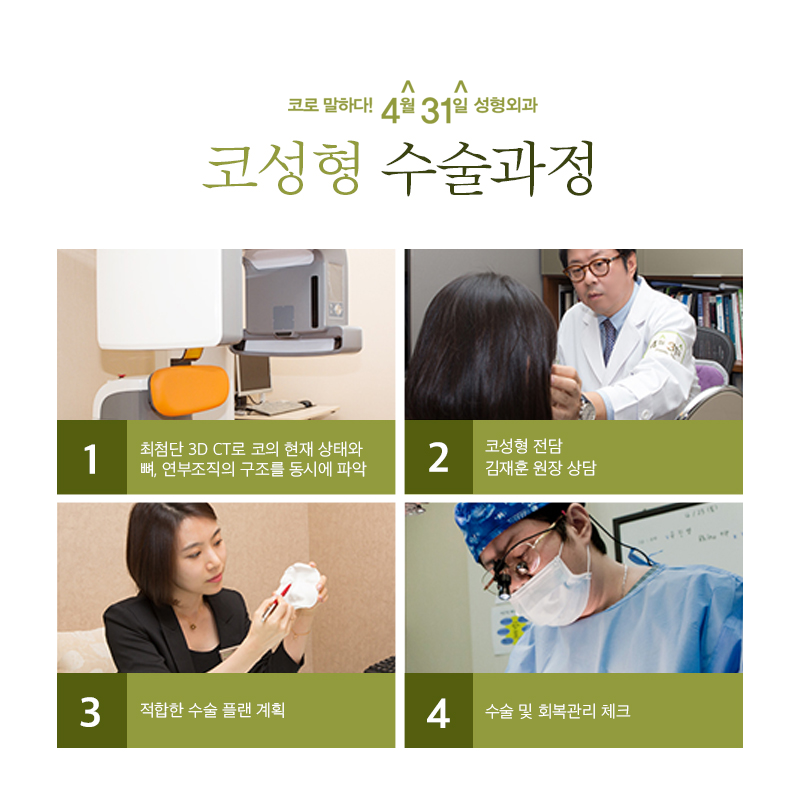
At our clinic, we use 3D-CT to understand the current condition of the nose and the structure of the bone and soft tissue at the same time,
and after a comprehensive examination of the nose, we plan the appropriate plan.
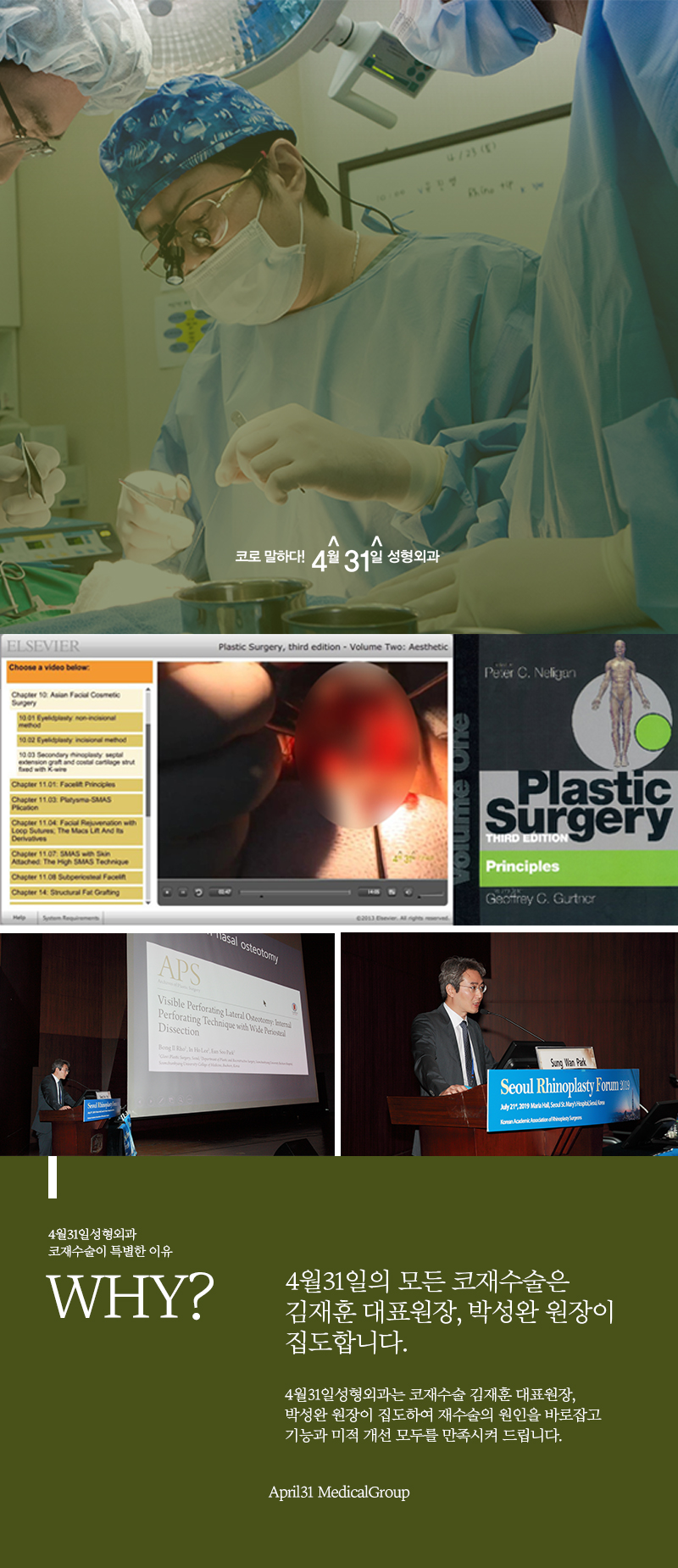
In particular, Dr. Kim Jae-hoon, the chief director and board-certified plastic surgeon,
has expertise in both theoretical aspects and practical surgery.
Not only was a revision rhinoplasty technique video included in Peter Neligan’s Plastic Surgery, the official textbook of plastic surgery used worldwide,
but he also published a paper in a world-class SCI international journal on a new classification and correction method for alar retraction tailored to Asians.
In addition, he published TIP Extension Suture: A New Tool Tailored for Asian Rhinoplasty in PRS, the world’s most authoritative international journal.
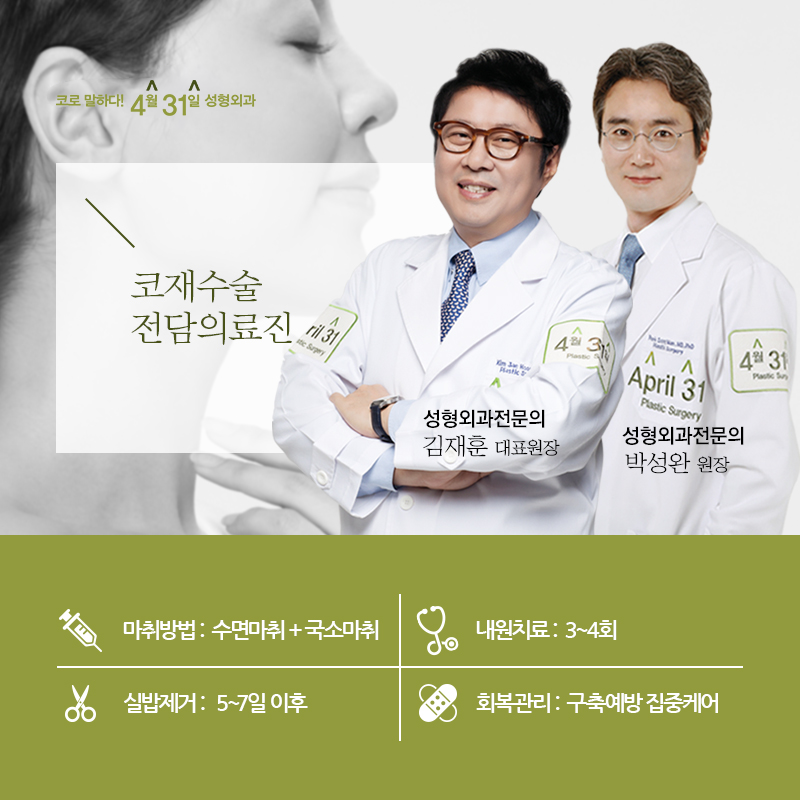
For a highly satisfactory revision surgery, a trustworthy medical team is essential above all.
At our clinic, Dr. Kim Jae-hoon, the chief director and board-certified plastic surgeon in charge of rhinoplasty,
and Dr. Park Seong-wan, a board-certified plastic surgeon,
are in charge of revision rhinoplasty treatment.
Through one-on-one consultations, they present solutions for the patient’s desired points and problems,
and provide the most suitable customized surgery,
while also offering recovery care that focuses on preventing contracture.

The nose plays an important aesthetic role,
but it also plays important functional roles such as smell and breathing,
so it is important to proceed with a method that considers both the aesthetic and functional aspects.
Choose April 31, the best place for revision rhinoplasty, correct the cause of failure,
and finally improve both function and aesthetics with a customized approach.
For detailed inquiries and consultation requests, please click the banner below.