Time passes so quickly that the cold winter is already over and spring is approaching.
Spring is also a season of seasonal transition, which we often hear about.
During seasonal changes, various conditions and causes inside and outside can accelerate skin aging,
leading to wrinkles
and making issues such as reduced skin elasticity stand out more clearly.
Recently, people of various age groups, regardless of gender,
have been investing more in improving skin aging, and various pore lasers have been drawing attention.
Among them, Fraxel has attracted the most interest,
but pain has been a concern.
For those people, today I’d like to introduce Pico Laser.

First, we need to look at why pores become enlarged.
From the teens through the mid-20s, skin metabolism is active, so sebum secretion also increases during this period.
There are sebaceous glands next to the pores that secrete sebum,
so pores become the passage through which sebum is released.
When excessive sebum secretion and fine dust accumulate, pores become blocked,
and skin troubles such as acne can occur.
In such cases, horizontally enlarged pores may develop, appearing round in shape.
After the mid-20s, sebum secretion gradually decreases and aging begins in earnest.
Sebum secretion is often not uniform, and the skin may show a combination-type pattern.
When skin elasticity decreases due to aging,
skin elasticity declines and pore elasticity also decreases.
In such cases, vertically enlarged pores may develop, appearing oval in shape.
So how should pores of various causes and types be managed?
You may be wondering about that.
For people like this, today I’d like to introduce Pico Laser, which has various advantages over Fraxel among pore lasers.

In Pico Laser, a pore laser, “pico” refers to the concept of time.
In other words, it refers to a laser that incorporates technology that achieves PICOSECOND, an ultrashort duration of one trillionth of a second.
Conventional lasers used technology that achieved NANOSECOND,
and Pico Laser applies a time scale that is 100 times faster than that.
Because Pico Laser is 100 times faster than before, it delivers stronger energy.
This is easy to understand if you think of it in relation to a water hose.
Just as water pressure becomes stronger when the outlet for the water is narrowed,
if the irradiation time becomes faster, the principle is that stronger energy is delivered.
You may be wondering why, among the various types of lasers used for pore treatment,
I recommend Pico Laser instead of Fraxel.
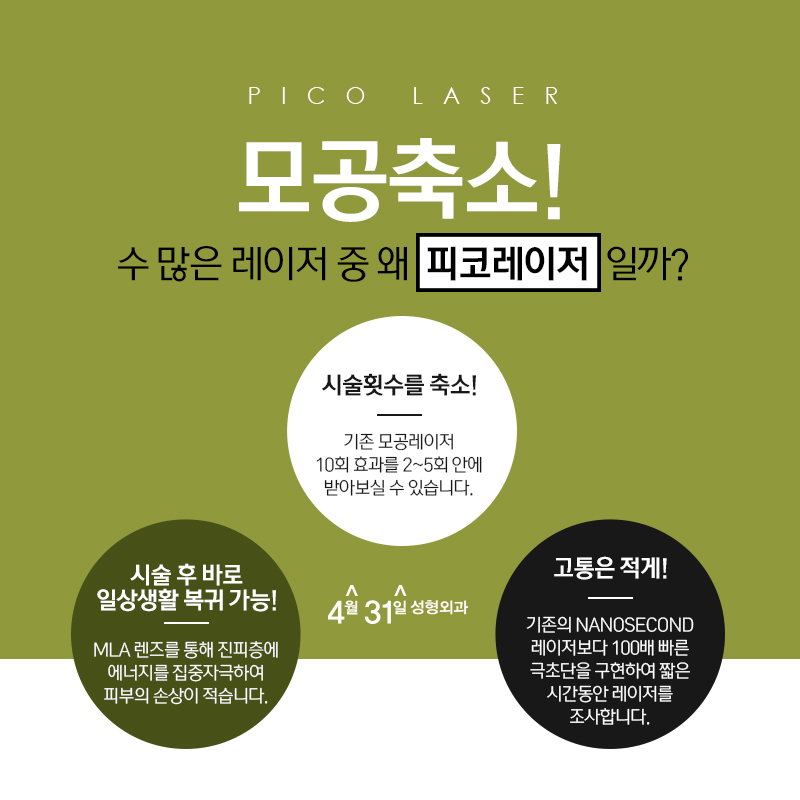
First, Pico Laser concentrates energy deep within the skin through an MLA lens,
so there is less damage to the skin and surrounding tissue, making it possible to return to daily life immediately after the procedure.
And because it delivers strong energy,
there is an effect of reducing the number of treatments, allowing you to achieve what would previously require 10 pore laser sessions in about 2 to 5 sessions.
In addition, because it achieves an ultrashort duration that is faster than conventional lasers,
it is less painful during the procedure.
A pore laser with various advantages over Fraxel,
you may be wondering how Pico Laser works.
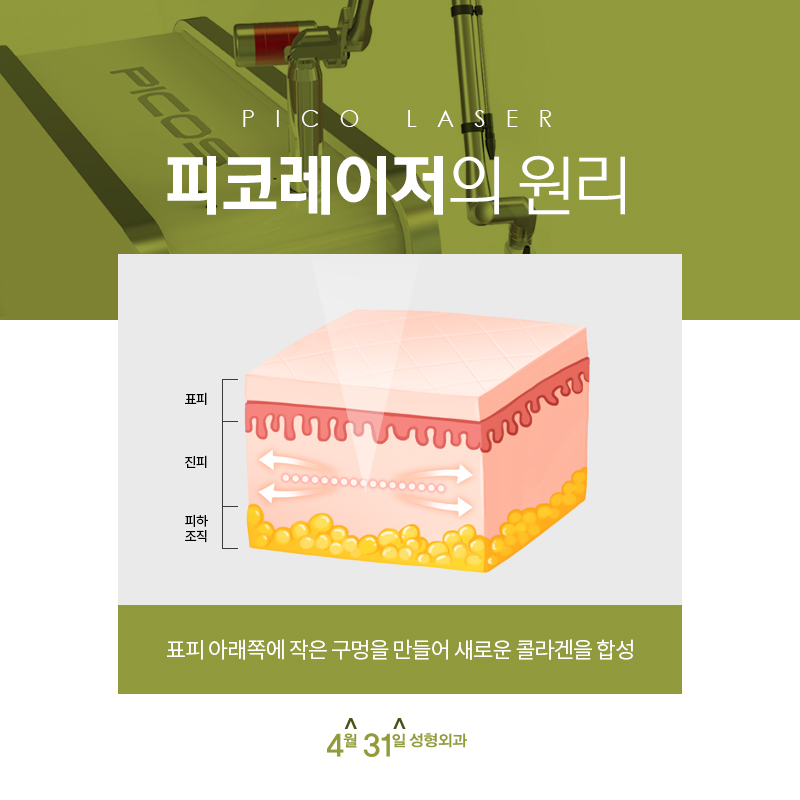
Pico Laser is designed around the principle of creating tiny holes below the epidermis, in the dermis, to synthesize new collagen.
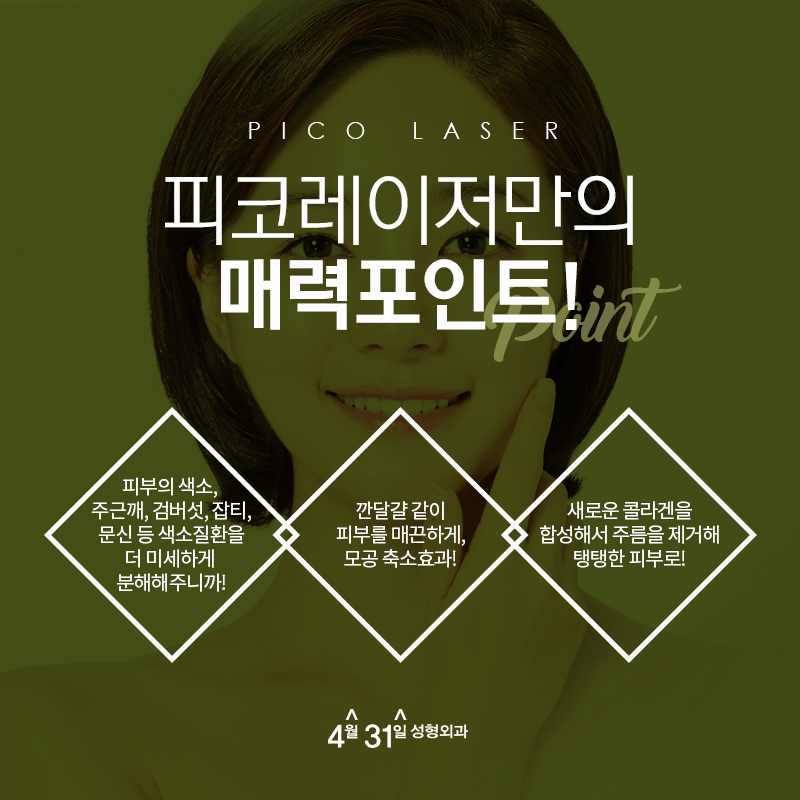
Thanks to this, the skin improves by filling in the pores,
so it has not only a pore-reduction effect but also an effect of improving pigmentation conditions such as melasma and spots,
as well as an effect of increasing skin elasticity and reducing wrinkles.

At our clinic, every Tuesday and Thursday we are holding the Pleasant Tuesday-Thursday Day event,
which offers discounts on all petite procedures, so please keep this in mind when you visit.
For detailed inquiries and consultation requests, please click the link below.