[ April 31 Plastic Surgery - All About Youthful Plastic Surgery ]
Hello, this is April 31 Plastic Surgery.
These days, interest in anti-aging is strong across all age groups, from younger people to older adults.
It would not be an exaggeration to say that the area most easily affected and most closely watched is the eyes.
Among these, we would like to talk about lower eyelid fat repositioning surgery and lower blepharoplasty.
Q. Why does the area under the eyes become bulging and sagging?

Usually,
① when the area under the eyes bulges outward
② when the skin under the eyes sags or wrinkles
③ when the tear trough is pronounced
In these cases,
to improve them, lower eyelid fat repositioning surgery or
lower blepharoplasty is considered.
If you understand why the area under the eyes looks bulging,
you can easily understand these two surgeries.
Why the under-eye area sags
[ April 31 Plastic Surgery - All About Youthful Plastic Surgery ]


First, as aging progresses,
the elasticity of the skin under the eyes decreases,
and at the same time, the septum that surrounds the orbital fat
also becomes loose, causing the internal fat
to be pushed out by pressure.
At the same time, the area bounded from the tear trough
is a region where the periosteum, muscle, and skin are tightly
connected, so this area does not sag,
but instead acts like a hinge and creates a groove.
Because of these two causes, the area under the eyes looks bulging
and appears hollow.

In the end, lower eyelid fat repositioning and lower blepharoplasty
have slight differences in surgical method and scope,
but in common, they are surgeries that correct these two issues
by releasing the area where the periosteum and skin in the tear trough
are tightly attached,
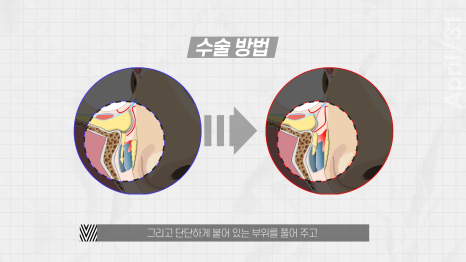
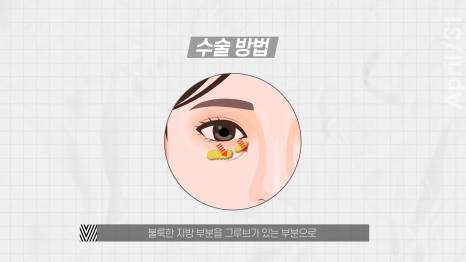
repositioning the bulging fat to the area where the groove was,
thereby solving the bulge and smoothing out the groove area.
Q. Then should I get fat repositioning
or lower blepharoplasty?

Usually, it is commonly thought that older people undergo lower blepharoplasty,
while younger people undergo lower eyelid fat repositioning.
That is half correct and half incorrect.
For example, even two people of the same age may
undergo lower blepharoplasty, while another may
undergo lower eyelid fat repositioning.
In the end, when deciding which of the two surgeries is appropriate,
the important factor is not age,
but the elasticity of the skin and muscles under the eyes.
Both surgeries have the same goal of smoothing out the bulge
and hollow area under the eyes, but whether the muscles or skin
can be maintained in accordance with these changes after surgery
is important in choosing between the two procedures.
If there is no sagging of the skin or muscles,
but the orbital fat under the eyes is relatively protruding,
for example, if it is slightly bulging even when still,
or if it is fine when still but becomes bulging when smiling
or closing the eyes,
then no skin manipulation is needed,
so lower eyelid fat repositioning surgery performed
through an incision in the inner conjunctiva is appropriate.
On the other hand, if the bulging under the eyes is accompanied by
sagging skin and muscles under the eyes,
as well as sagging of the midface,
then lower blepharoplasty, which allows skin manipulation,
is appropriate because the sagging skin and muscles
after fat repositioning need to be lifted.
Q. When can I return to work (daily life)?

Because lower eyelid fat repositioning surgery does not involve
manipulation of the skin or muscles,
it tends to cause less swelling and has a faster recovery period
than lower blepharoplasty.

In general, with lower eyelid fat repositioning surgery,
there is no need to remove stitches from the incision,
and there may be some bruising,
but after about a week, makeup can be applied
and daily life is possible.

On the other hand, with lower blepharoplasty, the stitches
from the incision are removed about 5 days after surgery,
and normal daily life recovery is possible after about 2 to 3 weeks.
To recover normally and quickly like this,
postoperative care is just as important as the surgery itself.
Keeping up cold compresses and under-eye taping properly
is the shortcut to a faster recovery.
Q. Many people worry about side effects of lower blepharoplasty.
What are the typical side effects?

Generally, the side effects of lower blepharoplasty
are often due to the desire to make the result more perfect.
These days, many patients already know this before coming in.
One is ectropion, a symptom in which the eyelid turns outward
after lower blepharoplasty.
It does not always occur,
but in the desire to remove all fine wrinkles under the eyes
and achieve a better result,
if too much skin is cut,
there will be downward tension after suturing,
which can lead to ectropion.
Achieving good results is important, but producing results
without side effects is even more important,
so it is important to perform the surgery to a degree
that maintains a natural look.
Another very important issue is bleeding.
Bleeding can make swelling last longer,
extend the recovery period,
or cause delayed bleeding,
which can lead to more severe scar tissue.
Minimizing bleeding during surgery is very important,
but for about 2 to 3 days after surgery,
it is important to rest and avoid putting pressure around the eyes,
such as by bending the head down too much or bumping into things.
Q. Do you have any tips for choosing a hospital
for under-eye surgery?

Choosing a hospital seems like a question that applies
not only to under-eye surgery,
but also to all plastic surgeries and procedures.

The most important thing is to receive help from a plastic surgeon
who has professional knowledge and experience with the surgery.
And I would also say it is important to choose a hospital
that provides good guidance and response in case of any problems
that may arise after surgery.
I think this kind of answer is actually a standard one,
so today I would like to offer a different tip.
Sometimes, by looking at the patient's condition,
a clear solution can be found,
but at other times, there are ambiguous cases
where it is unclear whether this surgery or another
would be better.
At such times, if you listen to the patient's thoughts
about the direction or values regarding surgery,
some people want to look much younger
through dramatic changes,
while others want to age naturally
even if the result is somewhat less than perfect,
through minimal surgery.

In this way, even when the doctor sees the patient's problem
as clear, the patient's values and direction regarding surgery
can be very diverse.
Personally, I think a good hospital is one that,
during consultation, does not simply present professional knowledge
or surgical methods for the desired area,
but also carefully considers the patient's various needs
and offers multiple options that can satisfy them
within a realistic range.
In the end, the final goal of medicine
is the patient, not the doctor,
and the final goal of plastic surgery is also
to produce results that satisfy the patient.
For that reason, rather than presenting only what I believe
to be the correct answer,
I think a good hospital is one that, in the process of approaching
the answer, also considers the patient's circumstances
and values regarding surgery,
and can provide a variety of realistic and satisfying choices.
If a hospital can do that, I believe the surgical results
will also be satisfying.
Today, we took time to talk about lower eyelid fat repositioning
and lower blepharoplasty, from the principles behind them
to how to choose a hospital.
Please look forward to the next content as well.