Hello.
This is April 31 Plastic Surgery.
If you are concerned about hollow under-eyes or dark circles,
you may be considering lower eyelid fat repositioning
or lower eyelid fat removal.
Today, we’d like to take some time to look at
the differences, pros, and cons of these two surgeries.
What are lower eyelid fat repositioning and lower eyelid fat removal?
What is the difference?
April 31 Plastic Surgery: Lower Eyelid Fat Repositioning vs. Lower Eyelid Fat Removal
As an eye surgery to improve a somewhat tired-looking impression,
the upper eyelid has
an eye-opening correction procedure → eye opening correction surgery
and a procedure that adds volume to hollow eyelids → eyelid volume-up surgery.
For the lower eyelid,
there is lower eyelid fat repositioning
and lower eyelid fat removal.
Lower eyelid fat repositioning
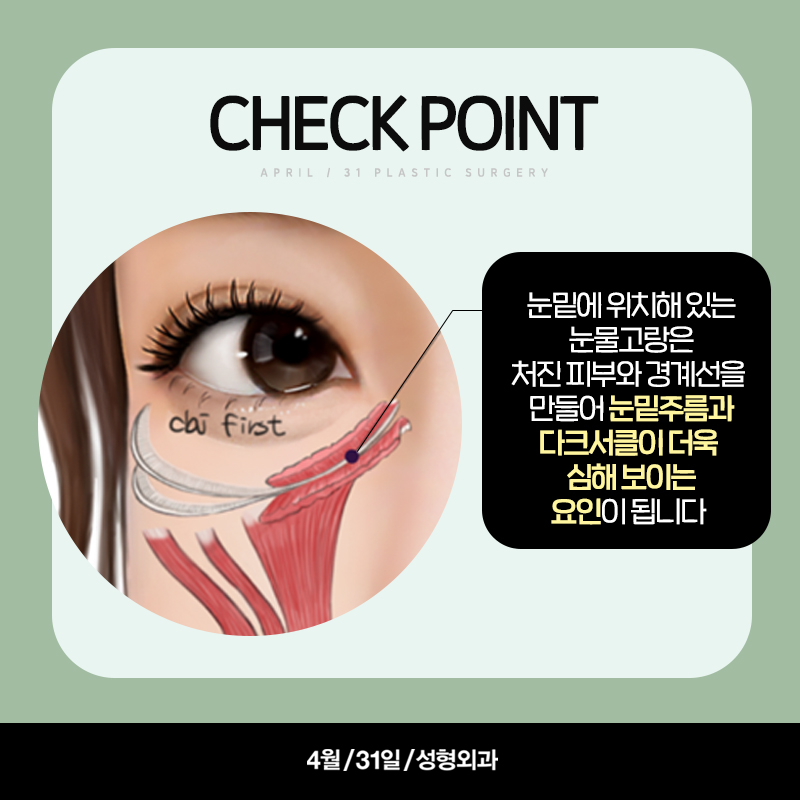
releases the tear trough ligament, which is the hollow area under the eyes,
and pulls the orbital fat downward
to fill in the sunken area,
literally repositioning it to a new location.
Lower eyelid fat removal surgery
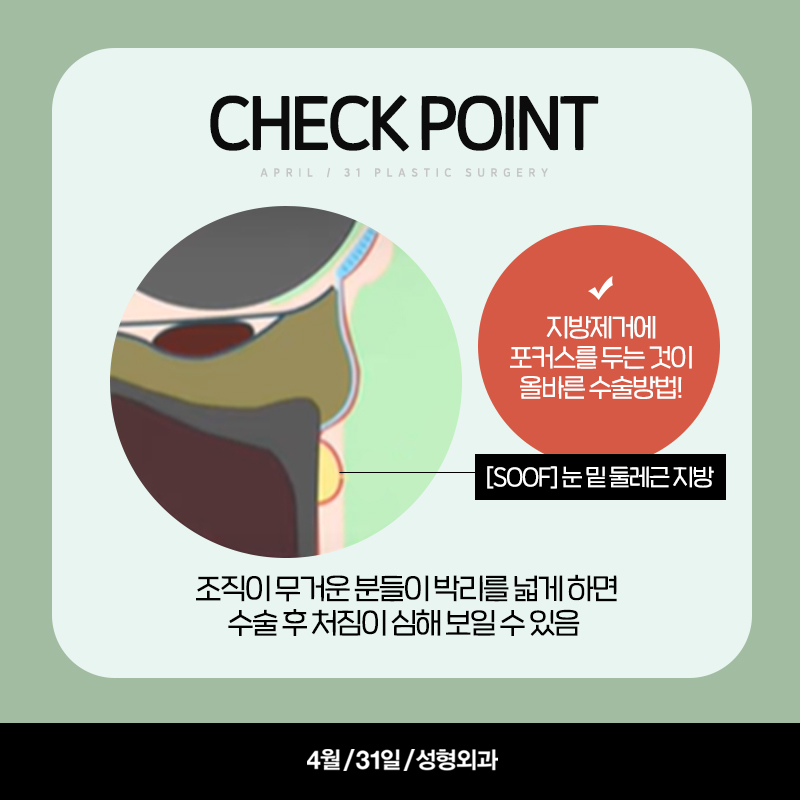
is performed when orbital fat pushes against the septum
and creates a bulging appearance,
by partially removing the protruding excess fat.
In some cases,
the two procedures are combined.
In some cases, repositioning is performed while also removing part of the fat.

Because it cannot be said that one of these surgical methods
is overwhelmingly superior,
it seems best to determine the appropriate surgery based on each patient’s eye condition,
after customized consultation.
These two procedures share the advantage of improving under-eye puffiness and dark circles,
but there are also some differences in their pros and cons.

The ability to fill in the sunken tear trough area
is an advantage of lower eyelid fat repositioning,
while the relatively wide dissection area required
can be a disadvantage.

On the other hand, lower eyelid fat removal
has the advantage of allowing surgery to be performed more minimally,
with relatively less dissection.
However, for people with deep tear troughs,
this area may be difficult to improve,
which can be a disadvantage.
What type of procedure is right for me?
April 31 Plastic Surgery: Lower Eyelid Fat Repositioning vs. Lower Eyelid Fat Removal

For people with a deep tear trough,
even if lower eyelid fat removal is performed,
repositioning is often helpful.

However, for people with a large amount of under-eye fat,
if the dissection area is made too large for repositioning,
the dissected under-eye fat may instead appear to sag.
In that case, if the dissection area can be kept somewhat narrower,
it is worth considering performing surgery with lower eyelid fat removal alone.
Are there cases where hollow under-eyes or dark circles
are not resolved with lower eyelid fat repositioning alone?
April 31 Plastic Surgery: Lower Eyelid Fat Repositioning vs. Lower Eyelid Fat Removal
There are many different reasons for dark circles.
For people whose dark circles were severe due to the shadow created by
the height difference between under-eye puffiness and the hollow tear trough,
we think they may experience a dramatic change after surgery.
However, if dark circles are present because the skin is thin and the red color of the orbicularis oculi muscle just beneath the skin shows through,
or if there is pigmentation in the skin itself,
dark circles may not be resolved with lower eyelid fat repositioning.
In such cases, it is better to combine surgery
with procedures that strengthen the skin layer
or laser treatment for pigmentation.
The most reliable way to find out
what kind of eye condition you have
and what surgery or procedure may be needed
is to meet with a board-certified plastic surgeon
and receive a diagnosis.
After lower eyelid fat surgery,
is there a chance of recurrence?
April 31 Plastic Surgery: Lower Eyelid Fat Repositioning vs. Lower Eyelid Fat Removal
It would be nice if we could live our entire lives looking young and beautiful,
but realistically, that is difficult.
As we age, due to changes in orbital volume,
changes in the shape of the orbital bone,
reduced elasticity of the septum and skin,
and sagging of facial tissue,
even after orbital fat has been removed or repositioned,
the under-eye bulging may reappear,
or the boundary of the tear trough may look sunken again.
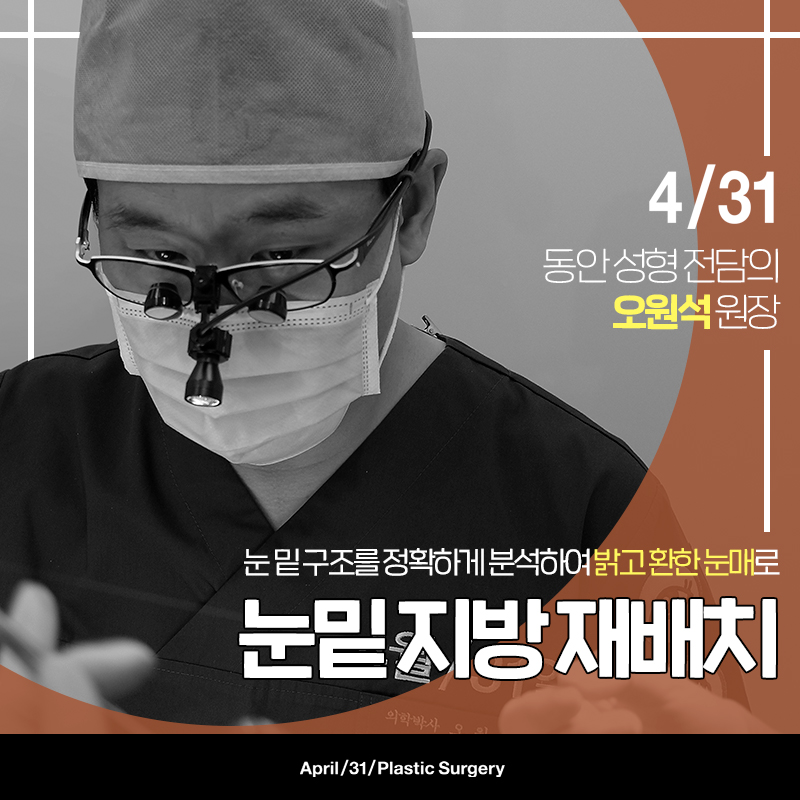
Minor issues that appear after the first surgery,
when the correction has otherwise been done well,
can usually be corrected with a simple method such as fat grafting.
However, if the cause is the relative hollowness caused by sagging tissue in the under-eye area or midface,
lifting surgery such as a midface lift should also be considered.
In particular, during surgery, after opening the septum to remove the fat,
taking care to properly manage the septal area
can help prevent recurrence.
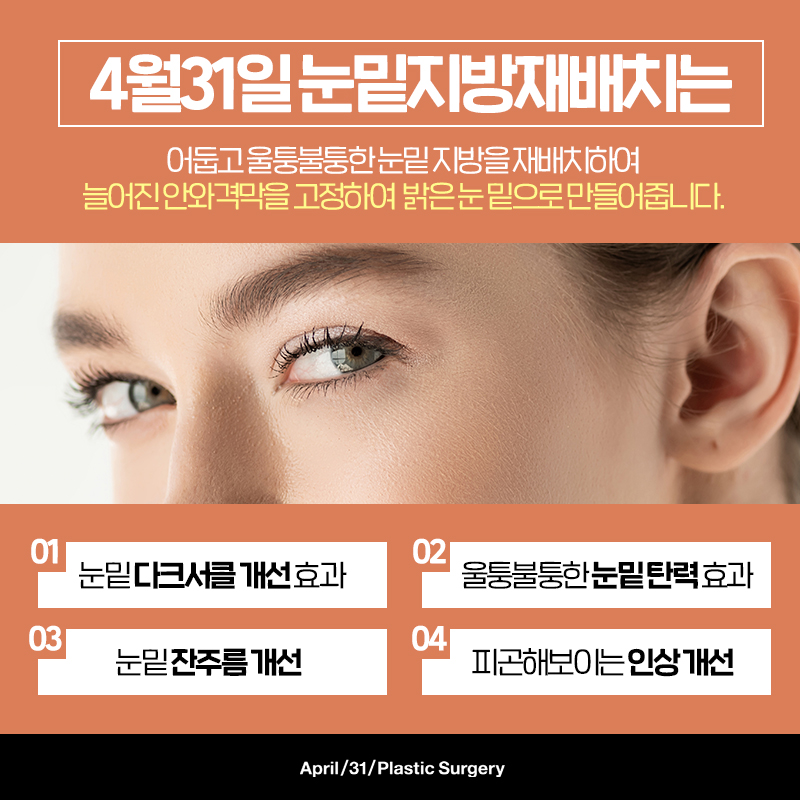
At April 31 Plastic Surgery,
when necessary, we remove fat through an incision as small as possible
and also perform high-frequency stimulation during surgery
to tighten the septum.