
Hello, this is AINIK Plastic Surgery.
The eyes can be said to play the most important role when speaking with someone or conveying your opinion.
Recently, as mask-wearing has continued due to COVID-19, only the eyes are visible among the facial features, so it is even harder not to pay attention to the eyes.
That is why more and more people have recently become interested in eye surgery. However, surgery on the eyes, which determines your image, should never be taken lightly.
Through an accurate examination, you must choose the surgical method that is right for you.
Today, let’s look at ptosis correction surgery, which can very naturally transform sleepy-looking or loose-looking eyes with AINIK’s own know-how.
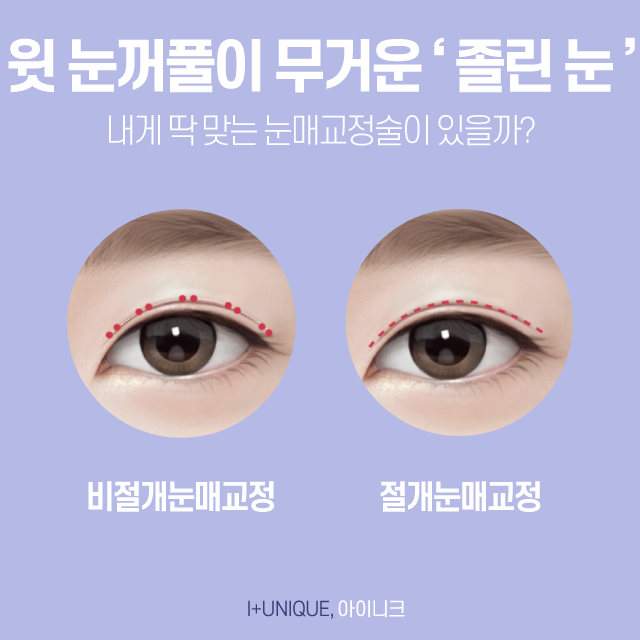
When the eyes are open, an ideal eye is one in which only 1–2 mm of the iris is covered and the rest is visible.
If more than that is covered,
it is commonly called sleepy-looking eyes,
that is, weak eye-opening strength.
The procedure that reinforces eye-opening strength
and helps the eyes open better
is called ptosis correction surgery.
Ptosis correction surgery is broadly divided into non-incision and incision methods. From here, let’s take a closer look at non-incision ptosis correction surgery.
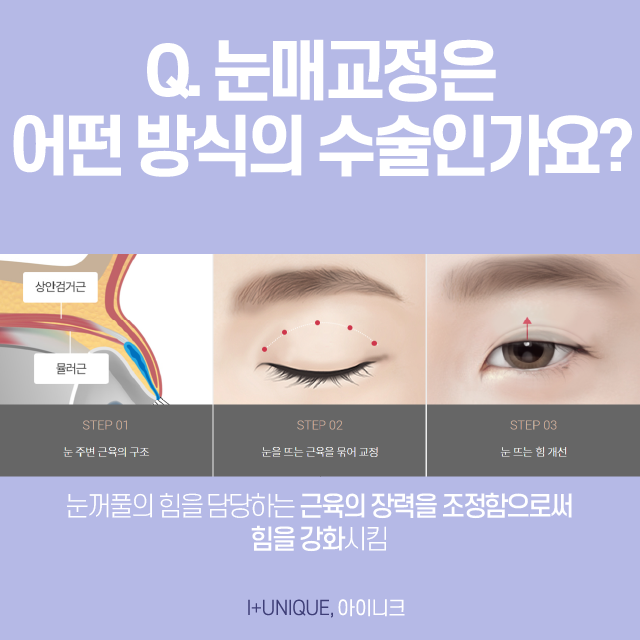
Before discussing non-incision ptosis correction surgery,
you first need to understand the structure involved in opening the eyes.
The levator palpebrae superioris muscle plays the most important role in opening the eyes.
This muscle is connected by a tendon to the eyelid.
Because a very thin muscle called the Müller muscle also works together beneath the tendon, the tendon fascia and Müller muscle are tied together and shortened to help the eyes open better.
As for the shortening length, for example, if you shorten it by about 8 mm, you can think of the eye opening by about 1 mm.
If 10 mm is shortened, it can be thought of as rising by 2 mm, and if 12 mm is shortened, by about 2.5 mm.
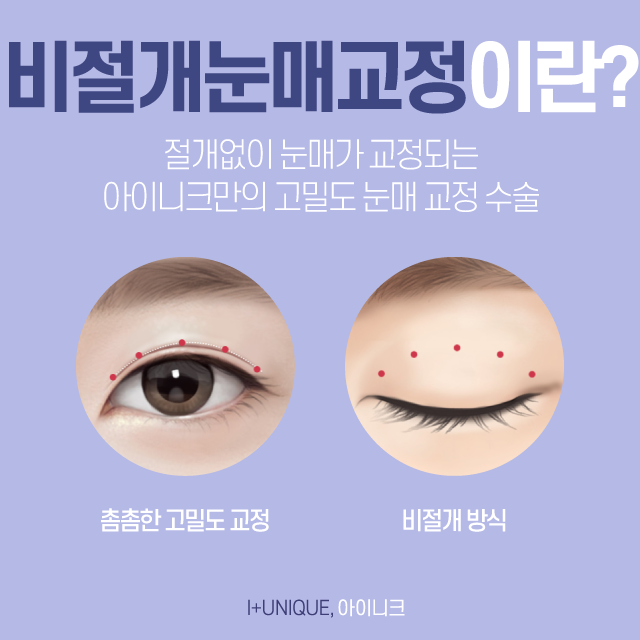
As the name suggests, this surgery corrects the eye shape without making an incision.
If the thread does not simply go in and come out, but instead hooks the tendon once and then exits so that a knot can be tied, the area where the tendon was hooked becomes shortened,
allowing the eyes to open better.
In particular, at AINIK Plastic Surgery,
we perform AINIK’s high-density ptosis correction surgery,
creating dense fixation points so they do not loosen and form a smooth line.
We place fixation points in appropriate positions for each area of the eye to help prevent overcorrection.
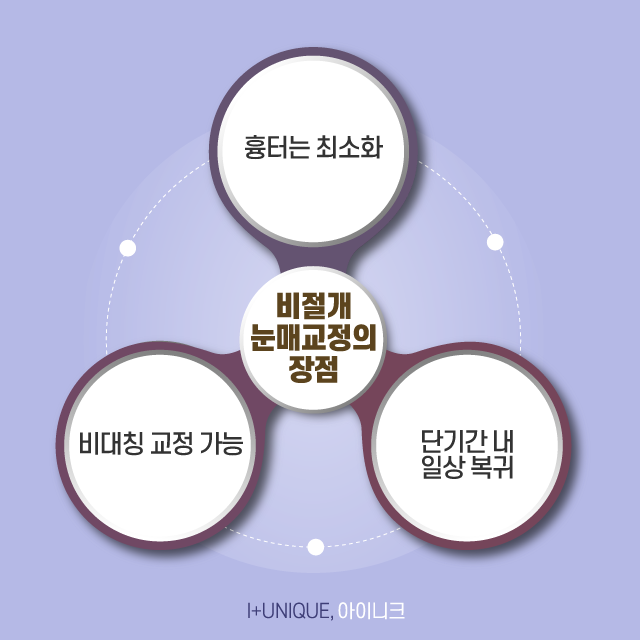
Now, let’s continue by looking at the advantages of non-incision ptosis correction surgery. First, because no incision is made,
there is almost no scar, and the recovery period is very fast.
Swelling is also minimal, though there may be differences depending on the person.
However, since it returns to its original state within a week,
there is no need to worry too much.
Lastly, another major advantage is that asymmetry can be corrected.
In addition, Director Yang Hae-won’s non-incision ptosis correction surgery at AINIK was notable enough to be featured in the U.S. text Aesthetic Plastic Surgery of the East Asian Face, making it a well-known and remarkable technique.
Therefore, if you are currently considering ptosis correction surgery, please consult to see whether AINIK’s surgical method, which strengthens eye-opening power through a delicate and meticulous high-density technique so the results last without loosening, can be applied to you.

AINIK Plastic Surgery has extensive experience and know-how, having performed more than 5,000 eye surgeries and revision eye surgeries to date.
As a result, it has received a commendation from the Minister of Health and Welfare,
and many famous celebrities and influencers also visit.
For eye surgery, please come to AINIK Plastic Surgery, which can confidently stand alongside any other hospital in terms of skill, and achieve satisfying results.
This has been AINIK, making it look like you were beautiful from the very beginning. Thank you.