
Hello, this is Inique Plastic Surgery.
Today, we’d like to talk about people who do not have double eyelids
but experience enough discomfort in daily life
that it affects their routines, along with the solution for it.
Specifically, this is about people with ptosis and no double eyelids.
These days, we live in an era where even eyes without double eyelids
are considered a major charm,
but people who do not have double eyelids and also have ptosis
likely still have some concerns, as mentioned above.
So, some of you may be looking for a place that can safely
correct ptosis without double eyelids,
and today, together with Inique Plastic Surgery,
we will once again review what kinds of difficulties people with both
a monolid and ptosis may face in daily life,
and also look into what the safest and most effective
corrective procedure might be.
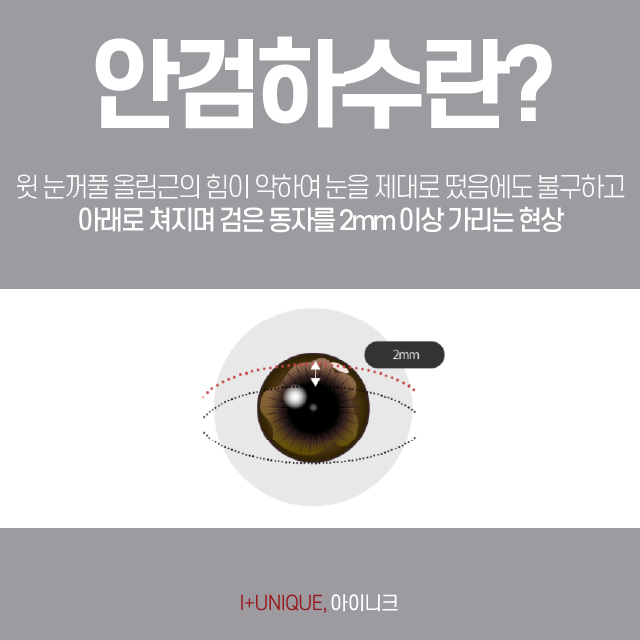
First, what is ptosis?
The eyes we consider ideal are those in which
the upper eyelid covers about 1 mm of the iris.
On the other hand, some people have the iris covered by the eyelid
by more than 2 mm compared to others.
This symptom of drooping eyelids is what we call ptosis.
In other words, it is a problem related to how much of the black pupil is exposed,
and it can be seen as a symptom that occurs when the strength of the levator palpebrae superioris,
which plays the most important role in opening the eyes,
is weakened.

Among people with ptosis,
there are many who find it difficult to keep their eyes comfortably open,
or who feel their confidence decline because of their drooping eyes
as seen in mirrors or photos,
and who feel they lack the strength to open their eyes wide when they want to.
For those who no longer want to live with this kind of discomfort in daily life,
they naturally begin looking into eye correction procedures that can improve ptosis.
So from here on, shall we look at what kinds of eye correction procedures
are available for people with ptosis and no double eyelids?
There are currently two major medical procedures for correcting ptosis.
They are incision eye correction and non-incision eye correction.
Let’s look at each one.
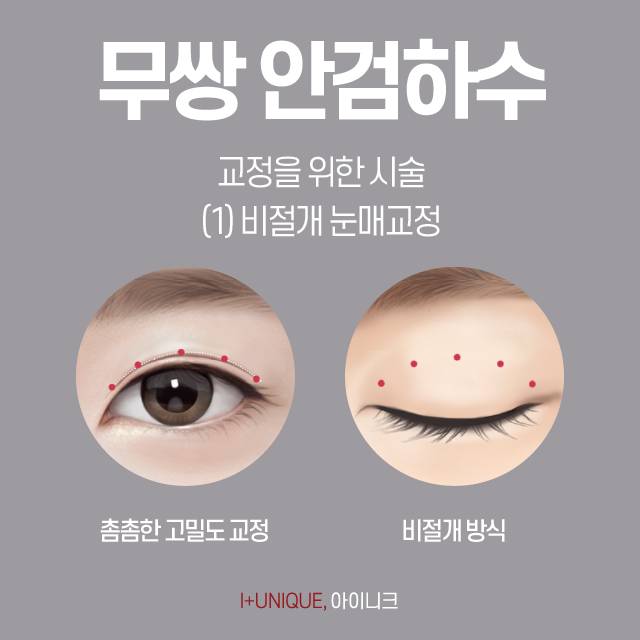
First is non-incision eye correction.
Non-incision eye correction, as the name suggests,
is a corrective procedure performed without an incision.
Ptosis occurs when the pulling force of the muscle called the levator palpebrae superioris,
which is located inside the eye socket and above the eyeball,
is weak.
Therefore, when performing non-incision eye correction,
the tendon extending from the levator palpebrae superioris toward the black pupil,
along with the thin membrane called the Müller muscle,
is shortened by tying it with sutures without making an incision.
That allows the thin membrane called the Müller muscle
to be shortened by tying it with sutures without an incision.
In this way, the thin membrane called the Müller muscle is shortened
with sutures without incision,
and as a result, even when opening the eyes with the same force,
it becomes much easier to open the eyes by the length of the knot,
and more of the black pupil becomes visible.
In theory, every 8 mm of shortening is said to raise the eyelid by 1 mm.
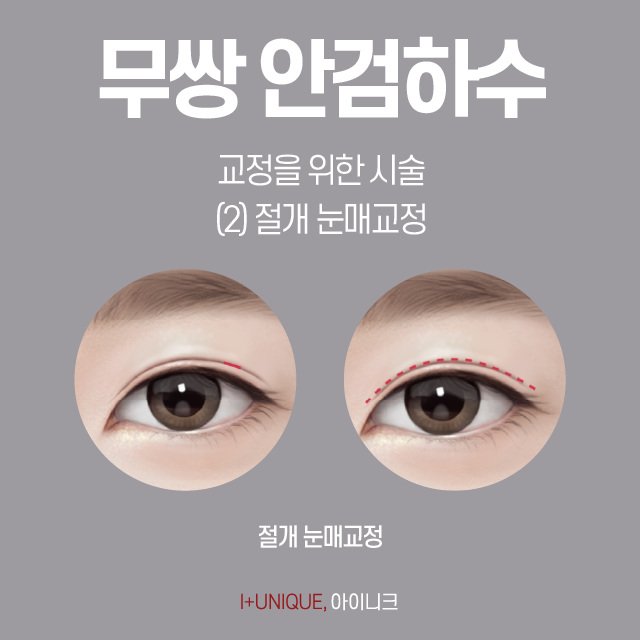
Next is incision eye correction.
Unlike non-incision correction,
incision eye correction is a procedure that opens the eye area with a scalpel to correct the eyelids.
The concept of shortening the tendon and Müller muscle is the same.
However, because it is opened with a scalpel and shortened while being directly viewed,
the accuracy can be somewhat better.
Both non-incision eye correction and incision eye correction have advantages and disadvantages.
First, non-incision eye correction has the advantage of faster recovery time
because there is no incision, so there is less swelling,
but its accuracy is relatively lower than incision methods.
However, compared to incision methods, the accuracy is relatively lower. On the other hand, incision eye correction includes an incision in the process, so recovery may take some time,
but it has the advantage of better accuracy and stronger adhesion,
which also reduces the possibility of the result loosening later.
Therefore, which type of eye correction procedure is more suitable
depends on the individual, so for this procedure,
it is best to consult with a specialist who has the best know-how
and create an appropriate plan.
Improving ptosis without double eyelids!
For those who want natural beauty,
the part that must be examined more carefully and cautiously in eye correction
is whether the medical team has the necessary experience and know-how.
At Inique Plastic Surgery, we are a specialized clinic for eye surgery
with extensive experience and know-how in eye procedures.
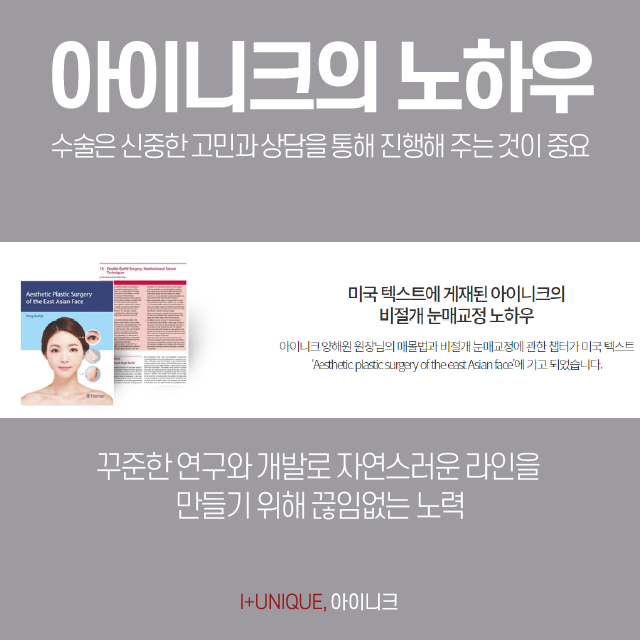
In particular, through Inique’s unique high-density correction technique,
we create dense fixation points so that the line does not loosen
and is formed smoothly.
This kind of know-how unique to Inique
even came to be published in a U.S. text.
Inique’s eye surgery know-how,
recognized overseas as well!
If you want natural-looking results,
come to Inique Plastic Surgery, where you can trust us with confidence.
Until now, it has been Inique,
as if you were beautiful from the very beginning.
Thank you.