
Hello, this is Inek Plastic Surgery.
Along with double eyelid surgery, inner and outer canthoplasty has become a basic eye surgery,
and because even small differences can have a major impact on the impression,
it is a part that must be decided carefully. It is very important to determine
how the surgery is performed and what kind of design is used, according to the proportions of your entire face.
So today, we will introduce Inek’s special
canthoplasty types and methods.
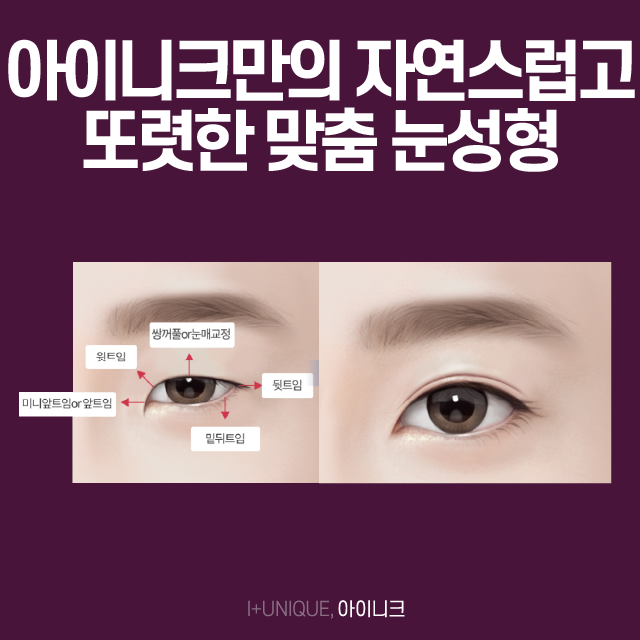
At Inek, as with other eye surgeries,
canthoplasty is especially customized to consider each patient’s condition.
The basic procedures include inner canthoplasty and outer canthoplasty,
as well as mini inner canthoplasty, upper canthoplasty, safe outer canthoplasty, and a procedure called dual canthoplasty, also known as lower outer canthoplasty.
These procedures are decided and performed after in-depth consultation with each patient,
so you can visit us with peace of mind!!
Now, let’s take a closer look at the methods
for each type of canthoplasty.
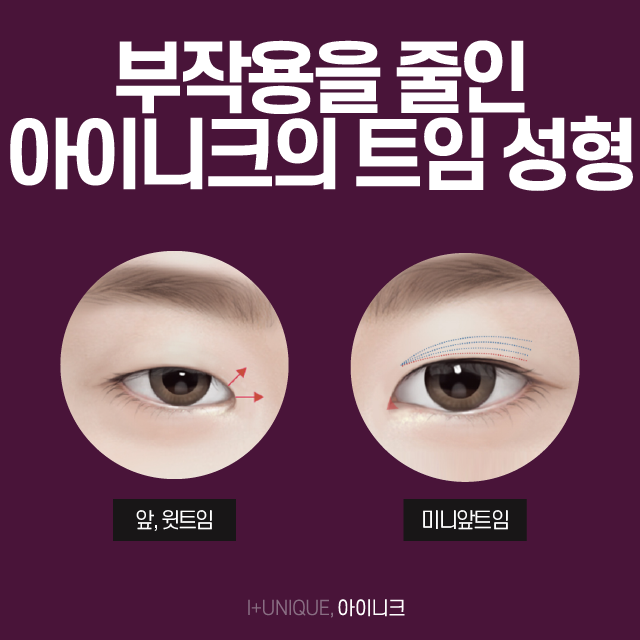
First, in the case of general inner canthoplasty and upper canthoplasty,
the Mongolian fold at the inner corner of the eye is refined to make the eyes appear clearer
and more defined.
If the direction of the Mongolian fold points upward at 45 degrees,
it is called upper canthoplasty. This procedure is preferred by people whose brow area appears somewhat wide,
or whose eyes appear small because of the shape of the inner corner of the eye.
Mini inner canthoplasty is a surgical method that reduces the risk of side effects,
using Inek’s proprietary technology, available only at Inek.
It was developed to supplement the shortcomings of general inner canthoplasty,
and refines the inner corner of the eye so that the lacrimal caruncle is not overly exposed,
the eyes do not look too close together, and scars are minimized.
Because the amount of opening is small, it is a procedure applied when only the angle needs to be adjusted by opening the front part,
and its advantage is that scarring is nearly nonexistent.
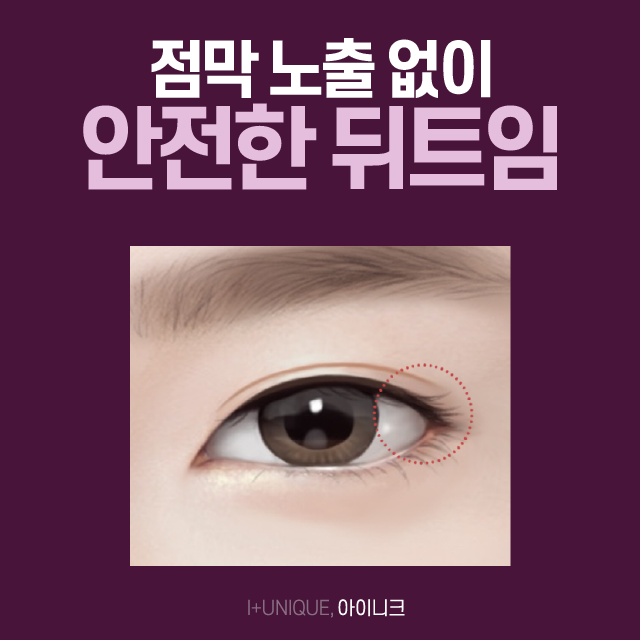
Next, safe outer canthoplasty is a procedure that helps prevent the exposure of red inner tissue and ectropion,
which can occur as side effects of general outer canthoplasty.
If too much red inner tissue is exposed, it can lead to bloodshot eyes, eye irritation,
frequent conjunctivitis, and discomfort in daily life.
That is why, at Inek, the skin and mucous membrane are separated,
the mucous membrane is excised only as much as needed to open the eyes more clearly,
and at the same time the skin is excised less than the mucous membrane,
a fundamentally safe outer canthoplasty method is used to block external exposure of the mucous membrane.
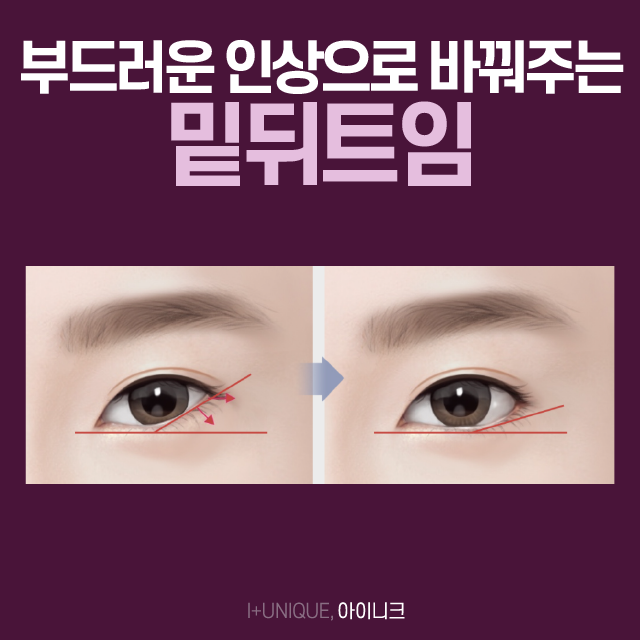
Lastly, let me tell you about lower outer canthoplasty,
also called dual canthoplasty.
Lower outer canthoplasty, also known as lateral canthal fixation or eye-corner lowering surgery,
is a procedure recommended for people whose eye corners are significantly upturned.
By opening the outer corner through outer canthoplasty and fixing it to the outer bone,
the eyes can be adjusted to the ideal angle of 5 to 10 degrees,
creating a softer impression and a clearer eye shape.

So far, we have looked at various types of canthoplasty,
including inner and outer canthoplasty, as well as their surgical methods
and side effects.
At Inek, which pursues natural beauty,
we carry out customized procedures based on our proprietary technology filed as a trademark with the Korean Intellectual Property Office,
taking into account the eye shape and conditions each patient wants,
so that they can achieve a clearer eye appearance. If you are currently considering surgery,
we recommend visiting us comfortably for a consultation.
Then, as if you had always been beautiful,
this was Inek.
Thank you.