
Hello, this is iNique.
Plastic surgery is a choice many people make.
But among so many options, choosing the right procedure for yourself
is often very difficult.
After a long period of 고민 and decision-making,
there are many people who choose to have surgery,
but due to problems that arise during the process,
there are times when the results are not satisfying.
For those who are considering revision surgery in such cases,
let’s take a look at the types of epicanthoplasty revision you need to know.

Epicanthoplasty is an eye plastic surgery procedure
performed to refine the epicanthal fold at the inner corner of the eye.
If epicanthoplasty was performed with overcorrection or insufficient correction,
you may end up with unsatisfactory results.
Therefore, through revision surgery,
you need to restore it to the ideal shape you want.
There are many different methods for epicanthoplasty revision,
and among them, iNique’s epicanthoplasty reconstruction
and the mini epicanthoplasty revision method
are commonly chosen.
Epicanthoplasty reconstruction is a method that restores the area where the lacrimal caruncle is excessively exposed
to create a natural inner eye corner.
The mini epicanthoplasty revision is a method that, after epicanthoplasty,
carefully refines the inner corner of the eye with a minor incision
when the shape looks rounded and cramped.

Before looking at the surgical methods for each type of epicanthoplasty revision,
shall we find out when the right time for surgery is?
Revision eye surgery is usually performed about 6 months after the initial surgery.
At that point, the scar tissue has softened, making it a suitable time for surgery.
However, if the symptoms are severe and cause inconvenience in daily life,
it is better to proceed with revision surgery through consultation with the medical team,
regardless of timing.

The first type of epicanthoplasty revision,
epicanthoplasty restoration, is a method that reconstructs lacrimal caruncle exposure.
The red area at the inner corner of the eye is the lacrimal caruncle,
and if its exposure exceeds the ideal amount,
it can create an unnatural and harsh impression.
Therefore, it is better to perform epicanthoplasty restoration
to cover the excessively exposed lacrimal caruncle.
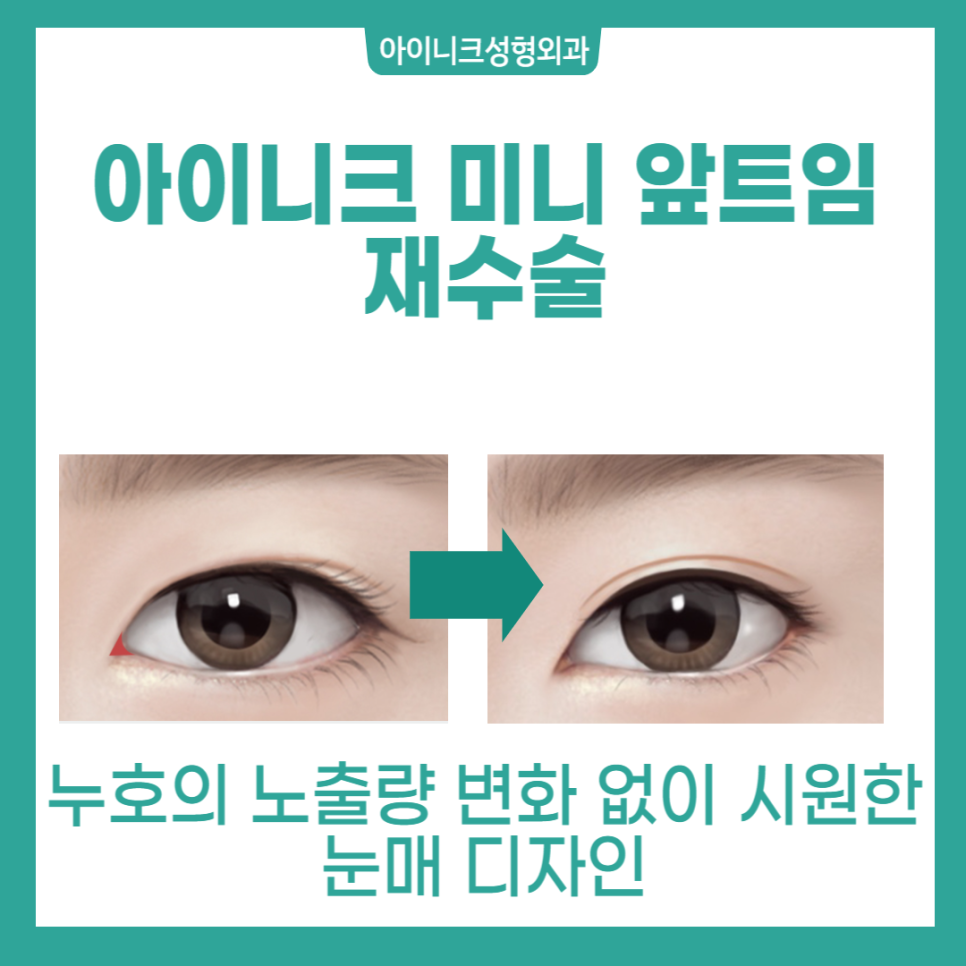
If you are worried that your eyes still look cramped even after epicanthoplasty,
improvement is possible through mini epicanthoplasty revision,
which can make the eye look brighter and more open.
Mini epicanthoplasty is a revision method that refines the shape of the inner corner of the eye
to create a refreshed-looking eye shape.
Because the degree of lacrimal caruncle exposure does not change,
it can create eyes that look even more natural and smooth.

Today, we looked at the types of epicanthoplasty revision
and the surgical methods for each.
If you are not satisfied because of your first surgery
and are considering ways to improve it,
now try it together with iNique, a specialist in eye plastic surgery.
Then, this has been iNique,
as if you had been beautiful from the very beginning.
Thank you.