
Hello, this is Inique.
Do you know about “ptosis,” a condition also called “sleepy eyes” or “drooping eyes,” in which the eyelid partially covers the pupil?
If you have ever taken a photo with your eyes wide open but later found that you looked half-closed, or if people around you often tell you that you look sleepy, you may have ptosis.
If you are concerned about these symptoms, you may have heard of ptosis and the correction procedure used to address it, known as eye opening correction.
Ptosis correction is broadly divided into two types: non-incisional eye opening correction and incisional eye opening correction. Today, we will look at the differences between these two methods, along with their pros and cons, and discuss who each one is recommended for.
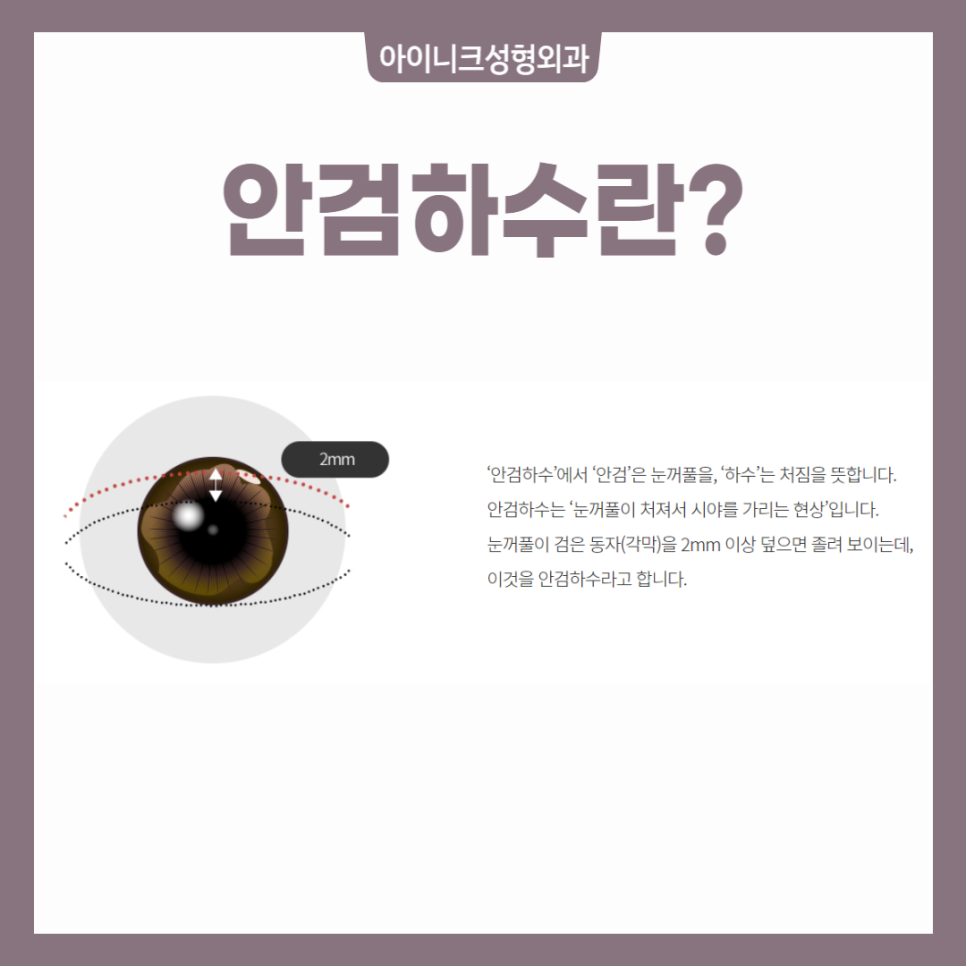
Ptosis is a term that refers to how much of the black pupil in the center of the eye is exposed.
In general, when you open your eyes normally, the eyelid covers about 1 to 2 mm of the pupil.
If more than 2 mm is covered, the eyes can look sleepy.

This is called ptosis, and when ptosis is present, the following symptoms may appear:
- People around you often tell you that you look sleepy or blank.
- When looking straight ahead, your field of vision does not feel clear and feels constricted.
- You use your forehead muscles when opening your eyes.
- Your eyelashes keep poking your eyes.
If the above symptoms appear, it may be ptosis, and it can be improved through eye opening correction.
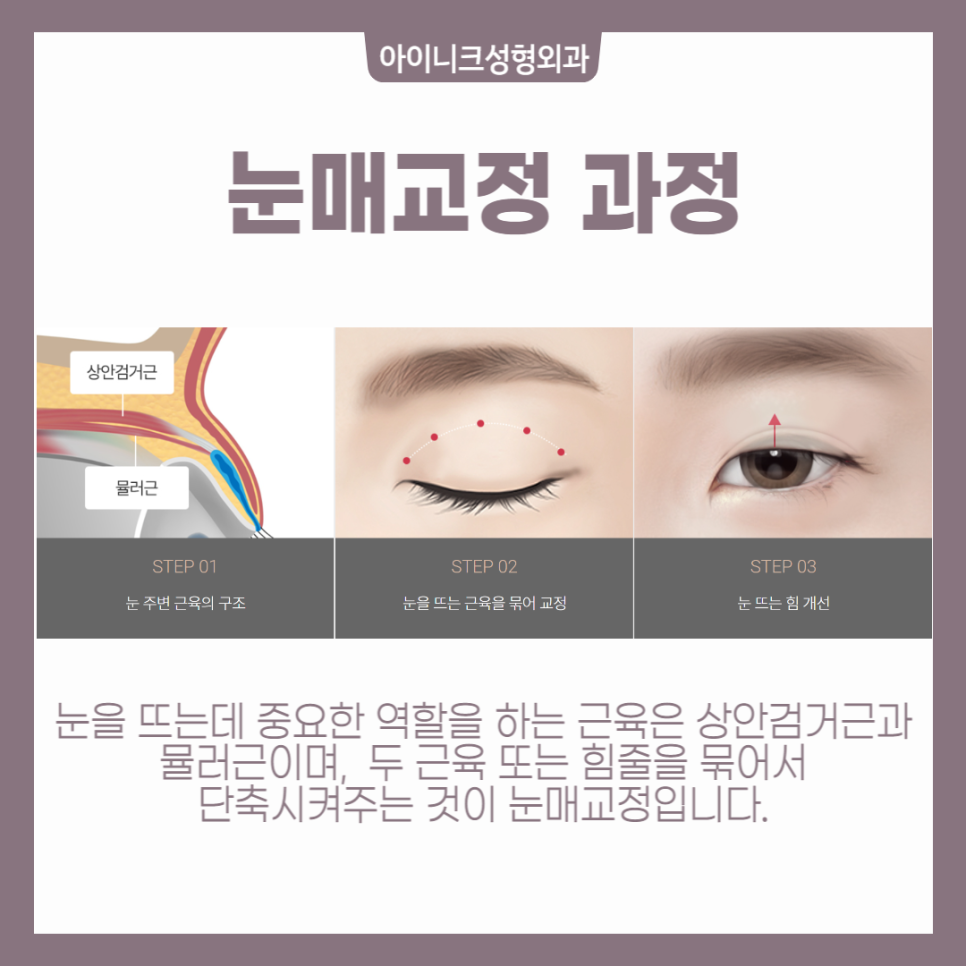
Correcting ptosis through surgery is performed by strengthening the force used to open the eyes.
The precise term for ptosis correction is ptosis correction (blepharoptosis correction), a procedure that shortens the levator aponeurosis, which connects the muscle that opens the eyes, and the Müller muscle.
The levator palpebrae superioris is the most important muscle for opening the eyes. By tying together and shortening the two muscles or tendons connected to it, the force used to open the eyes can be improved and ptosis can be corrected.
Eye opening correction is divided into non-incisional eye opening correction and incisional eye opening correction depending on whether an incision is made during the procedure.
From here on, let’s take a closer look at the principles of these two ptosis correction methods and compare their pros and cons.
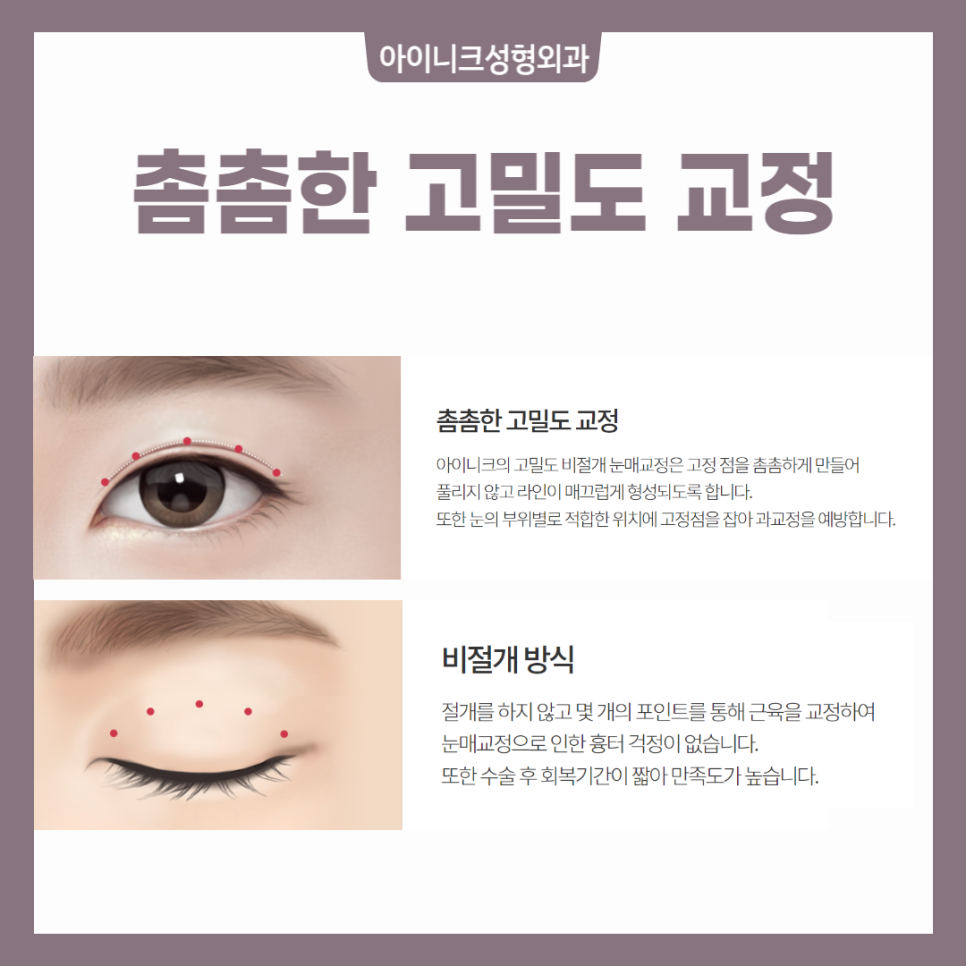
As the name suggests, non-incisional eye opening correction is a method of correcting the eye opening without making an incision, similar to suture-based double eyelid surgery.
If non-incisional suture-based double eyelid surgery creates a double eyelid by fixing thread at the center of the eyelid,
non-incisional eye opening correction passes thread through the inside of the eyelid and fixes the tendon and Müller muscle area to shorten it.
Inique Plastic Surgery enhances the durability of non-incisional eye opening correction by increasing the number of fixation points during the procedure so it is less likely to come loose.
It also creates fixation points with a dense, high-density method and adjusts the fixation positions by area to match the shape of the eye, helping the line form smoothly and preventing overcorrection.
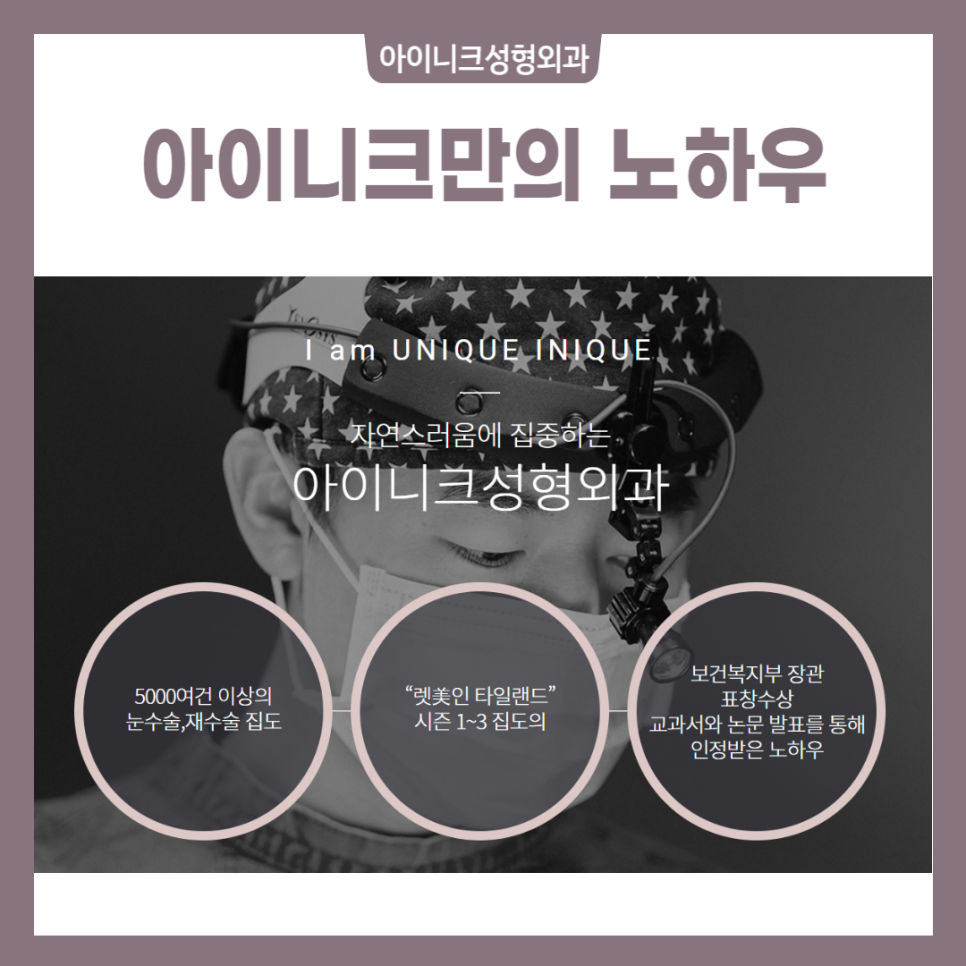
 Dr. Yang Hae-won of Inique Plastic Surgery has contributed a related chapter to the U.S. textbook Aesthetic Plastic Surgery of the East Asian Face based on expertise in suture-based methods and non-incisional eye opening correction surgery.
In this way, Inique Plastic Surgery is conducting research and developing its own techniques based on thousands of eye surgeries and revision surgeries, and as a clinic specializing in eye plastic surgery, it has also filed multiple trademark applications with the Korean Intellectual Property Office to establish its distinctiveness.
At Inique, ptosis correction is performed using differentiated surgical methods such as “high-density non-incisional eye opening correction,” which are possible only with specialized expertise and know-how accumulated over a long period of surgery.
Incisional eye opening correction is a procedure in which the skin covering the area is incised so that the tendon and Müller muscle can be tied and shortened while being directly visible.
There are also various methods within incisional eye opening correction, such as pulling and fixing the tendon, tying it to create a crease and shorten it, or excising the remaining portion by cutting it out. However, if revision is needed after surgery, excision makes it more difficult, so for safety, Inique Plastic Surgery mainly uses the tying method.
Incisional eye opening correction has the advantage that the correction is less likely to come undone after surgery, making it less likely for ptosis symptoms to recur.
So, when comparing non-incisional and incisional methods in ptosis correction, let’s look at the pros and cons of each, as well as who they are recommended for.
In the case of non-incisional eye opening correction, the muscles are corrected through only a few points above the eyelid without cutting the skin, so it has the advantages of minimal scarring and a faster recovery.
However, because it is a thread-based correction method, there is a possibility that the fixed area may come loose.
That is why Inique Plastic Surgery reinforces fixation by increasing the number of points to compensate for this drawback.
In the case of incisional eye opening correction, scarring may occur during the incision process, or the recovery period may be longer.
However, compared with the non-incisional method, it tends to last longer, and if there is a large difference in the eye-opening strength between the two eyes, it can be adjusted during surgery, so it is recommended when there is asymmetry in the eyes.
 Ptosis correction should be performed by considering each person’s unique eye shape and eye-opening strength at the same time.
To match the ideal eyelid shape, the eyelid should cover the pupil by 1 to 2 mm, but this is only a theoretical guideline. In practice, correction must be performed differently depending on each person’s eye shape and facial features.
If this is ignored, side effects such as overcorrection, where the eyes do not fully close, or a raised appearance between the eyes and eyebrows may occur.
At Inique Plastic Surgery, we provide careful consultation and precise surgery to deliver the most natural and satisfying results tailored to each individual.
If there is a possibility that you may not be satisfied with the result after eye opening correction, even if you have ptosis, we may advise against surgery or recommend doing only the minimum necessary.
The reason we are able to provide more personalized consultation and surgery to achieve the most satisfying results is the know-how accumulated through thousands of eye surgeries and revision surgeries over the years.
If you are considering ptosis correction, please visit Inique, a clinic specializing in eye plastic surgery with expertise and distinctiveness.
So far,
As if you were born beautiful from the beginning,
this has been Inique.
Thank you.